

It's late at night, a customer's phone lights up with a fraud alert, and a card that worked an hour earlier now declines. There's no branch to visit in the morning and no paper statement to point to. There's only an app, a chat window, and a growing worry that someone else might be spending the money needed for rent, payroll, or groceries.
That moment explains why fintech customer service can't copy a generic support playbook. A fast reply matters, but a fast wrong reply can open the wrong account, promise money that can't be returned yet, or miss a regulatory deadline. The support desk has to work inside the security system, not beside it, and every design choice that follows flows from that single constraint.
Table of Contents
- Why Fintech Customer Service Is Different
- The Trust and Security Connection
- Digital-First Complaints and Regulatory Deadlines
- Fraud Resolution as a Loyalty Differentiator
- Finding the Right Balance of AI and Human Support
- Applying These Principles in Real Scenarios
- Building a Support Strategy That Earns Trust
Why Fintech Customer Service Is Different
A customer contacts support after a suspicious transaction freezes an account. The chatbot asks for an account number, offers a password reset link, and can't explain whether the money left the account. The customer doesn't need a quicker greeting. The customer needs proof of identity, a clear statement of what happens next, and a human who can act without exposing the account to the person who may have caused the freeze.
Retail support usually protects convenience. A delayed shoe delivery frustrates a buyer, but it rarely blocks tonight's payment for essentials. Financial support protects access to money itself, so a frozen card, a missing payout, or a disputed charge carries immediate consequences for the customer's day, not just the customer's mood.
Three Pressures Arrive in Every Conversation
- Money is stuck or moving: A balance looks wrong, a transfer hasn't landed, or a charge the customer doesn't recognize has already posted.
- Identity is uncertain: The agent must confirm the person asking for help owns the account before sharing details or changing anything.
- Words create obligations: An agent who promises a refund or a date when access is restored may commit the company before an investigation supports that promise.
Those pressures explain a common point of confusion. Customers often read verification questions as stalling, while agents read them as protection. Good support closes that gap by explaining, in plain language, why a check is happening and what it enables, instead of running through a script.
There's also no physical fallback. A bank customer who fails online can walk into a branch with identification. A digital-only customer who fails in chat sits alone with a phone, refreshing a balance, with nowhere else to take the problem. Silence therefore feels heavier, and vague updates sound like indifference.
A slow answer annoys a customer. An unverified answer can hand an account to the wrong person.
The Trust and Security Connection
Customers judge financial support by a question that rarely appears on a satisfaction survey form. Did the interaction make the account feel safer? A polite agent who closes a ticket quickly but leaves a customer unsure about a suspicious charge hasn't finished the job, even if response time looks excellent.
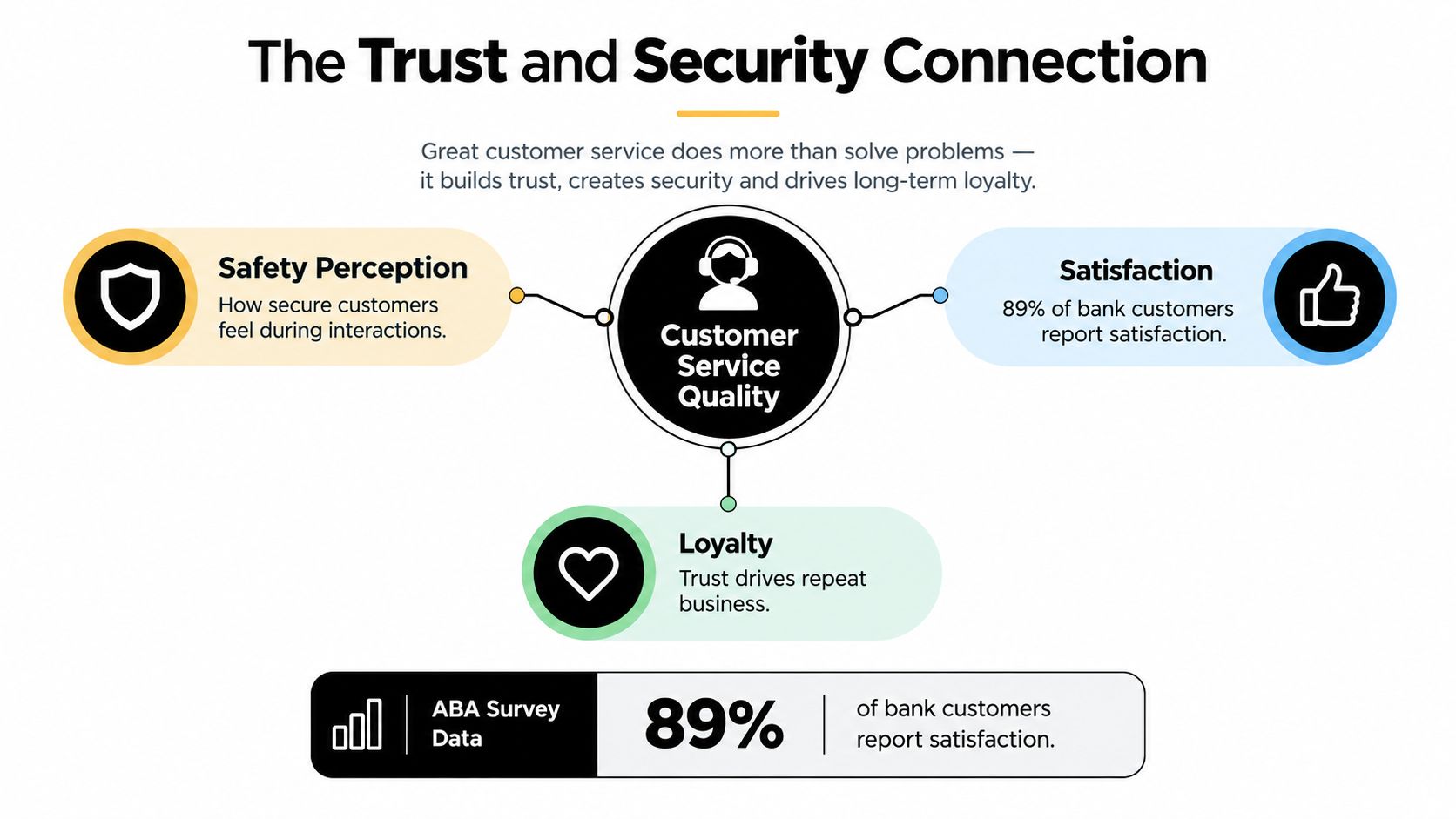
The data supports that framing. In the ABA and Morning Consult survey of 4,403 U.S. adults conducted October 1 to 6, 2025, 89% of bank customers said they were very satisfied or satisfied with their primary bank, and 95% rated customer service as excellent, very good, or good. In the same survey, 87% said their bank takes proactive steps to protect customers from fraud and scams.
Those numbers sit close together for a reason. Satisfaction and perceived protection rise together because customers experience security through service moments, such as an alert, a verification call, or a clear explanation of a declined payment. Security that stays invisible until something breaks doesn't build the same confidence.
A Fraud Alert Is a Service Interaction
Proactive contact counts as service, not just as risk operations. The survey found that 59% of customers had received a fraud alert about potentially suspicious activity, and the citation above reports that 96% of recipients considered those alerts valuable. An alert tells a customer the provider is watching before the customer has to ask, and it opens a conversation while there's still time to limit harm.
That conversation has to be designed as carefully as the alert itself. The customer needs a safe route back into the provider, not a link that looks like phishing, and agents need guidance on how secure live chat practices keep authentication inside a trusted channel. Teams that publish plain guidance, such as 2026 online banking safety tips, also give customers a reference point they can check before acting on a suspicious message.
- Alerts explain themselves: The message states what triggered it in general terms, what the customer should do, and what the provider will never ask for.
- Verification feels purposeful: Each check is tied to a visible benefit, such as unfreezing a card or reviewing a transaction.
- Escalation stays visible: Routine questions get automated answers, while urgent or sensitive cases move to a person without the customer starting over.
High satisfaction is clearly achievable, based on the survey results above. The lesson isn't that customers are easy to please. It's that proactive, understandable protection earns the satisfaction, and support teams deliver much of that protection through ordinary conversations handled well.
Digital-First Complaints and Regulatory Deadlines
Complaints no longer arrive mainly through branch visits or paper letters. Customers start in chat, continue by email, and escalate through formal digital portals, often about the same unresolved problem. A support operation that treats each channel as a separate conversation loses context exactly when the case becomes serious.
India's experience shows the scale clearly. Reporting on India's financial ombudsman system states that 1,334,244 complaints were received in fiscal year 2024–25, up 13.55% from 1,175,075 in 2023–24, and 91.22% of complaints at regional ombudsman offices were submitted digitally through the portal or email.
| Metric | 2023–24 | 2024–25 | Change |
|---|---|---|---|
| Total complaints received | 1,175,075 | 1,334,244 | Up 13.55% |
| Complaints per 100,000 accounts | 8.9 | 7.7 | Declined |
| Digital share at regional offices | Not stated | 91.22% | Not stated |
The table holds an apparent contradiction worth understanding. Total complaints rose while complaints per account fell, which can happen when digital usage and reporting grow faster than underlying problems. Raw volume alone therefore doesn't prove service is getting worse, though it absolutely proves the operation must handle more digital cases without losing records.
Deadlines Turn Conversations Into Evidence
Regulators add a clock to that volume. The same reporting context pairs with a United States expectation that the Consumer Financial Protection Bureau generally expects complete, accurate, and timely complaint responses within 15 calendar days, as described in research on predicting untimely responses to digital finance complaints. That study of 266,337 digital-finance complaints found that information available at intake contains predictive signal for identifying cases likely to receive untimely responses.
That finding changes how intake should work. A chat transcript alone isn't enough, because nobody can sort a queue by deadline risk from unstructured text alone. Teams need structured fields captured at the start, while the customer is present and the facts are fresh.
- Product and issue type: Card dispute, payout delay, account access, or suspected fraud, recorded in consistent categories.
- Authentication status and promised action: The record shows who was verified, what the agent committed to, and the regulatory deadline attached.
Practical rule: If a case can't be sorted by deadline and harm within seconds, intake captured a conversation instead of a case.
With those fields in place, queues can prioritize the cases most likely to miss a deadline or hurt a customer, rather than serving strictly in arrival order. AI-generated summaries then preserve the evidence trail for human review, and one unified case record across chat and email prevents duplicate investigations and contradictory answers.
Fraud Resolution as a Loyalty Differentiator
Most fintech marketing celebrates stopping fraud before it happens. Customers, however, remember what happened after a fraudulent charge appeared anyway. Detection is a technical achievement the customer barely sees. Resolution is the lived experience, measured in days without money and messages that either arrive or don't.
The gap between those two experiences is wide. In a 2025 U.S. study of more than 2,000 consumers who had experienced card fraud, the overall fraud-resolution experience scored an average of 76 out of 100, only 8% rated it excellent, and 25% gave it a failing grade.

The weakest points were practical, not cosmetic. The study cited above found that more than 40% of consumers did not receive temporary credit while their case was investigated, and 53% said real-time updates improved their experience while 32% said that capability was unavailable. A customer waiting for provisional funds isn't asking for delight. That customer is deciding which bill goes unpaid.
The Questions Customers Actually Ask
- When will temporary funds be restored? Silence here forces customers to borrow, delay payments, or move money from elsewhere.
- What evidence is required? Customers can't supply documents they don't know about, and late requests restart the clock in their minds.
- Who is investigating, and how often will updates arrive? A named process with scheduled updates feels different from a case disappearing into a queue.
Faster detection doesn't answer any of those questions. That's the uncomfortable insight for teams investing heavily in prevention while leaving disputes to generic ticket handling. A clear timeline, preserved context across every contact, proactive status messages, and reliable access to a person may do more for loyalty than another incremental gain in detection speed.
Building that experience means treating dispute support as its own playbook. Verified policy content gives consistent answers about provisional credit and evidence, AI summaries keep the case history intact, and clear rules on when to escalate an issue to a specialist stop sensitive cases from circling front-line queues. Automation supports the workflow. It doesn't replace the accountability a named human provides when money is missing.
Finding the Right Balance of AI and Human Support
The useful question isn't whether customers accept AI. It's which tasks they'll trust it with, and what happens when the answer is wrong. A customer asking where to find a routing number and a customer disputing a charge that emptied an account are not having the same conversation, and they shouldn't get the same level of automation.
Trust data draws that line sharply. Global financial-services research published by Salesforce in 2025 found that 54% of consumers trusted AI agents at least somewhat, yet only 10% trusted them completely, and 73% said it was important to know whether they were communicating with an AI or a human. A separate Deloitte survey cited in that research, covering 2,027 U.S. banking customers, found that 74% preferred human agents for banking-chatbot interactions.
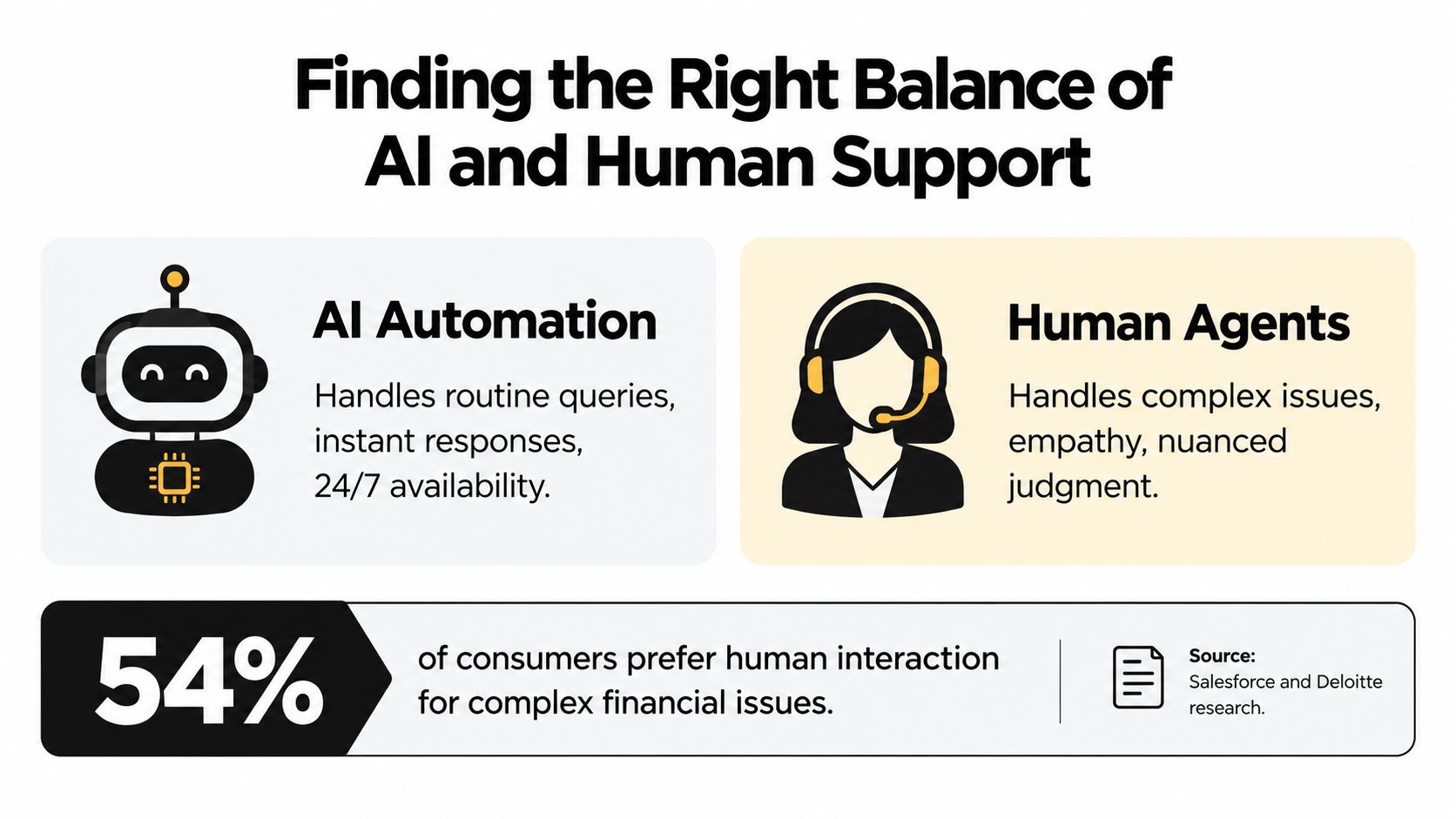
Those figures don't reject automation. They bound it. Customers accept help from software for retrieval, translation, triage, summaries, and routine explanations, because errors there are visible and correctable. They resist opaque decisions about disputes, account access, or financial harm, because an error there costs money and feels impossible to appeal.
Design Principles That Respect the Boundary
- Disclose the agent's nature: Customers should know immediately whether they're talking to software or a person, without having to guess.
- Escalate on confidence and consequence: Low confidence, changing account state, or signs of distress should trigger handoff, not another automated attempt.
- Preserve the whole conversation: A human taking over should receive a summary and full history, so the customer never repeats a painful story.
- Ground answers in first-party material: Responses drawn from a provider's own help center and policies, as explored in guidance on using ChatGPT for customer support, stay easier to audit and correct.
Availability complicates the picture in a healthy way. Customers outside business hours still need a response, which is where automation earns its place, and a customer service availability guide can help teams think through coverage expectations. The version promises an immediate automated response at night and a human decision when the case requires one, rather than pretending software can safely do both.
Applying These Principles in Real Scenarios
Principles only matter if they survive contact with a real queue at a bad moment. Three common situations show how structured intake, risk-tiered escalation, and preserved context work together in practice, and where automation should stop.
The stakes behind these scenarios keep rising. In Experian's fintech research on preparing for the AI fraud era, 59% of fintechs reported that fraud losses had increased versus the prior year, and 51% identified model drift or degradation as a major operational challenge. False declines hurt too, since the same research reports that 51% said their cost had increased and 32% called falsely declining a legitimate transaction the most costly outcome.
Scenario One, an Account Locked After a Fraud Alert
A customer's card declines at a pharmacy after an unfamiliar transaction triggers a freeze. Automation can confirm the account is restricted, explain in general terms why freezes happen, and start verification. It cannot decide the caller is legitimate, because the caller might be the attacker testing the support desk.
Step-up verification takes over before anything changes. Consumers in the Experian research viewed behavioral biometrics as the most secure authentication method at 83%, ahead of physical biometrics and passwords, which supports layering signals instead of relying on questions an attacker might answer from stolen data. A trained specialist then reviews the risk signals, explains what can be shared, and either restores access or states the next checkpoint and its timing.
Scenario Two, a Disputed Payment Under Investigation
A customer reports a charge that wasn't authorized and needs the money for a payment due this week. Intake captures the product, dispute category, amount in the customer's own words rendered into structured fields, and the response deadline. The customer receives a written summary of what happens next, whether temporary credit applies under policy, and when the next update will arrive.
Because chat and email sit in one case record, a follow-up message two days later doesn't start a second investigation. The agent sees the evidence already submitted, the promise already made, and the clock already running. That's how fintech customer service avoids the duplicate work and missed deadlines that fragmented channels create.
Scenario Three, a Multilingual Question After Hours
A customer writes in a language the overnight team doesn't speak, asking why a transfer hasn't arrived. Two-way translation handles the exchange, automation retrieves the correct explanation of settlement timing from verified help content, and the summary lands in the case record in the team's working language. If the transfer turns out to be flagged for review, the case escalates with context intact instead of being answered reassuringly and wrongly.
Across all three situations, the pattern holds. Automate low-risk status and explanation, demand stronger proof before changing account state, and route ambiguity to people trained for it.
Building a Support Strategy That Earns Trust
A durable strategy can be stated plainly. Treat support as part of the security system, structure every conversation as case data from the first message, and invest in the resolution experience after fraud occurs, not only in preventing it. Add AI with disclosure, confidence-aware escalation, and preserved history, then unify chat and email so one customer problem stays one case.
That model reframes the budget conversation. Support measured only by response time and ticket cost will always look like overhead to trim. Support measured by whether customers feel protected, informed, and willing to stay after something goes wrong looks like what it is, a retention system that competitors struggle to copy quickly.
A Short Audit for Any Fintech Team
- Verification before disclosure: Does every account-touching conversation confirm identity first, and can agents explain why in one sentence?
- Deadline visibility: Can a team lead sort open cases by regulatory deadline and customer harm right now?
- Handoff without repetition: Does a human taking over from automation receive a summary, or does the customer start again?
- Feedback that reaches product: Do recurring complaints change the product, following the discipline to build loyalty with customer insights instead of filing feedback away?
Teams that can answer yes to those questions have built more than a help desk. They've built the part of the product customers trust most on the worst day, which is exactly when trust decides whether an account stays open.
SignalZen gives small and medium fintech teams AI support trained on their own website, files, and help center, with chat and email unified in one workspace and human handoff that preserves the full conversation history. Its automatic translation, AI summaries, and Slack, Microsoft Teams, and Google Chat integrations help teams apply the risk-aware, escalation-ready model described above without adding a separate inbox. Teams ready to build that kind of support operation can start at SignalZen.



Better support without a bigger support team.
Start with AI. Add your team when the conversation needs a person.