

The customer has already explained the problem in chat, attached a screenshot, and followed the suggested fix. The support agent posts the case in Slack, tags engineering, and tells the customer it's been escalated. By the next shift, engineering is asking for the original error message, support assumes someone else is replying, and the customer is still blocked.
That situation doesn't call for another notification. It calls for a handoff that makes responsibility explicit. To escalate an issue without losing the customer, the team needs a qualified problem, a usable escalation packet, an accepted owner, and a customer-facing plan that survives the transfer.
Table of Contents
- What It Really Means to Escalate an Issue
- Why Most Escalations Fail Before the Transfer
- Qualifying the Issue Before You Hand It Off
- Building the Escalation Packet and Handoff Message
- When AI Should Stop and a Human Should Take Over
- Running the Service Recovery Conversation
- Timelines, Ownership, and a Final Checklist
What It Really Means to Escalate an Issue
Consider a hypothetical account-access ticket posted in a Slack engineering channel. The agent writes that login is broken and asks someone to investigate. An engineer reacts with an emoji, another asks whether the customer has tried resetting the password, and the original agent finishes the shift.
The next agent interprets the reaction as acceptance. Engineering interprets it as acknowledgment of the message, not responsibility for the case. After several days of disconnected replies, nobody can identify who was supposed to contact the customer.

Transfer responsibility, not just information
Escalation is a controlled change in responsibility because the current responder lacks the expertise, authority, or resources needed to resolve the problem. Sending a ticket elsewhere is only the delivery mechanism.
A clean transfer establishes distinct roles:
- Case owner: Coordinates the unresolved issue and ensures the next action happens.
- Technical responder: Investigates or implements the remedy. This person may differ from the case owner.
- Customer contact: Maintains the external conversation rather than leaving the customer to follow an internal discussion.
For a small team, the same person may cover several roles. The important distinction is between contributing to a thread and accepting responsibility for its outcome.
Acceptance rule: A tag, notification, or emoji isn't an ownership handoff. The receiving person must explicitly accept the case.
Inside Microsoft Teams or Slack, that acceptance should appear in the case thread and be reflected in the support record. The outgoing agent stays responsible for coordinating the handoff until acceptance occurs, rather than treating the posting action as completion.
Escalation also doesn't always mean moving upward. A specialist with the right access may be more useful than a manager without it. Management belongs in the path when the case requires an exception, competing priorities need a decision, or the existing response has failed.
The operational test is straightforward: another agent should be able to identify who owns the case and what happens next without asking the channel.
Why Most Escalations Fail Before the Transfer
A quiet escalation queue doesn't prove that customers are satisfied. It may mean that dissatisfied customers aren't pursuing the complaint further.
TARP complaint-behavior research reports that only 1%–5% of customers escalate to a local manager or corporate headquarters, while providing a corporate toll-free number can roughly double complaints reaching headquarters. In the same research summary, a 1982 Coca-Cola study found that first-contact resolution produced satisfaction and loyalty levels about 10 percentage points higher than resolution requiring multiple contacts.
Those findings support different operational cautions. Complaint counts depend partly on how accessible the escalation route is, and an extra customer contact shouldn't be treated as harmless administrative work.
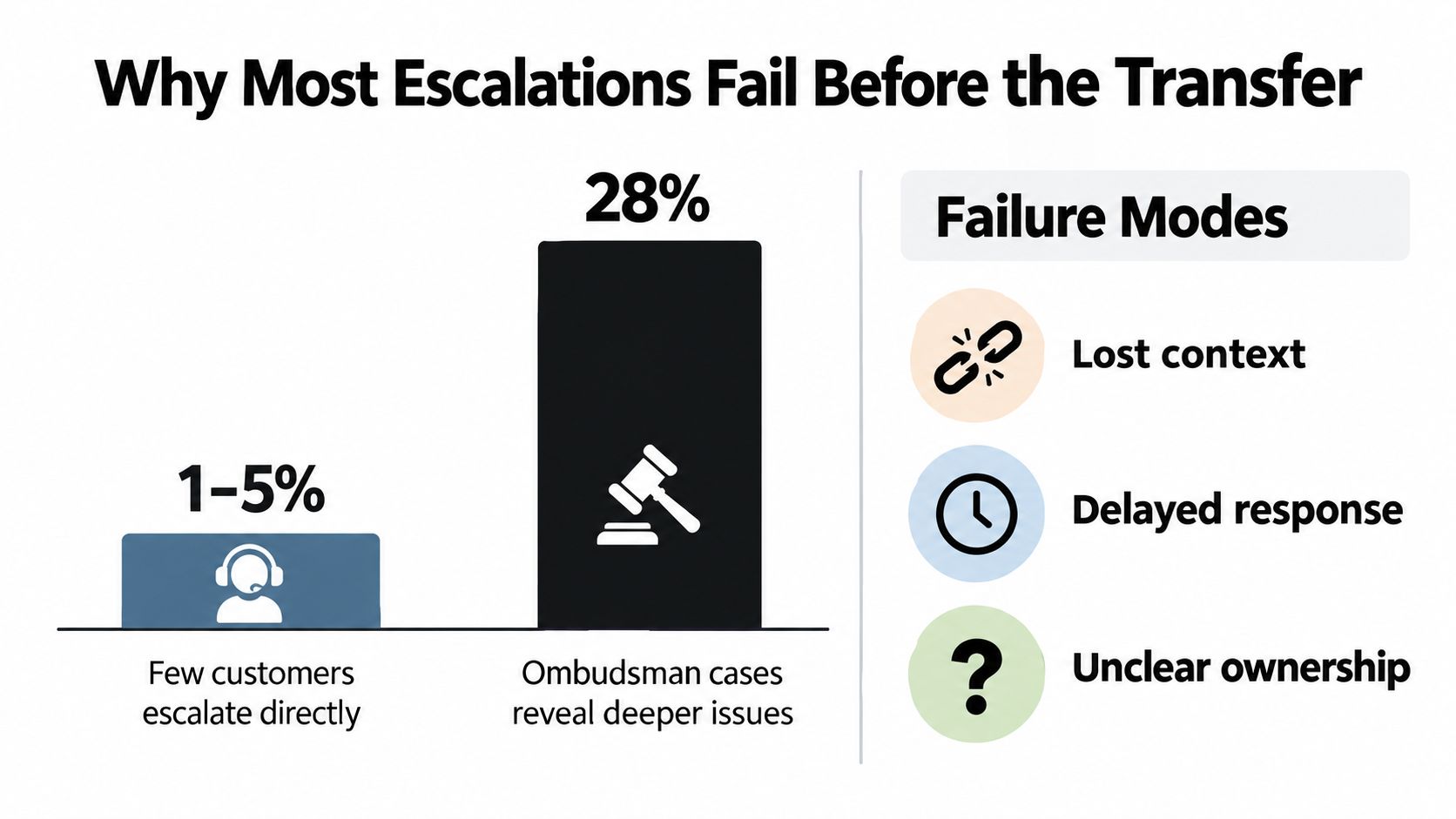
The measures shown in the graphic describe different populations, not stages of a single funnel. The Legal Ombudsman finding concerns complaints that reached an external escalation body; it shouldn't be read as the failure rate of ordinary support tickets.
Diagnose the missing work upstream
Before blaming the receiving team, inspect what arrived. A vague request can leave a capable specialist unable to act.
| Failure before transfer | What the receiving team sees | Operational consequence |
|---|---|---|
| Missing requested outcome | A description of frustration | Clarification before action |
| Incomplete troubleshooting record | A symptom without test results | Repeated advice |
| Unverified assumptions | A suspected cause presented as fact | Investigation in the wrong direction |
| No customer commitment recorded | An internal request without timing context | An overdue external update |
The duplicate-question loop starts when the receiving agent cannot distinguish information that's missing from information that was already gathered. Asking for a screenshot again may look reasonable internally, but the customer sees evidence that the previous conversation wasn't read.
A useful escalation should reduce uncertainty for the next responder, not merely move uncertainty into another queue.
An audit should include abandoned conversations and unresolved cases, not just tickets marked escalated. Reviewing the record immediately before transfer can reveal whether agents had enough authority to resolve the issue, whether the customer's requested remedy was captured, and whether an internal clarification request was ever answered.
The practical correction isn't necessarily another form field. Remove fields nobody uses, but make the information required for the next decision unavoidable.
Qualifying the Issue Before You Hand It Off
An angry customer with a cosmetic display problem and a calm customer reporting possible account compromise shouldn't receive the same priority. Emotional intensity matters to communication, but business impact and time sensitivity should determine the operational response.
Before routing, the agent should record the affected service and qualify the issue using evidence rather than labels such as urgent or important.
Capture evidence that changes the decision
- Impact: Identify the blocked activity, affected users, and any revenue exposure. Distinguish a complete failure from a degraded experience.
- Urgency: Record what becomes worse if the team waits, including a customer deadline or continuing disruption.
- Reproducibility: Describe the conditions under which the issue occurs and whether the team can reproduce it. An intermittent failure still matters.
- Security exposure: Flag possible unauthorized access, sensitive-data exposure, or suspicious account behavior without presenting an unconfirmed suspicion as a breach.
- Desired outcome: State whether the customer needs restored access, corrected billing, a refund decision, an explanation, or another remedy.
If the inquiry began outside live chat, qualification must include the original intake details. Recepta.ai's resource on handling missed calls and forms is relevant when those channels feed the support queue; a missed call shouldn't lose its callback requirement during triage.
Impact vs Urgency Decision Matrix
The following is a proposed routing aid, not a universal severity standard. Each team should align its categories with the services and authority it controls.
| Impact | Low Urgency | High Urgency | Routing |
|---|---|---|---|
| Limited disruption | Continue frontline troubleshooting | Prioritize a targeted remedy | Frontline owner, specialist if capability is missing |
| Significant business disruption | Arrange specialist investigation | Activate the urgent response path | Service owner and coordinating lead |
| Potential security, safety, or regulatory consequence | Seek qualified review before continuing | Stop risky actions and activate the designated response | Security, safety, or compliance owner |
A manager is appropriate when authority is missing, not just because the customer asks forcefully. A specialist is appropriate when expertise or access is missing. If the frontline agent can safely provide an authorized remedy promptly, escalating may add delay without adding capability.
Verify the priority independently. Research on IT incident-resolution SLAs found that failing to double-check priority reduced the likelihood of meeting the SLA by 8.2%, and high-priority incidents were consistently less likely to meet SLA targets than lower-priority incidents.
The verifier should check the evidence behind the classification, not just approve the label. New information can justify changing priority, but the record should explain why it changed.
Building the Escalation Packet and Handoff Message
“Customer still blocked, please investigate” describes neither a useful starting point nor a decision to make. A specialist shouldn't have to reconstruct the case from scattered chat replies, an email attachment, and an agent's memory.
The escalation packet is a compact working record. It should summarize the case while retaining access to the underlying evidence, so the receiving agent can check details instead of trusting a compressed account blindly.
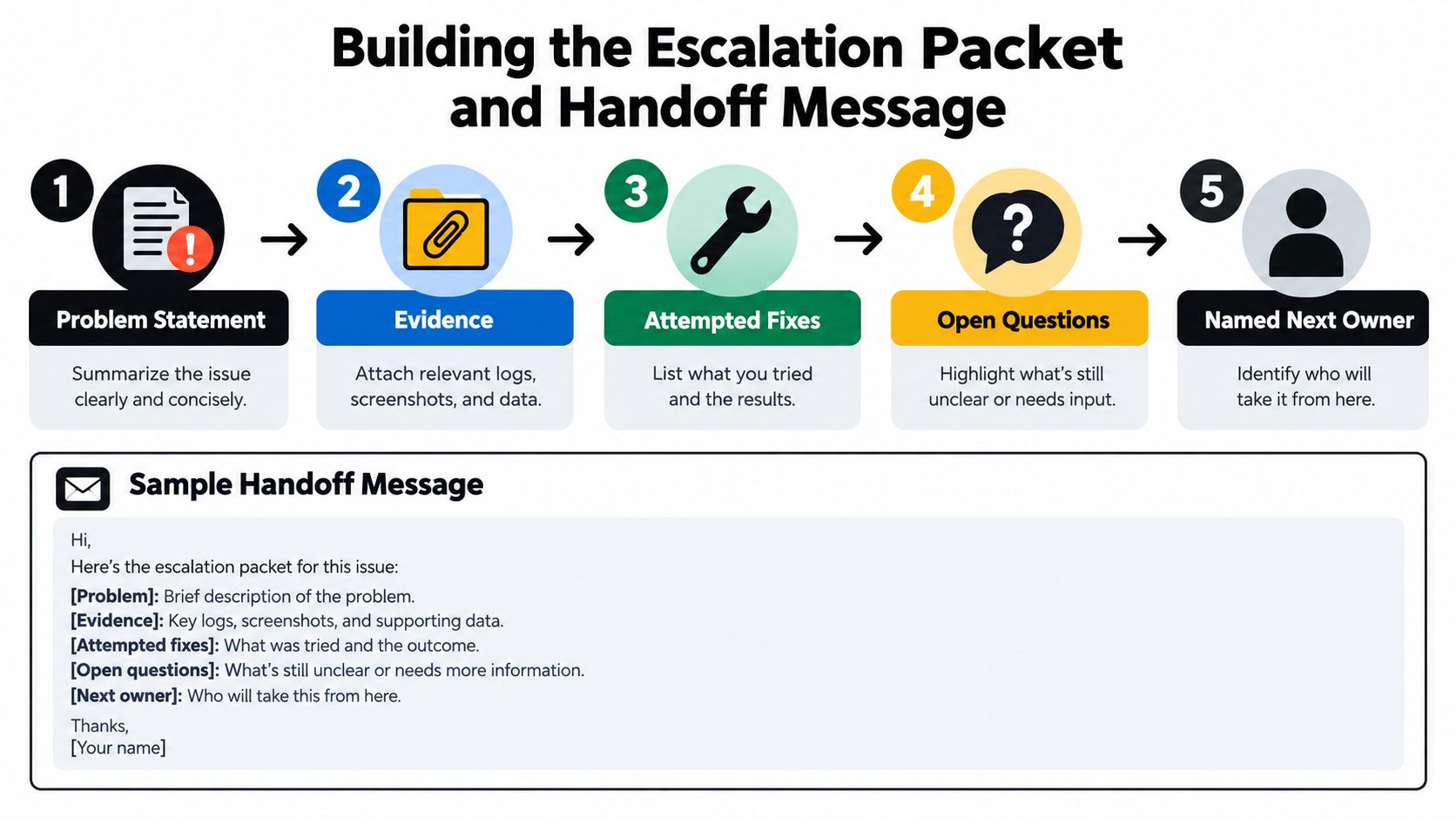
A reusable packet
The following template uses a hypothetical account-access case. The examples illustrate the required detail rather than describing an actual customer incident.
| Field | What belongs in the record |
|---|---|
| Problem statement | Account administrator cannot sign in after completing the reset flow; access restoration is requested |
| Evidence | Original transcript, exact error text, relevant timestamps with timezone, approved diagnostic records |
| Attempted fixes | Reset completed; alternate browser tested; neither restored access |
| Open questions | Whether the account is locked and whether the failure affects other users remain unconfirmed |
| Impact and urgency | Administrative work is blocked; the customer's stated deadline is recorded |
| Next owner | Named responder, acceptance deadline, next action, and customer contact |
Attempted fixes need results, not just action names. “Reset attempted” leaves uncertainty about whether the message arrived, whether the customer completed the process, and what happened afterward.
Evidence also needs boundaries. Screenshots and logs should be stored in an approved location, with unnecessary personal information removed before they appear in a broad collaboration channel.
A channel message that supports action
A reusable Slack, Microsoft Teams, or Google Chat message can read:
Escalation requested
Problem and outcome: [Confirmed failure and requested remedy]
Packet: [Reference to the approved case record]
Evidence and attempts: [Relevant findings and unsuccessful fixes]
Unanswered decision: [What the specialist must determine]
Priority: [Verified category and rationale]
Requested owner: [Named responder]; acceptance due [approved timestamp and timezone]
Customer update: [Named contact] will send the next update at [agreed timestamp].
The message shouldn't become a second, competing ticket. Decisions made in the channel belong back in the authoritative case record, especially when several responders contribute.
For email-originated cases, an email ticket system is a relevant workflow reference. In repair businesses, repair ticketing software is another category to consider when the support case must remain associated with a repair job.
A handoff summary can make the record easier to read, but it shouldn't erase unresolved questions. Human review should catch omitted constraints, uncertain conclusions, and remedies the customer has already rejected.
When AI Should Stop and a Human Should Take Over
A fast answer isn't a resolved issue. The useful question isn't whether AI can produce another troubleshooting suggestion, but whether another automated action is safe, informed, and likely to advance the case.
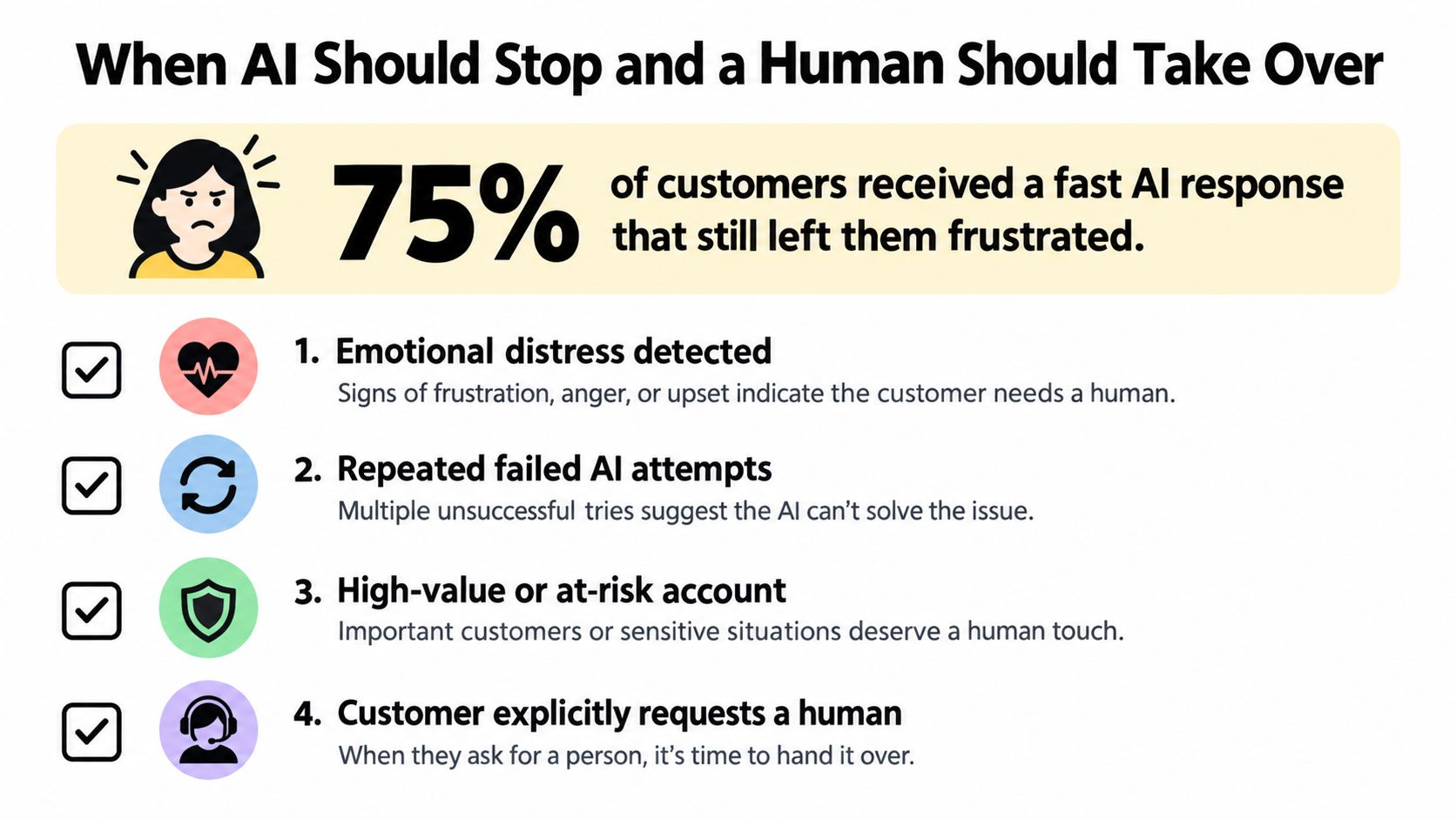
A 2025 survey of more than 600 U.S. consumers found that 75% had received a fast AI response that still left them frustrated, 68% ranked complete resolution as the most important support outcome, and only 7% rarely or never had to repeat themselves when switching channels. These findings support evaluating resolution and continuity rather than celebrating response speed alone.
Use consequence and uncertainty as triggers
The following is a recommended risk-based policy, not a claim that every case in these categories has the same severity:
- Billing disputes and account access: Bring in an authorized person when the case involves contested charges, identity verification, or permissions the AI cannot safely assess.
- Safety, legal, or regulatory concerns: Stop speculative troubleshooting and route to the designated qualified owner.
- Contradictory or incomplete knowledge: Don't let the AI choose between conflicting instructions or improvise a policy exception.
- Repeated rephrasing or failed remedies: Treat restated questions as evidence that the current approach may not be addressing the problem.
- Distress, accessibility barriers, or a human request: Offer human assistance without making the customer complete another automated loop.
Emotional language is a signal to review the interaction, not an automatic severity score. Conversely, a calm description of irreversible harm can justify immediate human involvement.
Routine, reversible requests can remain automated when approved instructions clearly cover the task. The team should define permitted actions as well as stop conditions, so the AI isn't rewarded for continuing beyond its authority.
Preserve uncertainty at takeover
The human should receive the AI's knowledge references, actions taken, and unresolved uncertainties in the packet described earlier. The summary must distinguish customer statements from verified findings and AI hypotheses.
Teams designing this boundary can use the discussion of ChatGPT for customer support alongside their own permission and escalation policies. Translation deserves review too: an apparently repetitive exchange may reflect misunderstood wording, accessibility needs, or cultural nuance rather than a difficult customer.
Running the Service Recovery Conversation
Technical progress doesn't excuse a poor recovery conversation. A customer can accept that a specialist needs time while still expecting the support contact to understand the disruption and explain what's happening.
A Journal of Marketing study, spanning 682 service-recovery interactions across 30 German firms, an experiment with 315 U.S. participants, and 5,068 airline recovery interactions, found that increasing active listening or empathy by 1% could increase the probability of customer gratitude by up to 14%. That finding isn't a guaranteed return from a scripted apology; it supports listening as part of substantive recovery work.
A channel-neutral recovery script
A proposed script for the hypothetical access case could read:
The failed sign-in is preventing completion of administrative work.
The recorded requested outcome is restored administrator access.
The reset completed successfully, but the cause of the remaining error isn't confirmed.
The account specialist has accepted the investigation, with the next review milestone recorded in the case.
The support contact will send an update at the agreed time, even if investigation is still continuing.
The wording acknowledges a specific failure without declaring an unverified cause. It also promises an update the team controls rather than a resolution deadline it hasn't approved.
Give corrective information, not repeated apologies
- Report meaningful progress: Explain what was checked, what was ruled out, and what remains uncertain.
- Name the current dependency: State whether the case awaits specialist review, an authorized decision, or customer information.
- Explain a workaround accurately: Describe its limits instead of presenting partial recovery as a complete fix.
- Confirm restoration: Check the customer's original task before treating the issue as resolved.
Guidance on dealing with angry customers can support agent coaching, but calm language must accompany corrective action. An apology-only reply leaves the practical failure untouched.
For hospitality teams evaluating external coverage, CS Outsource for hosts is a relevant service to review. Any external responder should receive approved communication boundaries rather than inventing compensation or access promises.
Timelines, Ownership, and a Final Checklist
An escalation policy needs separate milestones for first response, human acceptance, workaround, and final resolution. A quick acknowledgment shouldn't conceal a case that hasn't reached anyone capable of acting.
Legal Ombudsman guidance for 2024/25 reports that 28% of complainants who escalated hadn't received a final response from the original provider, while 49% of escalated complaints were resolved through early resolution. These are legal-service complaint measures, but they provide a useful warning about incomplete closure and a reason to examine opportunities for earlier resolution.
Define milestones without inventing service promises
The reference below is a runbook structure, not a benchmark. Teams should replace its qualitative targets with approved deadlines based on coverage, contractual commitments, and responder capability.
| Priority tier | First response | Human acceptance | Workaround | Final resolution |
|---|---|---|---|---|
| Critical | Activate the urgent response commitment | Use the designated acceptance deadline | Assess safe containment immediately | Track against the critical restoration commitment |
| Elevated | Apply the expedited response target | Assign within the staffed escalation window | Provide an approved interim option when available | Agree a case-specific target |
| Routine | Apply the standard service target | Accept through the normal staffed queue | Offer only if useful | Follow the standard resolution commitment |
Each milestone needs a defined start event and recorded completion time. The policy should also specify staffed hours, timezone handling, permitted clock pauses, and what happens when a dependency prevents progress.
Measure SLA attainment separately by priority tier and milestone. Aggregating everything into a single figure can conceal slow acceptance behind fast initial replies.
The final ownership check
Before the outgoing agent leaves the case, the runbook should require confirmation of:
- Accepted responsibility: The receiving owner has explicitly accepted, and the support record matches.
- A bounded next action: The task and its deadline are recorded.
- Fallback coverage: An acceptance timeout or unavailable responder triggers a named backup path.
- An external update commitment: The customer contact knows the agreed cadence and next milestone.
- A definition of done: Restoration, any remaining remedy, and required customer confirmation are documented.
- Closure evidence: The final response explains the outcome rather than merely changing the ticket status.
The objective isn't to escalate every difficult conversation. It's to make every necessary escalation reviewable, with a destination, a deadline, and evidence that the customer's original problem was addressed.
SignalZen offers AI assistance, conversation summaries, and human handoff with chat and email history preserved inside Slack, Microsoft Teams, or Google Chat. Teams rebuilding escalation workflows can visit the platform to evaluate how those capabilities fit their escalation packets, ownership rules, and customer-update process.


Better support without a bigger support team.
Start with AI. Add your team when the conversation needs a person.