

A customer has just written, “This is unacceptable,” across a live chat and an email thread. The order is late, the previous agent asked for the same details twice, and the customer now wants a manager. The instinct to defend the process is understandable, but it usually adds friction when the customer needs two things first: to feel heard and to see a credible path to resolution.
The answer to how do you deal with angry customers isn't a clever script. It's a disciplined operating method that combines emotional de-escalation, effort reduction, accurate ownership, and clear boundaries for abusive behavior. An angry message is uncomfortable, but it can also be one of the few direct warnings a business receives before dissatisfaction becomes silent churn or negative word of mouth.
Table of Contents
- Why Angry Customers Are Actually Good News
- A Two-Stage De-Escalation Workflow
- Designing Recovery Around the Customer's Real Goal
- When to Step Back and Escalate
- Real Customer Service Scenarios
- Post-Interaction Follow-Up and Loyalty Building
Why Angry Customers Are Actually Good News
Angry customers are often treated as interruptions to normal support work. That mindset wastes information. A visible complaint gives the business a chance to identify a broken promise, a confusing process, a product defect, or a support failure while the relationship may still be recoverable.
Only about 5% to 10% of unhappy customers formally complain after a service failure, according to research summarized by Arizona State University's service-recovery research. The exact share varies by context, but the operational lesson is consistent: the customers who speak up represent only a small portion of total dissatisfaction. A complaint should therefore be read as a signal about the wider experience, not proof that one unusually difficult person has created an isolated problem.
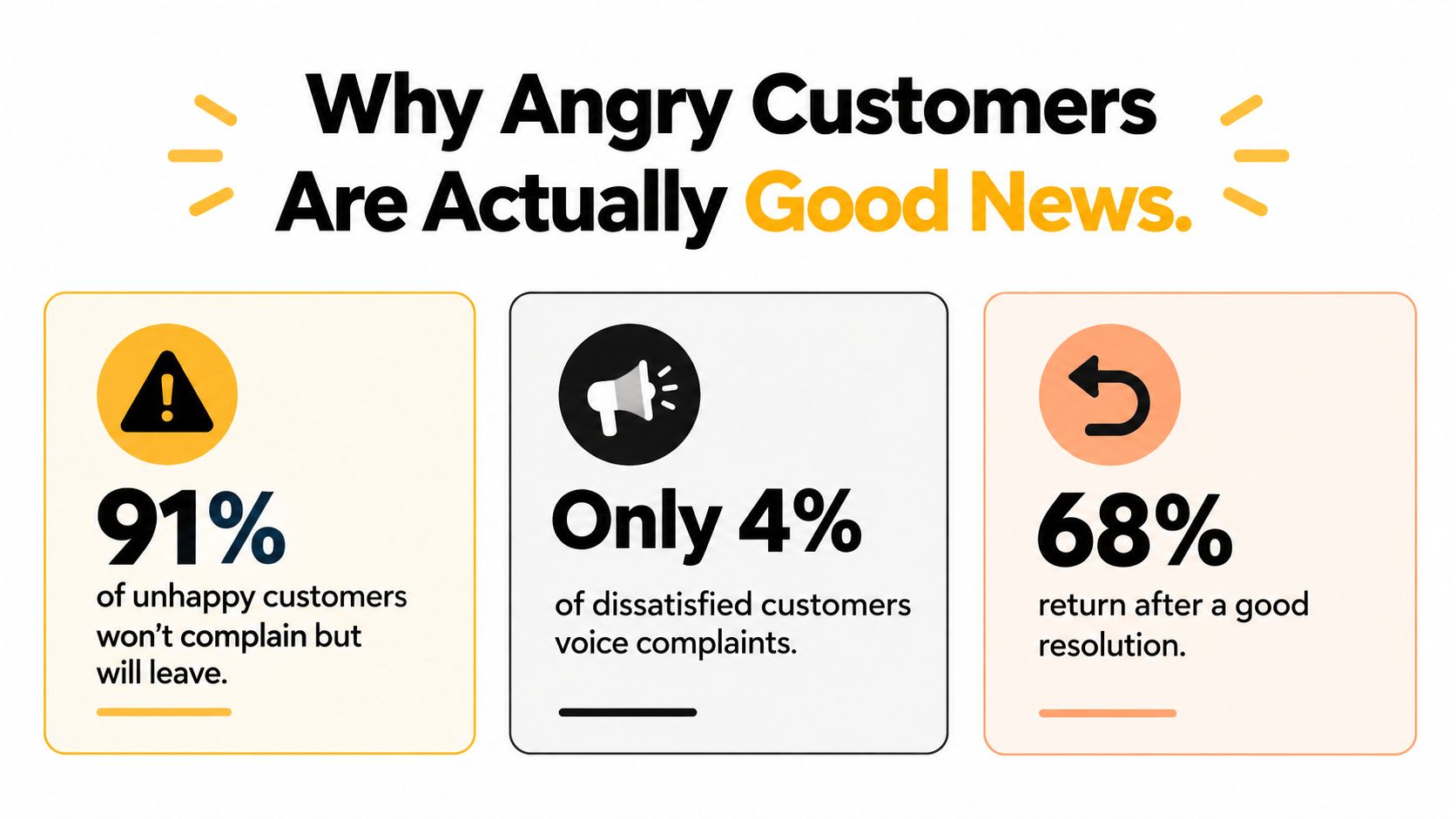
What the complaint reveals
A customer who complains is showing the team where trust broke. The message may mention a missing delivery, but the underlying issue could be an inaccurate promise, an unanswered message, or the burden of having to chase the company. Treating the ticket as a single transaction hides the pattern.
A support lead should review nearby signals such as:
- Cancellations and refunds: These can indicate dissatisfaction from customers who never contacted support.
- Repeat contacts: Multiple conversations about the same issue point to failed ownership or incomplete resolution.
- Low survey scores: These reveal frustration that may not appear in written complaints.
- Abandoned purchases: Customers may leave before giving the business a chance to recover.
The same Arizona State University summary found that most customers were dissatisfied with how companies resolved their complaints. Responding quickly matters, but a response alone isn't recovery. The customer must see that the business understands the practical failure, recognizes the impact, offers a fair remedy, and follows through.
Practical rule: Treat every angry complaint as both a customer problem and a diagnostic alert.
That change in perspective improves the agent's tone. The goal isn't to “win” an argument or close a ticket. The goal is to identify what failed, reduce the effort required from the customer, and create a reliable next step. When teams do that consistently, anger becomes actionable information rather than an isolated disruption.
A Two-Stage De-Escalation Workflow
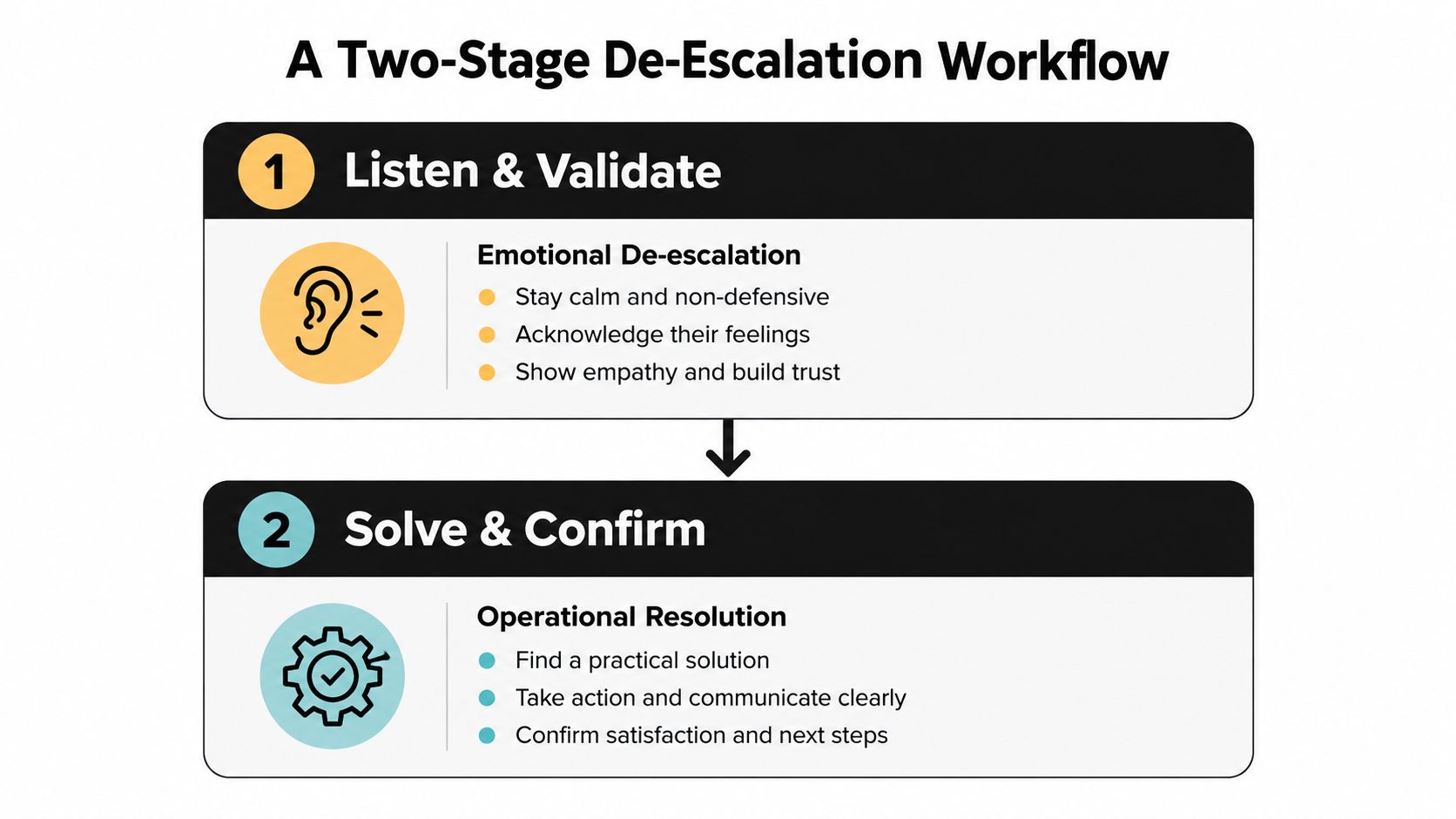
The most reliable approach separates emotional de-escalation from operational problem solving. Agents who rush into policy explanations while a customer is still venting often sound defensive, even when the policy is correct.
Stage one reduces emotional pressure
Start by naming the specific experience, not by reaching for a generic phrase. “You were told the replacement would arrive, and it still hasn't shipped” demonstrates more understanding than “I understand your frustration.” The first statement identifies the failure and gives the customer something concrete to confirm or correct.
Then reflect the core issue in plain language. Keep it short, and ask one focused diagnostic question. For example: “The main problem is that the promised delivery date passed without an update. Is the missing order the priority, or does the customer need a refund instead?” A focused question moves the conversation toward the desired outcome without interrogating the customer.
A 2023 multi-study investigation of social-media complaints found that increasing active-listening language by 1% raised the probability of customer gratitude by up to 14%, while increasing empathy by 1% raised it by up to 90% (Journal of Marketing Research). Those findings support treating empathy as a response feature that can be improved, but not as a substitute for accurate action.
Avoid these common triggers:
- Defending intent too early: “We didn't cause the delay” doesn't address the customer's loss of time.
- Using empty empathy: A phrase without evidence of understanding can feel automated.
- Asking for repeated background: The customer shouldn't reconstruct a history the team already has.
- Continuing automation after a human request: Once the customer asks for a person, route the conversation appropriately.
Stage two creates ownership
After the customer confirms the issue, state the action, owner, and expected time. A useful structure is: “The support team will check the shipment status now. The assigned agent will update the customer by the agreed time, even if the carrier hasn't replied.” The promise must be realistic and trackable.
The remedy might be a repair, replacement, refund, explanation, or manager review. Close by confirming that the proposed outcome addresses the stated need. Teams developing consistent service behaviors can also use the Sift AI customer service standards as a reference point for defining response quality.
SignalZen can support this workflow by classifying urgency, drafting replies from verified first-party content, preserving the full thread, and handing sensitive cases to a human. Teams can also use proactive live chat messages to clarify expectations before confusion becomes anger.
Measure the workflow by first meaningful response, customer repetitions, time to ownership, and reopen rate. Sentiment matters, but factual accuracy and completed remedies matter more.
Designing Recovery Around the Customer's Real Goal
An apology acknowledges harm. It doesn't automatically fix the customer's problem.
The 2017 U.S. Customer Rage findings reported that 75% of complainants wanted a repair or fix, but only 29% received one, while 60% wanted an apology and only 31% received one (Arizona State University's consumer-rage findings). The gap explains why a polished apology can still leave a customer dissatisfied. Customers usually want progress that removes the inconvenience, not language that merely describes concern.
When an apology was added to a monetary solution, satisfaction reached 73%, according to the same source. That doesn't mean every angry customer needs compensation. It means the remedy should match the failure, and the apology should accompany meaningful action rather than replace it.
A practical recovery protocol
A strong recovery record captures the customer's experience in a form another agent can use without asking the customer to start again.
- Record the failure and impact. Note what happened, what the customer lost, and what outcome they requested.
- Apologize for the experience or service failure. Avoid unsupported legal admissions, but don't hide behind passive language.
- Offer the fastest authorized fix. Provide the remedy the agent can approve, or identify the manager who can decide.
- Explain the cause and prevention step when known. Customers don't need speculation. They do need an honest account of what the team has confirmed.
- Confirm acceptance. Ask whether the proposed outcome solves the stated problem.
- Document the root cause and commitment. Record who owns the follow-up and what must happen next.
A customer satisfaction process can benefit from a broader customer satisfaction improvement framework, especially when complaint data needs to feed product, billing, and operations teams.
What weak recovery looks like
A public complaint shouldn't be moved into a private channel. The business should acknowledge the public concern before continuing privately, otherwise observers see avoidance rather than care. Agents also shouldn't promise a deadline they can't monitor, because a missed promise creates a second service failure.
Rigid scripts cause similar trouble. A script can protect tone and policy, but exceptional cases need judgment. A customer with a broken item may need a replacement, while a customer charged incorrectly may need a corrected invoice. The same apology cannot carry both resolutions.
The large complaint-recovery study of 35,597 customers across 41 industries found that recovery has a stronger effect on loyalty in more competitive industries, during faster economic growth, among luxury-product customers, and among customers with higher satisfaction or stronger customization expectations. The practical conclusion is clear: personalized recovery has more value when customers have alternatives or expect customized service.
When to Step Back and Escalate
Empathy is not a requirement to tolerate abuse. A customer can be legitimately angry about a serious failure without insulting, threatening, or harassing an agent. Once the interaction becomes unsafe, the correct intervention may be employee protection rather than more calming language.
Recent evidence covering public-facing workers across healthcare, foodservice, education, retail, transportation, and other sectors found that 53% had experienced verbally abusive, threatening, or unruly customers in the previous six months. Among affected workers, 81% reported burnout, and they were 1.3 times more likely to be actively seeking another job and 1.9 times more likely to disagree that their workplace was safe, according to research summarized by the National Association of Convenience Stores.
Set the boundary before the crisis
A support team needs a written distinction between difficult behavior and prohibited abuse. Legitimate anger may include blunt language, repeated requests, or strong criticism of the company. Harassment includes personal insults, threats, discriminatory abuse, intimidation, or refusal to stop after a clear warning.
A workable protocol looks like this:
- Name the boundary: “The team can continue helping, but personal insults and threats must stop.”
- Give one clear warning: Don't debate whether the language was justified.
- Pause or end the interaction when abuse continues: A manager should support the decision.
- Preserve the record: Keep the full conversation, including threats and previous warnings.
- Route high-risk cases to a manager: The frontline agent shouldn't carry the risk alone.
- Support the employee afterward: Review what happened, check safety, and provide coaching without blaming the agent.
Better empathy isn't always the right intervention. Sometimes protecting the employee is what makes reliable empathy possible.
A 2025 academic study also found that sustained exposure to rude customers can weaken frontline employees' identification with their organization unless they perceive effective managerial protection. Managers should therefore treat escalation rules as part of service quality, not as an exception to it.
Teams can make escalation easier by routing collaboration into existing workspaces, including helpdesk support from Slack or Microsoft Teams. The channel is less important than ensuring a manager receives the context and the agent doesn't have to keep engaging alone.
Real Customer Service Scenarios
A live chat customer says a replacement hasn't arrived and demands a refund. The chat history shows that another agent already confirmed the original mistake. The next agent shouldn't ask for the order number again. A better reply identifies the failure, confirms whether the customer wants the refund or replacement as the priority, and states who will complete that action.
If the refund requires approval, the agent should say so without making the customer chase the approval. “The refund request is with the billing manager, and this agent owns the update” is stronger than “The issue has been escalated.” The first sentence gives ownership. The second merely changes the queue.
An email customer has already explained a billing error in detail, then posts publicly because no one replied. The business should acknowledge the public complaint with a concise statement that the team is reviewing it, then continue privately without forcing the customer to repeat the account history. A public-to-private handoff should reduce exposure while preserving accountability.
A third customer is angry because a technical fix is taking longer than expected. An instant but unresolved reply may intensify distrust, especially if it repeats an apology without new information. A slower update with a named owner, a confirmed next action, and a time for the next message gives the customer something dependable to evaluate.
Context should travel with the conversation
For each handoff, the receiving agent needs the failure, impact, requested outcome, actions already taken, promises made, and unresolved decision. AI summaries can help condense long threads, but the summary must remain grounded in the actual conversation and verified company information.
The customer shouldn't have to translate the problem for every channel. A consistent record lets a chat agent, email agent, and manager work from the same facts while still adapting tone to the channel. Human judgment remains necessary when the remedy falls outside policy, the account is high value, or the customer's safety concern changes the priority.
Post-Interaction Follow-Up and Loyalty Building
A ticket isn't finished when the agent sends the remedy. It's finished when the business verifies that the remedy worked and learns what caused the failure.
The recovery study involving 35,597 complaining customers found that complaint recovery can have a disproportionate loyalty effect under certain market and expectation conditions, as discussed earlier. That makes follow-up more than courtesy. It confirms whether the promised repair, replacement, refund, or explanation delivered the outcome.
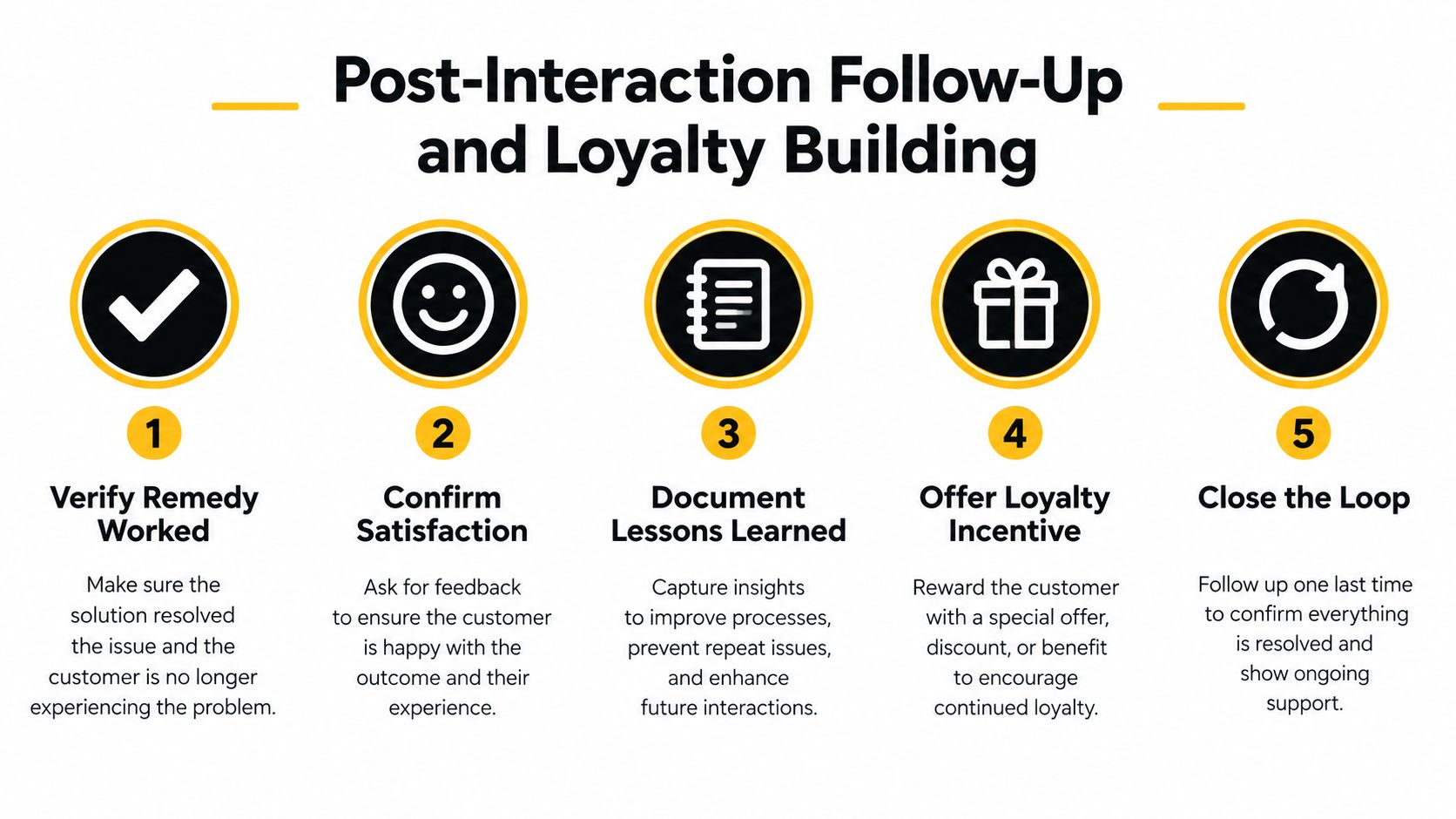
Use a short operational checklist:
- Verify the remedy worked: Check delivery, access, billing, or repair status.
- Confirm satisfaction: Ask whether the original need is now resolved.
- Document the lesson: Record the root cause and update the relevant knowledge source.
- Review the interaction: Track repeat contacts, escalations, reopening, and first-contact resolution.
- Close the loop: Send the promised final update instead of leaving the customer to infer completion.
Teams can also use closing chats to improve live-chat ratings as a practical reminder that the final exchange shapes how customers judge the entire interaction. A centralized history and explicit escalation rule prevent the same frustration from resurfacing under a new ticket.
SignalZen unifies chat and email history, provides AI-assisted drafts from verified first-party content, and routes conversations to human agents in Slack, Microsoft Teams, or Google Chat when judgment is required. Visit SignalZen to give support teams clearer ownership, fewer repeated questions, and safer escalation paths for angry-customer interactions.


Better support without a bigger support team.
Start with AI. Add your team when the conversation needs a person.