

Shortening every conversation is the most repeated advice in an AHT call center, and it is often the wrong one. A three-minute call that sends the customer back tomorrow is not a win. It is unfinished work that shows up again as another ticket, another hold, and another angry repeat.
Average handle time is the full labor of one interaction, not the clock on the spoken part. Teams that chase a single low number hide transfers, weak notes, and problems that never got solved. A longer handle can be the cheaper one when it prevents a second contact, especially while newer agents are still learning the product.
Table of Contents
- What AHT Means in a Call Center
- How to Calculate Average Handle Time
- AHT Call Center Benchmarks by Industry
- How AHT Changes Staffing and Cost
- Why a Lower AHT Is Not Always Better
- Ways to Reduce AHT Without Losing Quality
- What to Measure Next in Your Call Center
What AHT Means in a Call Center
An agent hangs up after three minutes of talking. Then the same agent spends another three minutes writing notes, updating the order, and classifying the ticket. The customer is gone. The work is not.
That second half is why average handle time (AHT) exists. It measures the complete time required to process one customer interaction: talk time, hold time, and after-call work such as documentation, ticket classification, or a customer-record update. Verint's handle-time guide treats that full span as the definition, because talk-only reporting can substantially understate the labor required to resolve a request.
Why the spoken clock misleads
A password reset, an order-status question, a billing dispute, and a technical failure do not share a natural length. Measuring only the conversation makes a careful agent look slow and a rushed agent look efficient. The rushed agent may have skipped the note, so the next person starts from zero.
Practical rule: If the timer stops when the customer hangs up, the report is missing the work that still sits on the agent's screen.
What the minutes mean for capacity
AHT is a capacity metric with a quality constraint, not a score to drive toward zero. It feeds workforce planning, staffing, forecasting, and cost analysis. If a center receives 10,000 calls and AHT is 6 minutes, the workload is 60,000 handling minutes before breaks, training, absenteeism, or other shrinkage. A 10% reduction, with volume and service quality held steady, drops that to 54,000 minutes, a saving of 6,000 minutes, or 100 staff-hours, as that same guide shows.
Historical industry analysis in that guide also reported that AHT increased by 10.99% between 2013 and 2016. Interactions were getting heavier, not automatically faster. The useful question is which minutes are diagnosis and which minutes are hunting for an answer.
How to Calculate Average Handle Time
The arithmetic is simple. The interpretation is not.
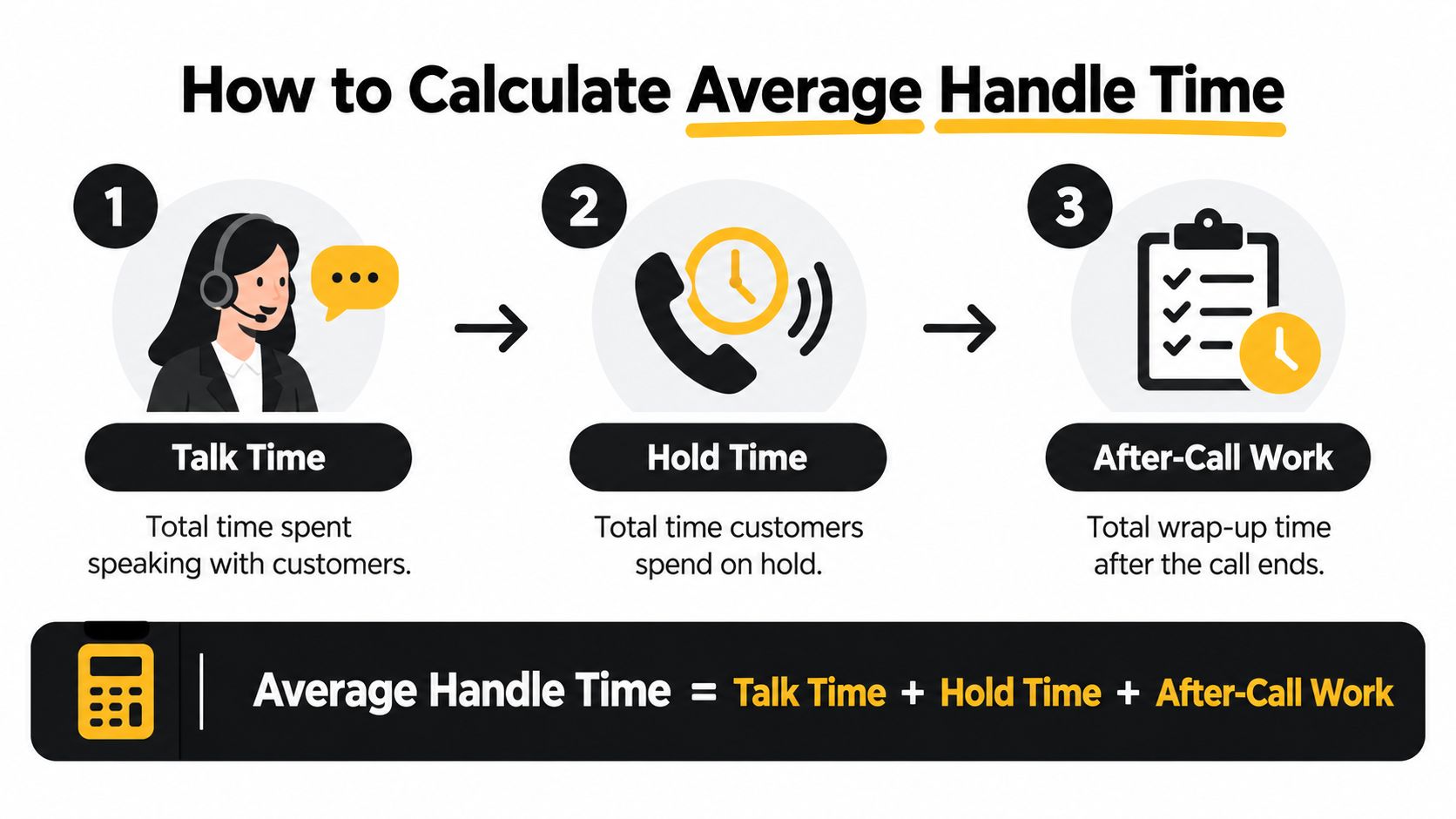
AHT = (total talk time + total hold time + total after-call work) ÷ total number of calls.
Nectar's 2026 call-center statistics describe the same composite: talk, hold, and wrap-up, divided by completed calls. Units must match. Minutes in, minutes out.
One worked example
Take 1,000 calls with 4,000 minutes of talk, 1,000 minutes of hold, and 1,000 minutes of wrap-up.
- Add the labor: 4,000 + 1,000 + 1,000 = 6,000 minutes.
- Divide by calls: 6,000 ÷ 1,000 = 6 minutes of AHT.
Change one piece and the average still moves the same way. Swap the long hold for a long note, 2,000 minutes of wrap and almost no hold, and the headline stays near six minutes. The fix does not. A fat wrap-up share points to weak case-note habits or fragmented systems. A fat hold share points to slow knowledge lookup or a back-office wait.
What the formula leaves out
After-call work includes ticket classification and customer-record updates. It does not include breaks, training, or absenteeism. Those belong in shrinkage, after the handling workload is known. Mixing them into AHT makes every agent look slower on days when the team is in class.
Published references disagree on purpose. One cross-industry point is about 6 minutes 10 seconds. A broader customer-service benchmark sits near 589 seconds, roughly 9 minutes 49 seconds. Those two figures cannot both be "the" target for one SMB queue. Slice the average by interaction type, channel, language, and escalation status. Billing questions and order-status requests should not sit in the same bucket as technical troubleshooting, where log review and escalation coordination naturally add minutes.
AHT Call Center Benchmarks by Industry
Published targets disagree because they blend unlike work. Capacity's AHT glossary places a common cross-industry figure at about 6 minutes, with a wider contemporary band of about 6–8 minutes. Sector sketches in that summary spread even further.
| Sector or view | Approximate AHT |
|---|---|
| Cross-industry, common summary | About 6 minutes |
| Broader contemporary band | About 6–8 minutes |
| Retail | Roughly 3–4 minutes |
| Banking and financial services | 4–6 minutes |
| Telecommunications | 5–7 minutes |
| Healthcare | 6–8 minutes |
| Technical support | 8–10 minutes |
Why a retail minute is not a support minute
Channel, problem type, and whether hold and after-call work are included all move the number. A retail order-status call and a software-support case are not the same job. The longer case can be necessary diagnosis, not waste. Comparing them against one global target makes careful technical work look inefficient.
Translate the average into hours
A center handling 20,000 calls a month at 6 minutes has 120,000 handling minutes, or 2,000 hours, before shrinkage. A 9-minute technical case uses 50% more handling time than a 6-minute contact. A 4-minute transactional case uses one-third less. Those gaps change staffing and queue capacity directly.
Compare each contact reason with its own history, not with a stranger's industry average.
Treat the benchmark as workload and cost context, not as a customer-experience score. Segment by contact reason and channel, then watch whether that segment's own baseline is drifting.
How AHT Changes Staffing and Cost
Workload hours come first. Shrinkage, breaks, and service-level buffers come after.
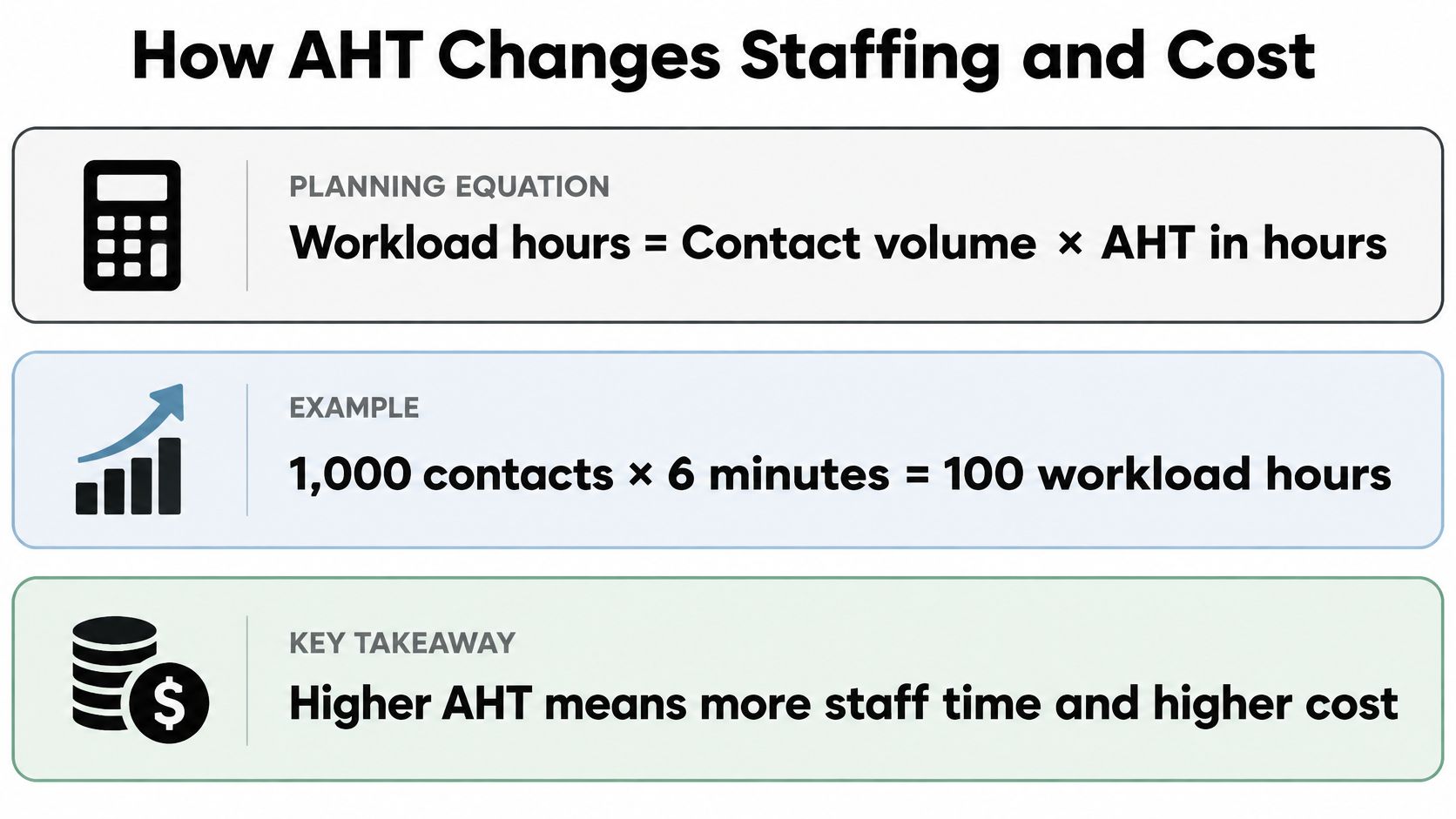
The planning approximation is workload hours = contact volume × AHT in hours. Altigen's performance-metrics guide uses a clear case: 1,000 contacts at 6 minutes each create 100 agent-hours of handling workload before shrinkage, breaks, training, and service-level buffers.
Occupancy moves when the average moves
Occupancy is the share of staffed time spent in handling work. If volume and headcount stay put and AHT falls, agents spend less of their time on interactions, so occupancy drops. If AHT rises, the same team runs hotter and the queue gets riskier. Occupancy is commonly managed around roughly 75–85%. A speed program that ignores that band either leaves people idle or pins them against the wall.
Saving 30 seconds per contact removes 8.33 workload hours per 1,000 contacts. That benefit is real only if the saved time does not return as repeat contacts or manual follow-up. Otherwise the dashboard celebrates a cut the schedule never feels.
The small-team choice
Three options usually sit on the table: hire, move repetitive questions off the human queue, or accept longer waits. Clinics and similar practices often face the same math with a tiny roster, which is why some look at Medical Virtual Assistants to cover routine patient calls without inflating the core team. Whatever the path, pair AHT with queue service level, abandonment, first-contact resolution, quality, and customer effort. A speed gain that creates hidden rework is not a staffing win.
Why a Lower AHT Is Not Always Better
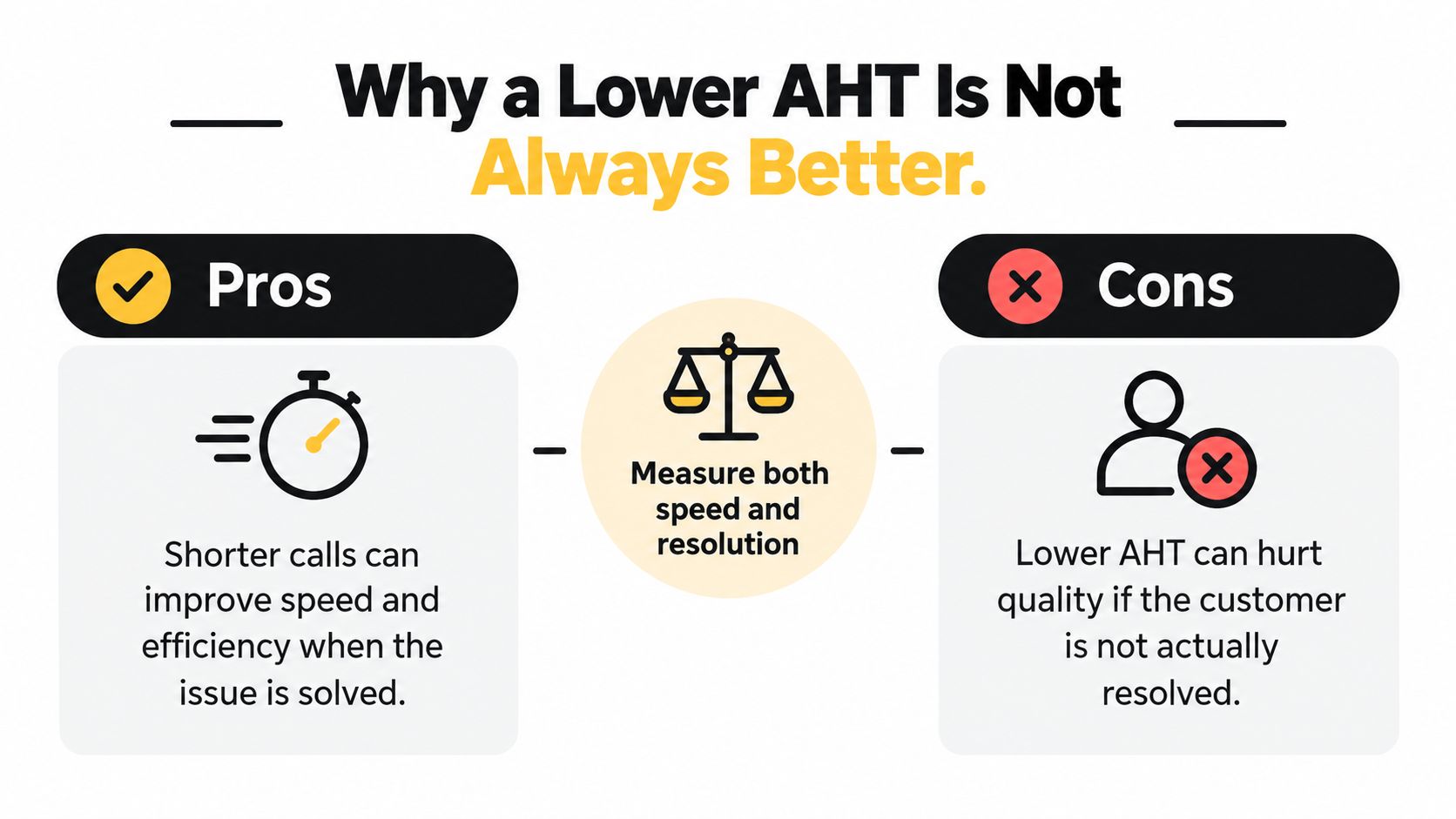
A falling average is easy to cheer and easy to fake. Agents can end early, transfer, or skip diagnosis. The clock looks better. The customer comes back, or lands in self-service that never solves the problem.
A 2025 KPI benchmark guide is explicit that cutting handle time helps only when the issue is fully resolved by the end of the interaction. Leading centers in that guidance are shifting toward issue resolution, conversation tone, and customer-effort score rather than AHT alone. How agents communicate with customers during those extra minutes often decides whether the case stays closed.
Pair every intent with an outcome
A password reset and a billing dispute should not share a target. Report AHT beside the result for each intent.
- Order status: Short is fine when the status is accurate and the customer does not write back.
- Refund exception: A few extra minutes of policy explanation can beat a reopen and a supervisor escalation.
- Technical troubleshooting: Diagnosis time is the job. Cutting it often creates a second, longer case.
- Account security: Rushing verification is a risk, not a productivity trick.
For each segment, put first-contact resolution, reopen rate, escalation rate, and customer effort on the same row as AHT. A modestly higher AHT can cost less when it prevents a second contact and an escalation. Avoided repeats are real workload, not a soft preference for "being nice."
The SMB question is practical. Which intents deserve a faster path, and which ones should agents deliberately take longer on?
Ways to Reduce AHT Without Losing Quality
Wasted minutes and necessary minutes need different levers. Three jobs stay separate: answer repetitive questions before they reach a person, shorten search and writing time, and keep complex cases with people who can finish them.
Knowledge, process, and assist
Findable answers cut hold. Verified first-party knowledge, suggested prompts, and a clear escalation path stop the agent from parking the customer while they hunt. High hold is usually a retrieval problem, not a talking problem.
Drafts cut wrap-up. Reply drafts, one-click tone changes, and thread summaries mean after-call work is not a second investigation. The agent confirms the note instead of reconstructing the thread from memory.
Routing protects the hard cases. Simple status checks should not consume the same people who debug failures. Home-service companies hit a similar split, and call answering for home services is one way routine booking calls stay off the technician's phone.
AI belongs in the first two jobs more than in a universal timer. A controlled study of 5,179 customer-support agents, summarized by CloudTalk's statistics roundup, found an AI assistant raised issues resolved per hour by 14% on average and by 34% for novice agents. That is consistency and ramp help. The same roundup cites a 2025 ICMI survey of 113 contact-center, customer-service, and IT-support professionals: 79% expected AI to make agents more productive, mainly by automating repetitive tasks, improving knowledge management, and freeing people for harder work.
What good assist looks like in the queue
Report three buckets, each with resolution quality and reopen rate: AI-resolved, AI-assisted human, and fully human. Do not blend them. A workspace assistant can answer from the website, files, and help center, draft replies, hand off with history plus a summary, keep chat and email in one queue, and translate both ways so language does not force a transfer. Customer service automation only pays off when those answers are verified. Unverified replies and lost context create the repeats a lower average was supposed to avoid.
Novice agents gain the most when the assistant supplies the next accurate step, not when it hurries them off the thread.
What to Measure Next in Your Call Center
Skip another company-wide target. Build a one-week baseline from the contacts already in the queue.
- Pick three to five intents. Order status, billing, and technical failure are enough to start. Record talk, hold, and after-call work separately for each.
- Use your own recent contacts. A retail band or a technical-support band is context, not the baseline.
- Pair each intent with outcomes. First-contact resolution, reopen or repeat rate, escalation rate, and a simple effort or satisfaction check. Thoughtful CSAT survey questions show whether a faster path actually felt resolved.
- Decide the exceptions in advance. Name which intents should get faster and which may run longer if that prevents a second contact.
- Split automation on the dashboard. Contained, assisted, and fully human cases stay apart. Do not claim a gain until complexity and channel look similar.
Teams that want the minutes to become appointments, not just shorter calls, can turn call data into bookings once the intent split is trustworthy. The practical move this week is smaller. List the repetitive questions that create hold or wrap-up, put the verified answers in one knowledge source, and route those questions to an assistant that hands off with the history intact. For a team already in Slack, Microsoft Teams, or Google Chat, that can mean a workspace-based assistant. Watch novice ramp and repeat contacts for a month before judging whether handle time moved for the right reason.
SignalZen gives small teams AI answers from their own site, files, and help center, plus live handoff inside Slack, Microsoft Teams, or Google Chat, so repetitive questions leave the queue without stripping context from the cases that still need a person. That is the AHT cut that holds up next to first-contact resolution, not a timer that pushes agents to hang up early. See how the queue, the copilot, and the summaries fit together at SignalZen.


Better support without a bigger support team.
Start with AI. Add your team when the conversation needs a person.