
Reliable ecommerce customer service now means near-real-time responses across channels. Recent benchmarks show 88% of customers expect faster replies than they got a year ago, and 74% expect service to be available 24/7.
That is the reality for the store already buried in shipping questions, refund complaints, and “where is my order?” tickets. The inbox that used to feel manageable can turn into a trust problem fast, especially when one customer gets a quick answer in chat and another waits half a day for the same policy question by email.
Table of Contents
- Why Ecommerce Customer Service Drives Repeat Revenue
- Response Speed, Reliability, and the Email Gap
- Staffing Strategies That Keep Response Times Realistic
- Automation Mistakes That Increase Support Workload
- Choosing the Right Support Model for Your Ecommerce Business
- Handling Returns Without Losing Customers
- Putting It All Together Into a Scalable Support System
Why Ecommerce Customer Service Drives Repeat Revenue
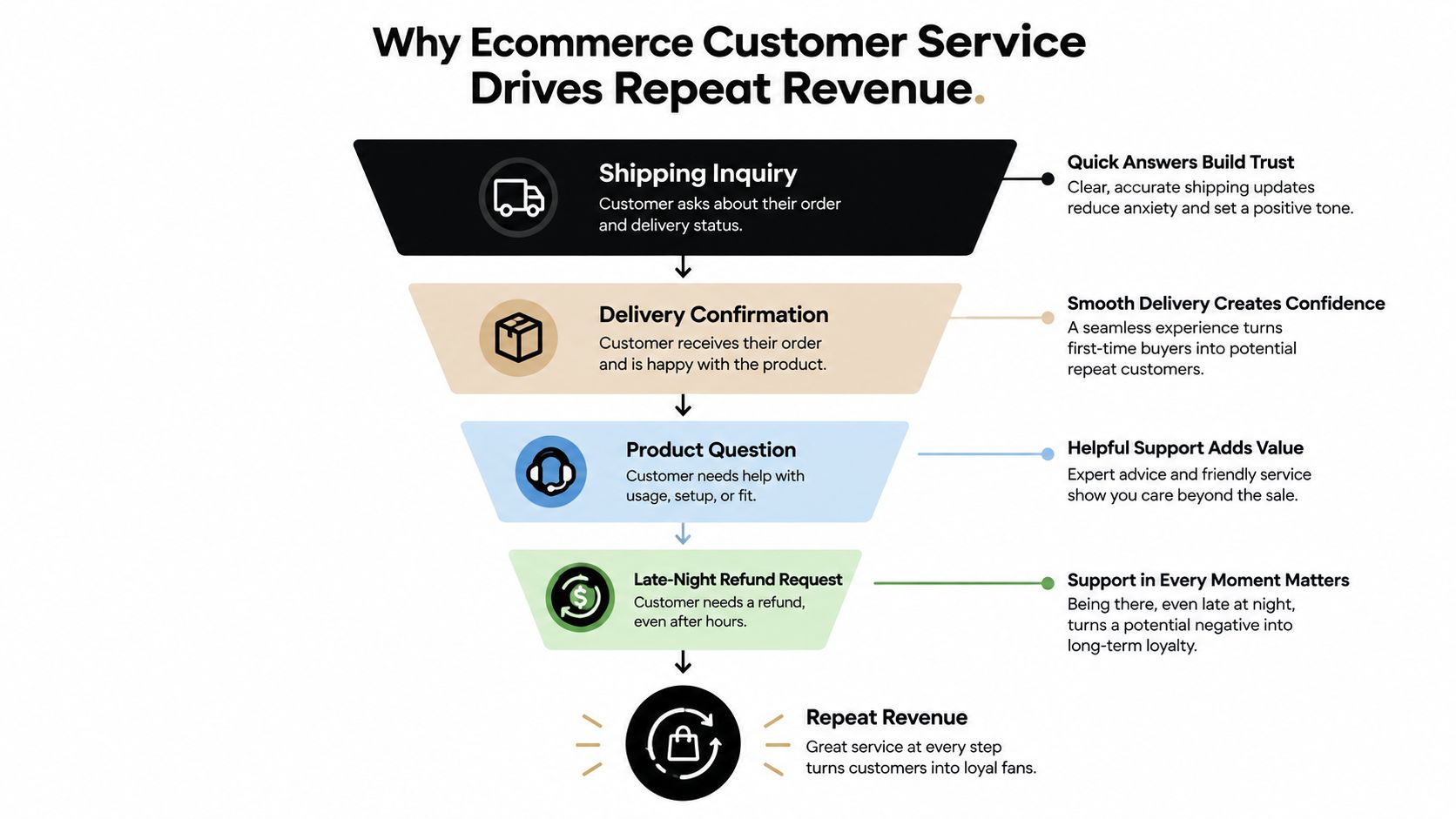
A shipping question lands first. Then a return request. Then a late-night message asking when the refund will hit. Each one looks small on its own, but together they shape whether the shopper comes back or leaves with a bad taste.
Customer service in ecommerce is not just a cleanup function after the sale, it is part of the buying decision itself. When answers are slow, inconsistent, or impossible to find, the customer stops trusting the store's promises. That matters more than a discount code because pricing can be compared instantly, but confidence is built or broken in the interaction.
Trust is built in the small moments
The first response often matters less for its exact wording than for whether it shows the store is paying attention. A fast, accurate answer to an order question lowers anxiety. A vague response, or worse, a different answer from a second agent, teaches the customer that the business is improvising.
That is why support should be treated like a retention engine, not a cost center. For small and medium retailers, every ticket is a chance to reduce uncertainty around order status, delivery timing, returns, and product fit. The stores that win repeat business usually make the policy easy to find, the answer easy to trust, and the handoff to a person invisible when it needs to be.
Practical rule: if a shopper has to ask twice, the process is already leaking trust.
Map the contact reasons before they map you
Most stores already know the top reasons customers reach out. The problem is that the answers live in scattered inbox habits, not in a deliberate service design. Shipping delays, refund timing, return eligibility, and product questions should each have their own response pattern, because a one-size-fits-all tone does not solve a one-size-fits-all issue.
A strong operation checks two things at once. It measures how quickly the team replies, and it checks whether the reply is the same no matter where the customer asks. That consistency is what turns a support interaction into a repeat purchase opportunity, and it is also what keeps one bad answer from spreading across email, chat, and social messages.
For stores trying to improve without hiring a large team, the first step is simple. Identify the highest-volume reasons people contact support, make sure every channel gives the same policy answer, and remove any delay where the customer only needed reassurance.
online customer service guidance
Response Speed, Reliability, and the Email Gap
Email is still where many ecommerce teams stumble. A global benchmark report found that only 59% of ecommerce companies offered customer support by email, and 30% of those companies ignored customer emails entirely, which is hard to reconcile with any claim of good service. Among companies that did respond, the average response time was 17.3 hours. The benchmark report also found that straightforward questions averaged 15.82 hours, while unusual requests took 19.16 hours.
Speed means different things by channel
That email lag would be frustrating anywhere, but it looks especially weak next to live chat expectations. Customer-experience research cited in 2026 found that 72% of customers expected a response within 30 minutes, 64% expected real-time responses regardless of channel, and leading ecommerce live chat teams were responding in roughly 12 to 30 seconds. Those findings show the gap, not just between channels, but between what customers now expect and what many stores deliver.
The dangerous mistake is to manage every channel with the same SLA. Email can handle more context, but not endless delay. Chat needs immediate acknowledgment, even if the full resolution takes longer. Customers forgive a careful answer. They do not forgive silence that forces them to chase the business.
Reliability matters as much as speed
The same benchmark report showed that more than half of global ecommerce companies replied within six hours, 75% replied within 24 hours, nearly 10% took longer than 48 hours, and only 46% replied to both test emails. That last number is the key warning. A store that answers one message and misses the other has not built a support system, it has built a lottery.
Practical rule: customers notice unpredictability faster than they notice slowness.
To tighten operations, track first-response time, time-to-resolution, and reply consistency by channel. Then segment by intent. A shipping delay, a policy question, and a fraud concern do not deserve the same target, because the commercial risk is not the same.
A good response model starts with immediate acknowledgment, moves quickly on simple issues, and routes complex cases without losing the thread. The email gap does not close by wishing for better inbox behavior. It closes when the team gives each request type a realistic response target and enforces it the same way every time.
Staffing Strategies That Keep Response Times Realistic
A small ecommerce team cannot staff like a call center, and pretending otherwise burns people out fast. The better answer is to build coverage around the work that arrives, not around an ideal schedule that only works when volume is calm.
Build coverage around peaks, not averages
Peak seasons expose weak staffing faster than any dashboard. If order questions spike in the evening, the team needs someone available then, even if it is a part-time specialist or a shifted schedule. If returns create the most back-and-forth, that work should not sit with whoever happens to be online, because refund and exchange decisions often need policy judgment.
Cross-training helps, but only if it is selective. The point is not to make every agent handle everything equally. It is to make sure the first person who touches a ticket can either solve it or route it without asking the customer to restate the whole issue.
Use a unified queue with clear priorities
A store loses time when chat lives in one place, email in another, and the people answering both keep switching tabs. A unified queue keeps the conversation history in one view, which reduces duplicate questions and makes it easier to escalate without confusion. That matters most when the issue started in chat and ended up by email, or the other way around.
For teams that need help staffing across time zones or after hours, latin american virtual assistants can be a practical resource when the work is repetitive, clearly documented, and ready for consistent handoff. The value is not just lower cost, it is coverage that keeps the queue moving when the core team is offline.
Support teams stay calmer when they are not forced to solve every issue at the same priority level.
Set priorities by business risk
Pre-purchase questions usually need a fast answer because they affect conversion. Delivery problems need speed because they create anxiety and follow-up contact. Refund requests need accuracy because a wrong answer creates rework and more customer frustration. That order is not theory, it is how a queue should behave on a busy Monday.
A simple staffing rule set keeps the operation from drifting:
- Route pre-purchase questions fast: These usually need quick product, sizing, or delivery guidance.
- Prioritize delivery problems second: Customers want reassurance and a clear next step.
- Handle refund cases with the most context: Policy errors here create repeat contact.
- Preserve every handoff: The next agent should not ask for the same details again.
- Keep escalation paths obvious: If the issue needs authorization, the customer should not stall in a dead end.
The point is not to over-engineer support. It is to make sure the first reply is fast enough to matter and the second reply is accurate enough to close the loop.
Automation Mistakes That Increase Support Workload
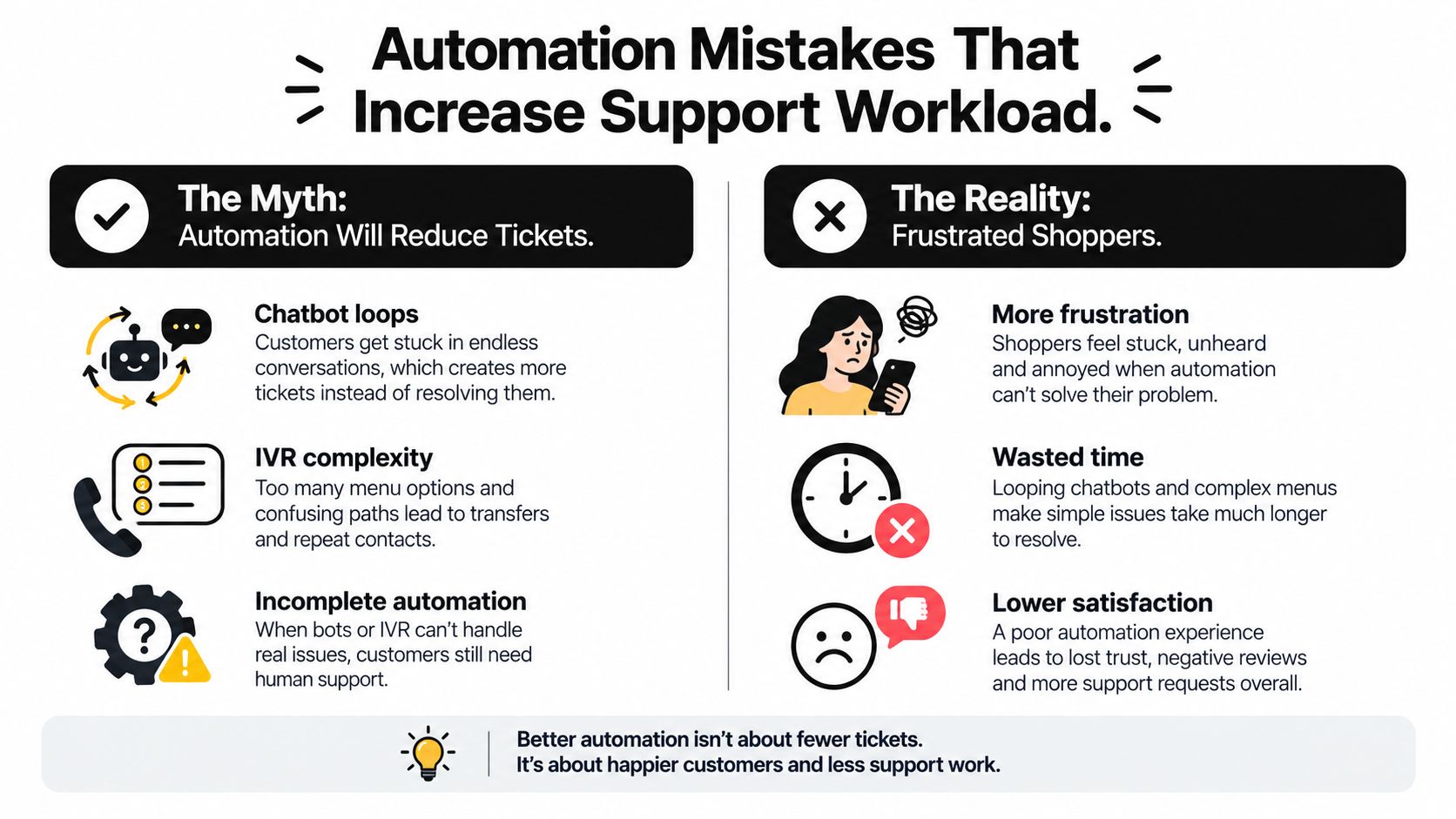
Automation often gets sold as a ticket killer, but bad automation can do the opposite. If a shopper already tried to solve the problem on their own, the bot has one job, give a useful answer or hand off cleanly. When it fails at that, support volume rises because the customer comes back angrier and more skeptical.
Self-service is already the default
A survey of 500 online shoppers found that 80% usually try to resolve an issue online before contacting customer service, using sources such as a company website, forums, or a mobile app, and that same research reported dissatisfaction with automated tools like chatbots and IVR systems. That survey makes the design problem clear. Customers are not rejecting self-service. They are rejecting bad self-service.
The mistake is to measure containment and stop there. A bot can keep someone inside the widget and still fail the customer. What matters is whether the answer was accepted, whether the customer had to repeat the story later, and whether the issue actually got resolved.
Common automation failures are usually simple
Generic answers are the obvious problem. Missing policy context is next. Unclear escalation is the one that hurts most because it traps the shopper in a loop where the system sounds helpful but never finishes the job.
A better framework is more disciplined:
- Automate repetitive intents: Order status, basic policy questions, and routine return guidance are good candidates.
- Ground responses in first-party content: The bot should use the store's own site, files, and help center, not loose internet guesses.
- Keep the history intact: A human agent should see what the bot already covered.
- Escalate exceptions with a summary: The customer should not retype the same problem twice.
For a practical discussion of how AI support can fit into this workflow, the SignalZen guide to ChatGPT for customer support is useful context.
The core rule is simple. Automation should lower effort, not just deflect contact. If a store cannot answer accurately, preserve context, and route exceptions cleanly, the bot becomes another source of work.
For teams looking to reduce wasteful contacts without losing control, the CartBoss guide on reducing support tickets is worth a look because it reinforces the same principle, solve the root cause before trying to hide the symptom.
Choosing the Right Support Model for Your Ecommerce Business
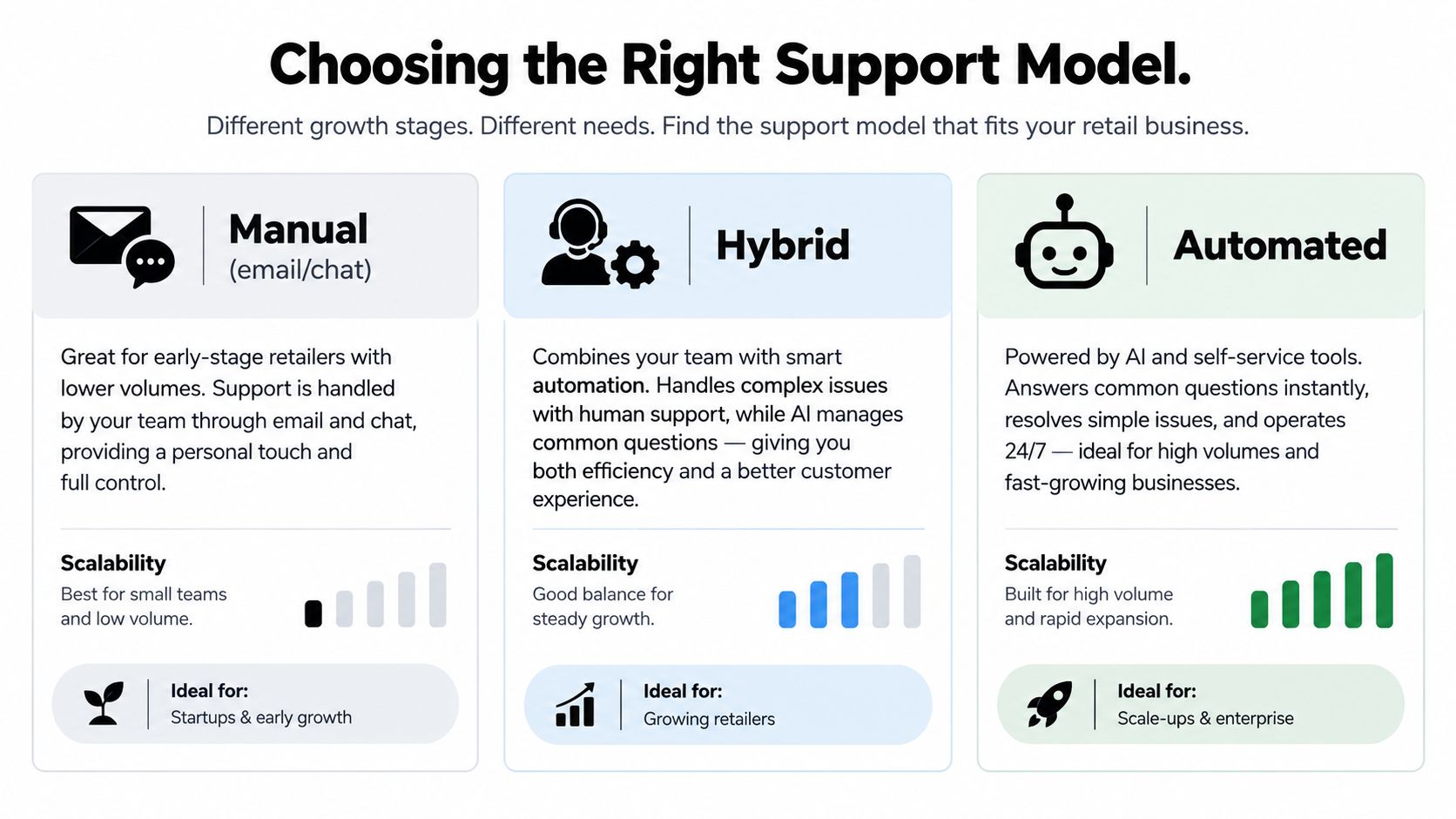
Three support models show up most often in small and medium ecommerce. Manual-only support looks simple at first, chatbot-first support looks efficient, and a unified AI-assisted setup looks more operationally mature. The right choice depends on how much volume the store handles, how many channels it serves, and how often customers need policy-heavy help.
| Ecommerce Support Model Comparison | Model | Speed | Accuracy Risk | Best Fit |
|---|---|---|---|---|
| 1 | Manual email and chat | Slowest, depends on headcount and shifts | Lower automation risk, higher inconsistency risk | Small catalogs, low volume, highly personal brands |
| 2 | Chatbot-first | Fast first reply, slower real resolution when the bot stalls | Higher if answers are generic or out of date | Repetitive questions with simple policies |
| 3 | Unified AI-assisted support | Fast acknowledgment with human escalation built in | Lower when grounded in verified content and history | Stores with multiple channels, returns, or multilingual demand |
Manual-only support is predictable, but it scales poorly
Manual handling works when volume is low and the team can stay on top of every message. The upside is direct human judgment. The downside is that the customer experience depends heavily on who is online, what channel the shopper used, and how many other tickets are waiting.
It also breaks down in a common ecommerce pattern, a customer starts in chat, then follows up by email, and the second agent has no context. The conversation becomes repetitive, and the store pays for the same issue twice.
Chatbot-first support trades speed for risk
A chatbot can deliver instant acknowledgment and handle routine questions well enough. The risk appears when the bot sounds confident but cannot complete the interaction. Then the customer escalates anyway, often more frustrated than before.
A chatbot-first model makes sense when questions are narrow and policy language is stable. It becomes brittle when the store has complex returns, multiple shipping options, or a large number of exceptions.
Unified AI-assisted support is the most balanced option
A unified model uses AI for immediate responses, then hands off to a human with full history and a concise summary. That structure works because it preserves speed without pretending automation should solve everything. It also makes multilingual coverage easier when the team cannot staff every language directly.
For stores that already work inside collaboration tools, SignalZen's Slack and Teams integration for Shopify live chat is one example of how a unified workspace can keep chat and email aligned.
The decision rule is practical. If the store has low volume and simple policies, manual support can work. If the store gets repetitive questions and can tolerate some bot friction, chatbot-first may help. If the business sees cross-channel tickets, returns complexity, or multilingual demand, a unified AI-assisted model is usually the safer long-term bet.
Handling Returns Without Losing Customers
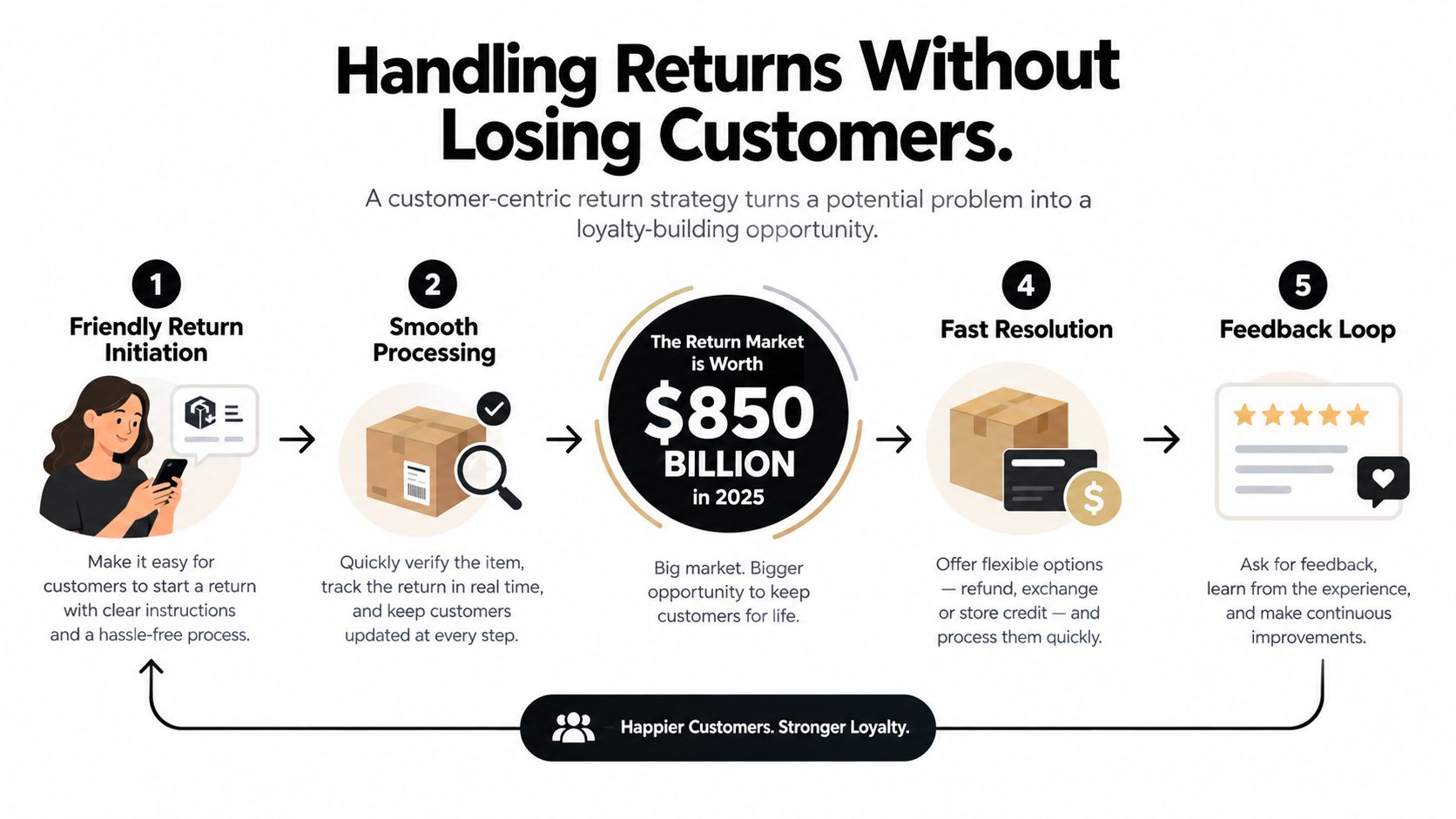
A return is not a backend task. It is the moment when the customer decides whether the store feels fair, clear, and worth buying from again. NRF research estimates that consumers will return $849.9 billion of merchandise in 2025, equal to 15.8% of annual retail sales, which shows how central this interaction is to ecommerce operations. That research also found that 81% of consumers read return policies before buying, 76% prefer instant refund or exchange options, and 71% are less likely to shop again after a poor returns experience.
Returns need a customer-facing workflow, not just a policy page
The mistake many stores make is treating returns as a form and a warehouse task. That leaves the customer guessing about eligibility, shipping status, and refund timing. A cleaner approach starts before purchase, with clear policy language in the product and checkout journey, then keeps the customer informed through the full return process.
A survey of 8,000 consumers in North America and Europe found that only 54% completed the returns process at home without issues, down from 60% the prior year, and the figure fell to 47% among shoppers aged 18 to 35. Those numbers matter because they point to friction inside a process that should feel simple.
A better returns flow keeps the customer updated
The flow does not need to be complicated. It does need to be consistent. The store should confirm eligibility, explain what happens next, give a status update while the item is moving, and separate refund timing from carrier timing so the customer knows what is still pending.
That is where human handoff matters. If the return is unusual, damaged, or possibly fraudulent, the customer should get a quick escalation with context preserved. They should not have to repeat the order number, the reason, and the policy question three times to three different people.
Practical rule: a return that feels transparent usually feels faster, even when the refund still has a processing delay.
For a deeper operational look at refunds inside Shopify, the ServeApps guide to managing returns and refunds smoothly on Shopify is a useful companion because it focuses on execution rather than slogans.
Strong return guidance does three things well. It explains eligibility in plain language, it tells the customer what happens after the return starts, and it gives a path to a person when the case stops being routine. Stores that do those three things usually reduce repeat contacts without making the process feel cold.
Putting It All Together Into a Scalable Support System
Fast answers only matter when they are accurate. The stores that hold up under pressure usually build one support system, not separate systems for chat, email, and returns. That means one policy source, one conversation history, and one place where the team can see what happened before the customer asked again.
Unified chat and email queues reduce context fragmentation, while AI summaries help human agents pick up a thread without making the customer restate everything. That becomes especially useful when the customer starts in chat during browsing, then follows up later by email after checking delivery or return status. The support team gets continuity, and the customer gets the feeling that someone is actually listening.
Multilingual demand should be treated as a staffing multiplier, not a hiring crisis. Two-way translation and preserved history can let a single-language team cover more ground without guessing at meaning or forcing customers into awkward workarounds. The same logic applies to after-hours coverage, where automated acknowledgment buys time without leaving the shopper stranded.
The simplest launch plan is also the most realistic. Clean up the policy language first, automate the high-volume intents second, and measure both speed and resolution quality from day one. If a case is complex, escalate it with full context and a concise summary so the human agent can solve it without restarting the conversation.
SignalZen brings chat, email, first-party knowledge, AI summaries, translation, and human handoff into one support workflow for ecommerce teams. For stores that need faster replies without losing control of the answer, SignalZen is built to keep the conversation moving and the handoff clean.

Better support without a bigger support team.
Start with AI. Add your team when the conversation needs a person.