

Only 14% of customer-service issues were fully resolved through self-service in Gartner's 2024 figure, based on a survey of 5,728 customers conducted in December 2023, according to Gartner's customer-service survey announcement. Publishing an answer isn't the same as helping someone finish a task.
Table of Contents
- What a Knowledge Base Article Actually Does
- The Parts Every Knowledge Base Article Needs
- How to Write One Customer Intent
- How Customers and AI Find the Right Article
- How to Prove an Answer Is Still Correct
- Two Articles Built From Real Questions
- Publish Where the Answer Stays Current
What a Knowledge Base Article Actually Does
A useful knowledge base article works like a spare part. Its title is the part number someone searches for, its scope says which product it fits, and its instructions are the fitting sheet. Even excellent instructions cause trouble when someone selects the wrong part.
Say a customer needs to reset a password for a web application. Search returns a page covering passwords, account invitations, security settings, and mobile sign-in. The answer might be somewhere on that page, but the customer still has to identify the applicable procedure.
An AI assistant faces a related problem. It may retrieve a password paragraph without the nearby warning that the procedure doesn't apply to accounts managed through an employer's sign-in system.
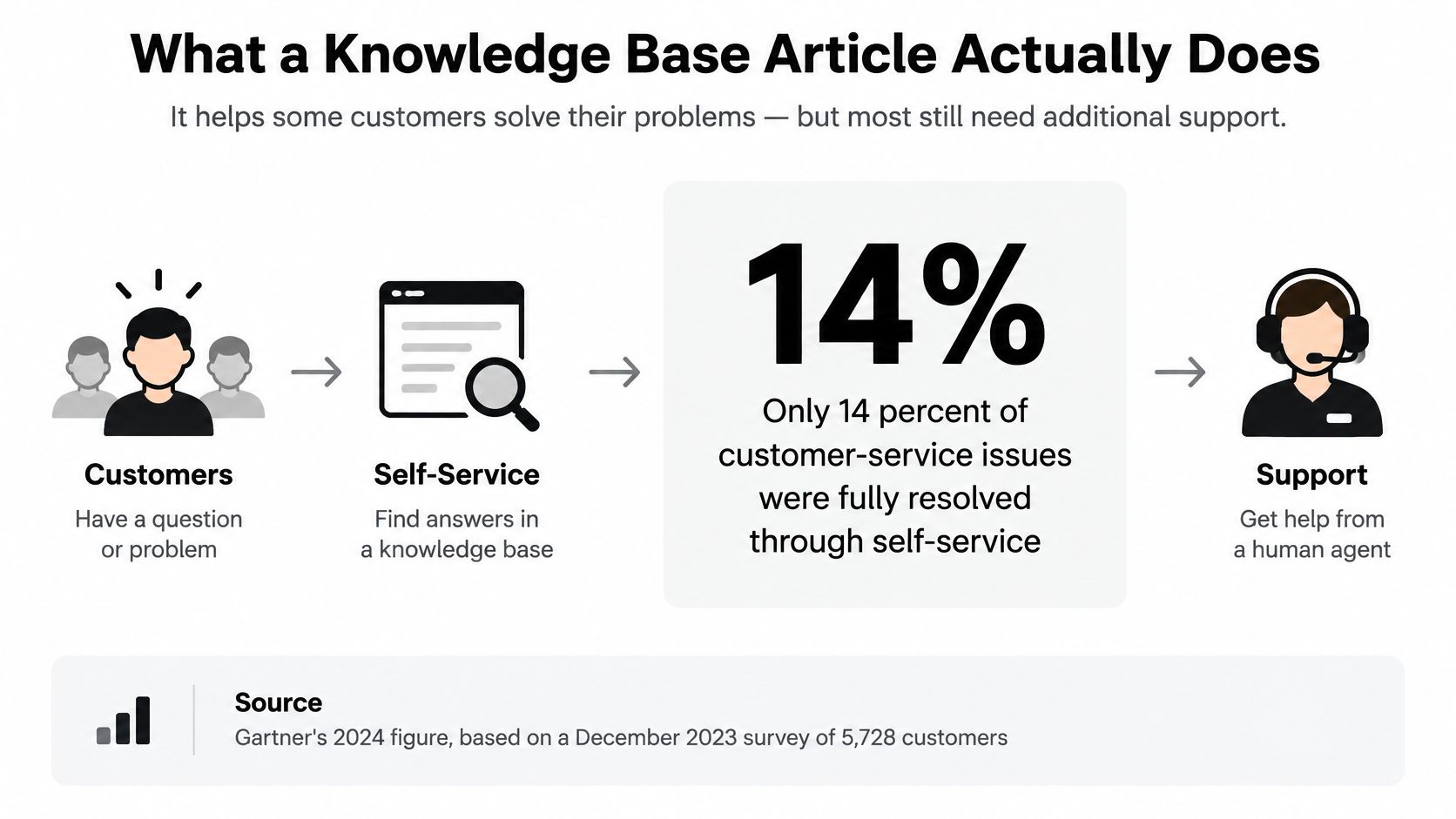
An answer that stands on its own
A knowledge base article is a published answer to a specific customer question, tied to a product or process. It contains enough context for a person to complete the task and for an assistant to retrieve the relevant passage without changing its meaning.
That's different from a mixed FAQ page, which groups unrelated questions together. A saved chat transcript contains conversational detours and customer-specific assumptions. A policy buried in a PDF may contain the authoritative rule but leave the practical next step unclear.
A public collection such as the customer help center gives those individual answers a predictable home. The useful unit is still the article, not the collection around it.
A published page isn't a completed support task. The customer needs a usable answer and a clear stopping point.
Willingness isn't resolution
In 2024, 91% of customers were willing to try online support options first when information bases were user-friendly and provided the needed information, according to an AmDocs study cited by ServiceNow's help-desk statistics. That measures willingness, not successful resolution, so it shouldn't be treated as the opposite of Gartner's result.
For a small support team, the practical question is whether an article removes uncertainty. Does the customer know whether it applies? Can the customer recognize success? If it fails, is the next action obvious?
The success test is simple: the customer finishes the task or knows exactly when to ask a person.
The Parts Every Knowledge Base Article Needs
Parts of a knowledge base article
| Part | What to include | Why it matters |
|---|---|---|
| Title | The customer's question in everyday words | Matches search and chat phrasing |
| Scope line | Product, version or plan, and when it applies | Stops the wrong procedure from being quoted |
| Prerequisites | Account, permission or tool needed first | Keeps setup out of the task steps |
| Numbered steps | One action per step plus the expected result | Gives a sequence a person or AI can follow |
| Failure states | What wrong looks like and the next check | Prevents a half-finished answer |
| Verification | How the customer knows it worked | Closes the task instead of looping |
| Escalation | When to contact a person and what to send | Hands off with useful context |
| Metadata | Owner, last verified date, effective date, related articles | Shows who stands behind the answer |
The writer can copy this table into a draft before composing polished sentences. An empty cell usually reveals a missing product decision or an unanswered support question.
Separate eligibility from action
Prerequisites describe what must already be true. Access to the account email, permission to manage billing, or possession of a recovery code belongs before the procedure, not halfway through it.
Scope answers a different question: whether this procedure belongs to this customer's situation. A concrete scope line might read:
Applies to the current web application for accounts using email-and-password sign-in. Employer-managed sign-in and mobile-only accounts aren't covered.
A product version belongs in that line when different versions behave differently. A plan restriction belongs there when the customer might otherwise follow instructions for a feature the account doesn't include.
Password reset and two-factor authentication setup should remain separate articles. Customers may mention both during a conversation, but completing either task requires different prerequisites and verification.
Describe failure as carefully as success
Writers often explain the expected path and omit the screen that customers ask about. A reset email that never arrives needs an explicit branch: check spam, confirm the address entered, and identify whether the account uses an older address.
That branch also needs a boundary. An article shouldn't instruct a customer to keep requesting emails when the customer can no longer access the destination inbox.
Verification must be observable. A confirmation message, a visible connection status, or successful sign-in is more useful than a vague statement that the process is complete.
- Failure state: Describe the symptom the customer can recognize.
- Next check: Give an action that distinguishes likely causes.
- Stopping condition: State when further attempts won't help and a person should take over.
Metadata makes the answer accountable. The visible owner can be a responsible team rather than an individual's personal contact details. Last verified means someone tested the answer; effective date means the policy or behavior started applying.
Related terms can capture everyday alternatives, while the procedure uses the product's official label consistently. Related articles should support the surrounding task rather than distract from it.
Every row should be complete before sentence polishing begins. Missing scope and verification dates can make otherwise similar articles impossible to distinguish safely.
How to Write One Customer Intent
A password article can easily become an account-security manual. The writer starts with resetting a forgotten password, adds changing a known password, includes two-factor setup, and finishes with account recovery.
The resulting page answers several questions incompletely. A narrower article, titled Reset a forgotten password, gives the writer a clear boundary.
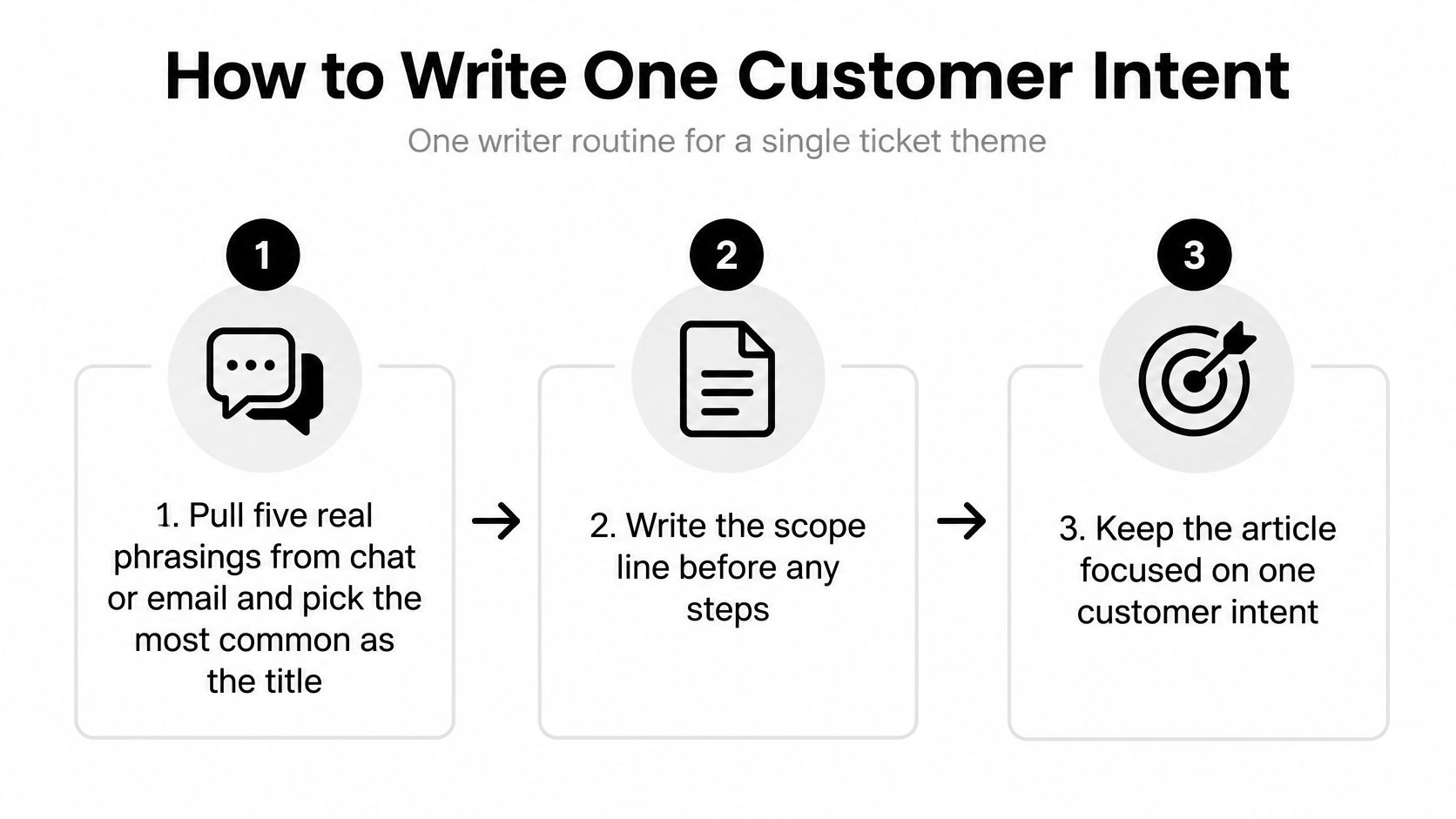
A repeatable drafting routine
Collect customer phrasing. Pull a small sample of real chat and email questions about forgotten passwords. Choose the recurring wording that describes the task, removing personal details and conversational filler.
Write the scope before the procedure. State which sign-in method the instructions cover. Explicitly exclude employer-managed sign-in if an administrator controls that process.
List what the customer needs. Access to the registered email address is a prerequisite. Knowing an existing password isn't, so the article shouldn't accidentally require it.
Draft in action order. Start at the sign-in screen, identify the reset control, and describe the resulting screen. Each numbered instruction should contain an action that the customer can perform immediately.
Handle the likely interruption. If the email doesn't arrive, give checks that match the actual product behavior. Don't suggest a recovery option that the application doesn't provide.
Define visible completion. Successful sign-in with the new password is stronger evidence than merely submitting the reset form. The article should distinguish a request received from a password successfully changed.
Limit escalation to uncovered cases. Loss of access to the registered inbox may require human help. Specify safe information to attach, such as the account email and the exact error message, never a password or reset token.
Read aloud and remove the neighboring task. A sentence explaining how to enable two-factor authentication belongs elsewhere. A short reference to the appropriate next article is enough.
Make the draft easy to test
The bad combined article might be titled Passwords, security, and account access. The focused replacement answers only forgotten-password recovery; changing a known password and setting up two-factor authentication receive their own destinations.
Headings should describe recognizable questions at a consistent level. Instructions need short sentences, exact interface labels, and a product name spelled the same way throughout.
Screenshots need matching scope too. A screenshot from an older interface shouldn't sit beside instructions for the current application, and its caption should identify the version represented.
Draft check: A colleague who doesn't own the feature should be able to complete the task using only the article.
That colleague should record each point where an assumption was necessary. Those notes reveal missing instructions more reliably than another round of stylistic editing.
How Customers and AI Find the Right Article
Customers search for outcomes, not internal feature names. Someone seeking a receipt may type a question about proof of payment rather than the label assigned to the invoice-download control.
For each article, the writer should collect the official term, everyday synonyms, a recurring misspelling when relevant, and the question form used in chat. These belong in natural explanatory text or a related-terms field, not a repetitive block of keywords.
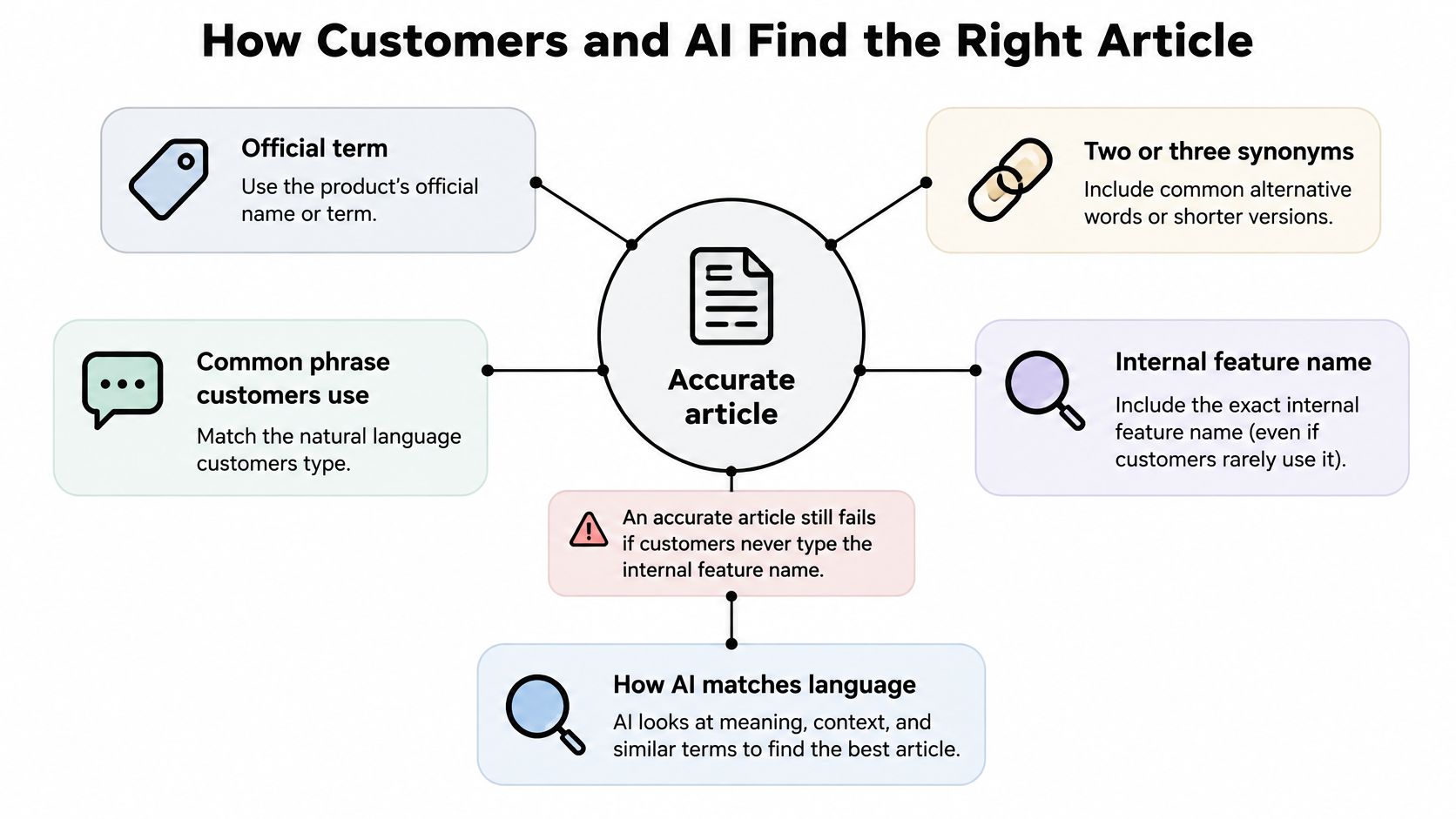
Resolve overlap before adding content
When search returns several plausible articles for the same job, the editor should merge duplicate answers or distinguish their conditions explicitly. Separate web and mobile procedures can remain separate when their scope lines direct customers to the right destination.
A systematic review of software-documentation research identifies inconsistency, incompleteness, missing change information, and lack of traceability among recurring maintenance problems. For retrieval, the practical response is stable headings, explicit conditions, and consistent terminology.
The same preparation matters for a knowledge base chatbot: retrieval needs clearly distinguishable passages, not competing copies of similar advice. SemDash's practical answer engine optimization strategies provide an adjacent resource for teams considering how answer engines discover and present content.
Related links should cover the preceding prerequisite or the next task. A large directory of loosely connected pages makes the customer perform the sorting again.
Read signals at article level
Metric readings for article-level signals
| Signal | Likely cause | Fix |
|---|---|---|
| Low search-to-click rate | Title or synonyms miss customer wording | Rewrite the title and add a synonym line |
| High no-result rate | Missing intent or coverage gap | Publish the missing article or merge into an existing one |
| High clicks with repeat contacts | Steps are unclear or incomplete | Rewrite the steps and add a failure state |
| Low helpful votes for one intent | Article answers a neighboring question | Narrow the scope or move the topic |
| Deflection followed by escalation | No visible verification or escalation trigger | Add a visible check and an escalation criterion |
These are diagnostic clues, not proof of a single cause. The support lead should inspect the search phrase and subsequent conversation before deciding what to rewrite.
Helpful votes need the same context. Positive feedback on account setup says little about a refund article, so a site-wide average can hide a specific failure.
A short, findable article can serve customers better than a detailed page they never select. Before publication, the writer should answer:
- Customer wording: What would someone type without knowing the feature name?
- Topic ownership: Which neighboring article should lose this topic so the answer has a clear home?
How to Prove an Answer Is Still Correct
A 2024 empirical study of software documentation defects found that 59% of reported problems involved incorrect command syntax, product or platform information that no longer matched current software versions, or incorrect execution steps, according to the software-documentation defect study. These are exactly the kinds of procedural mistakes an assistant can repeat fluently.
The answer should therefore be treated as a versioned technical artifact. The team responsible for shipping the feature should own its behavioral accuracy, even when a writer manages wording and publication.
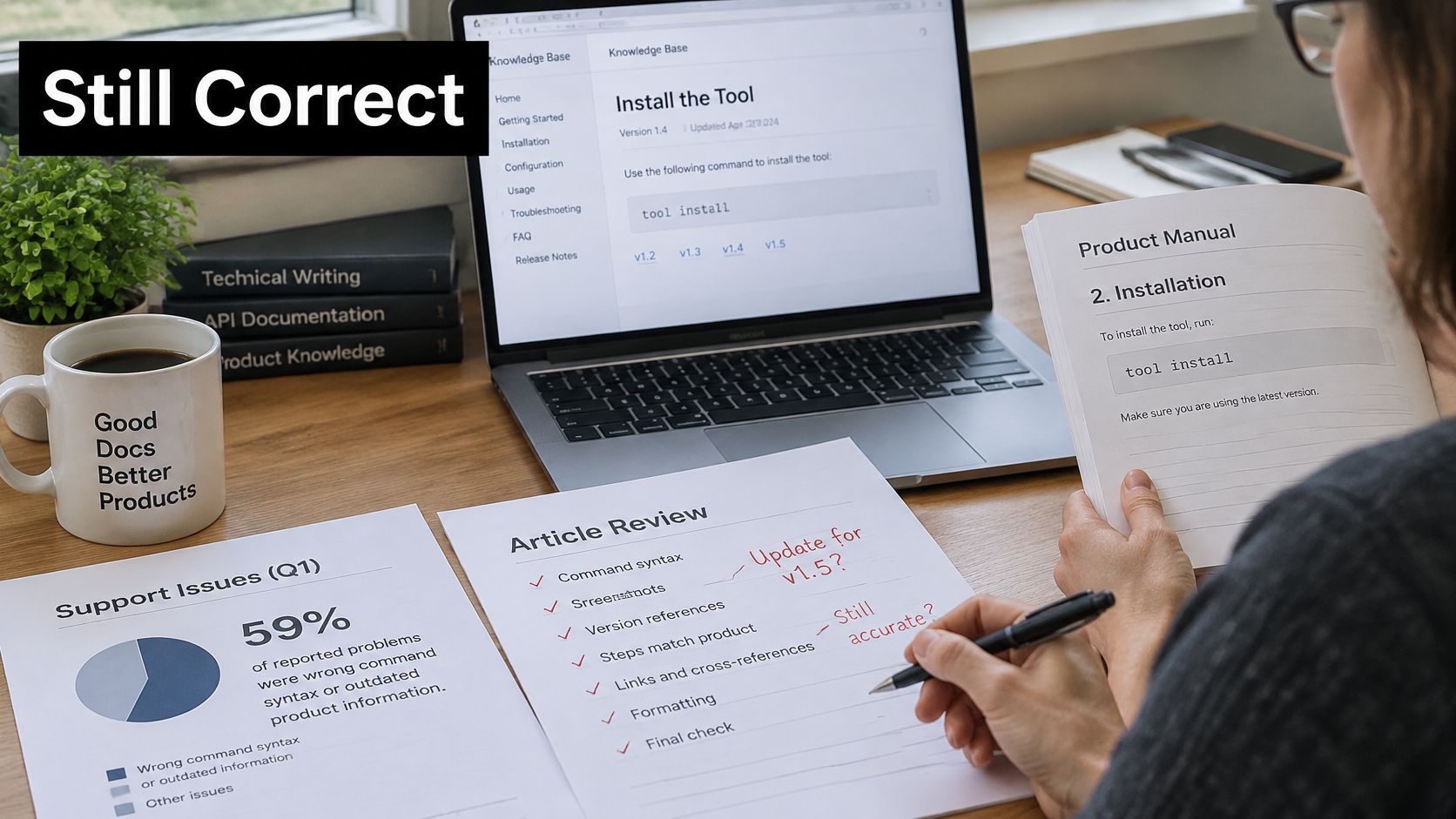
Review when the underlying answer changes
When to recheck a knowledge base article
| Trigger | Owner | What to retest |
|---|---|---|
| Product or configuration release | Feature team | Steps, screenshots and version scope |
| Price, refund or policy change | Named article owner | Effective date and conflicting articles |
| Failed searches or repeat contacts | Support lead | Title, synonyms and missing intent |
| Broken link, command or API name | Writer | Syntax and current field names |
The owner should execute the procedure against the applicable product environment, not merely reread it. A renamed button may be easy to fix, while a changed permission requirement can invalidate the entire sequence.
High-risk topics need a scheduled review as well as event-triggered checks. Refunds, security, eligibility, and operational limits deserve a deadline chosen by the responsible team according to the consequences of an incorrect answer.
If a review deadline passes, the article shouldn't retain a current-looking status. The team should flag it for revalidation, restrict automated use where possible, or withdraw it until the uncertainty is resolved.
Keep evidence separate from polish
Automated checks can detect dead links, mismatched terminology, schema changes, and some command errors. A person still needs to confirm that the described behavior occurs and that the customer has permission to perform the action.
A useful review record includes the tested product version, the reviewer's team, and the result. The public page should show the last-verified date and effective date, while internal notes can hold test evidence and the change history.
External answer checks can reveal discrepancies too. Teams using Kliqo AI to compare AI answers about competitors should treat the comparison as a way to identify claims worth checking, not as evidence that their own policy is correct.
Safety rule: An unanswered question is safer than a polished automated answer whose source has expired.
When source documents conflict, the owner must resolve the contradiction before approving a replacement. Choosing whichever paragraph sounds more confident isn't a review method.
An unanswered chat or an escalation should enter the documentation queue with the customer's wording and the failed step. That turns a support interruption into a concrete revision request rather than another unassigned reminder.
Two Articles Built From Real Questions
The following storefront scenarios show how a support team could turn recurring questions into bounded answers. Their interface details are illustrative, not claims about a particular retailer.
Where is the order
- Title and scope: Where is the order covers purchases completed through the storefront, excluding marketplace orders.
- Prerequisites: The customer needs the order-confirmation email and access to the associated account.
- Procedure: Open the account's Orders page. Select the matching order. Follow the tracking link when it appears.
- Failure state: If no tracking number appears, check the shipment status. The article must state the store's actual waiting rule rather than assume a standard delay.
- Verification: The carrier page opens and displays tracking information matching the order.
- Escalation: Contact support when the documented status condition requires help, including the order number but not payment-card details.
- Metadata: The fulfillment team owns the article and records verification and effective dates.
Safe quotation: Tracking is available through the link on the order details page when a tracking number has been assigned.
Unsupported invention: The order will arrive tomorrow. Nothing in the example establishes a delivery date.
How to download a receipt
- Title and scope: How to download a receipt covers card payments shown on the web billing page.
- Prerequisites: The customer needs access to the account with billing permission.
- Procedure: Open Billing. Select the relevant invoice row. Choose the receipt download control.
- Failure state: If the payment is older than the visible list, follow the documented route for historical receipts.
- Verification: The downloaded receipt shows the intended transaction.
- Escalation: Send the billing team the transaction reference when the receipt remains unavailable. The related article is the refund procedure, not refund rules embedded in the download instructions.
- Metadata: The billing team owns the answer and maintains its validation record.
Safe quotation: Receipts for listed card payments can be downloaded from the corresponding invoice row.
Unsupported invention: Downloading the receipt makes the purchase eligible for a refund.
A question spanning shipment status and proof of payment should receive both article titles, not a merged essay. For teams connecting structured content to retrieval systems, AI-ready knowledge engineering by devPulse offers an implementation-oriented companion.
The next useful exercise is to reshape a live ticket into this format before commissioning a library.
Publish Where the Answer Stays Current
The authoritative article belongs in the help center customers already search. A slide deck, private chat note, or copied attachment may help someone temporarily, but those copies are difficult to keep aligned.
Publication also requires a clear decision about obsolete material. An old procedure should be redirected to its replacement or labeled as applying only to a supported older version, rather than left competing with the current answer.
A final publishing check
- Intent: The article resolves a specific customer task without absorbing a neighboring procedure.
- Scope and currency: Customers can see where the instructions apply and when someone last verified them.
- Customer language: The title matches the question a customer would ask.
SignalZen's Knowledge Base publishes a help center that customers read and that the AI answers from; its articles also feed the support team in the same chat widget. The Help Center is server-side rendered for search-engine indexing, previews results as visitors type, and can present navigation, search, and articles in the visitor's selected language.
The Help Center feature guide provides the publishing reference. The support lead can begin with repeated questions from recent conversations and add categories only when the material needs them.
A practical first assignment is a forgotten-password article based on an unresolved ticket. The writer completes the required parts, obtains the feature owner's approval, records validation, and publishes that answer before drafting a batch.
SignalZen offers knowledge base publishing and AI Support that answers from a business's help center, website, files, and instructions. Visit SignalZen to give customers and the support team a shared source for answers, with human handoff when a question needs personal attention.



Better support without a bigger support team.
Start with AI. Add your team when the conversation needs a person.