
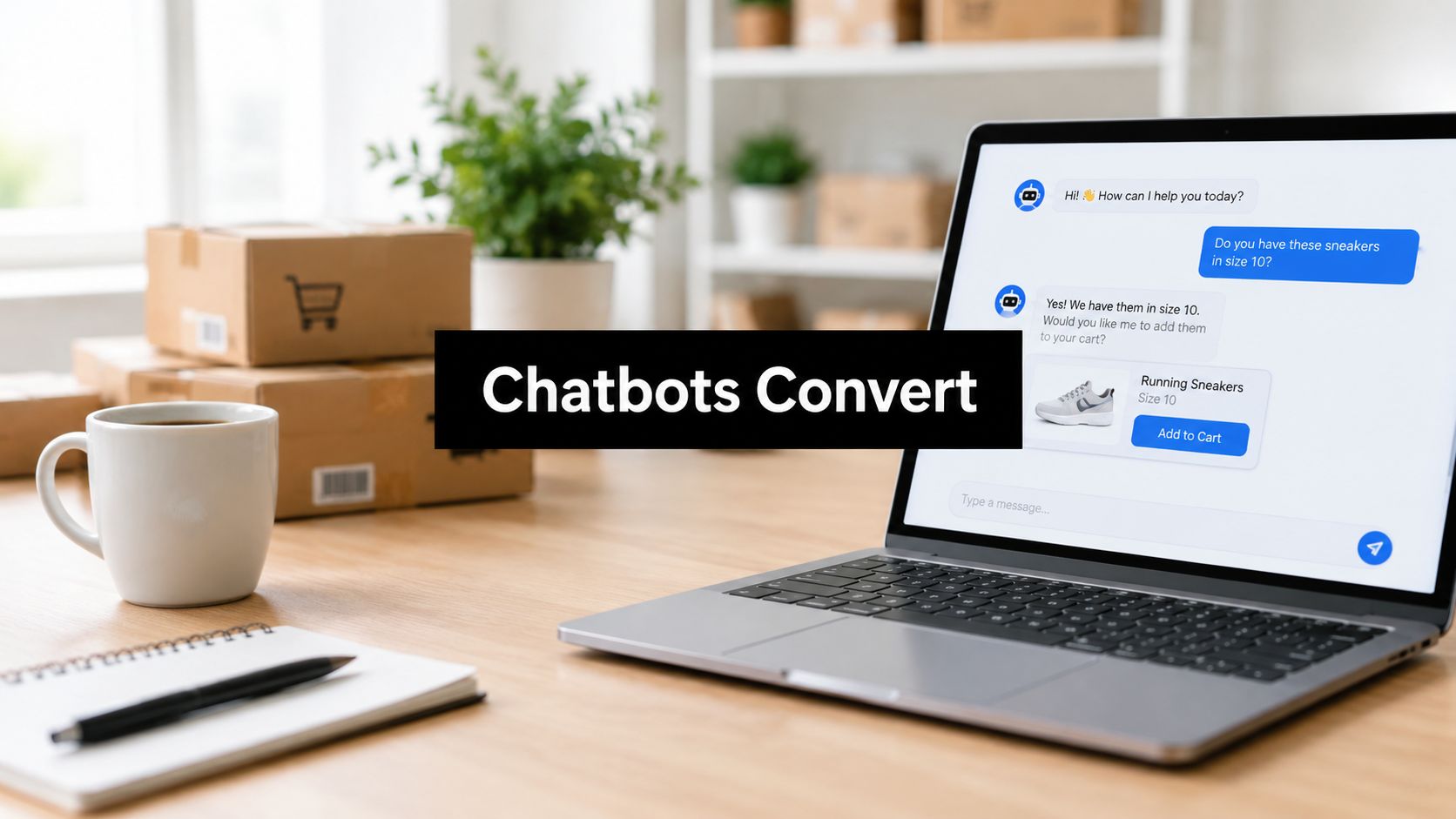
At 11 p.m., the store owner is still answering the same message for the third time, “Where's my order?” The buyer doesn't care that the shipping carrier updated late, or that the weekend shift is short-handed. They want a clean answer, and if they don't get one, they'll buy somewhere else next time.
That's why chatbots for ecommerce shouldn't be treated like a shiny FAQ widget. They work best as a triage and recoverability layer, the thing that catches routine questions, gathers context, and hands off the messy cases before frustration turns into a lost customer. For store teams trying to tighten customer communication, a practical starting point is a broader customer communication strategy for eCommerce, because the bot only works when it fits the rest of the service experience.
The right question isn't “How many messages can the bot handle?” It's “How many buyers did it help move forward, and how many bad moments did it save from getting worse?” That distinction is what separates a helpful storefront assistant from a costly automation layer that creates more tickets than it removes.
Table of Contents
- The 11pm Order-Tracking Message That Changes Everything
- What Ecommerce Chatbots Actually Do Under the Hood
- Three Job Flows Every Storefront Bot Must Handle
- Retrieval Bots, Intent Classifiers, and Agent Frameworks Compared
- Measuring What Matters After Launch
- Integrating the Bot With Your Storefront, Helpdesk, and Team Tools
- Where Chatbots Quietly Fail and How to Prevent It
- Your Operating Principle for Choosing and Running an Ecommerce Bot
The 11pm Order-Tracking Message That Changes Everything
The most common ecommerce bot win is unglamorous. A shopper sends a Friday-night order lookup, gets a clean update, and does not turn a refund request into a chargeback dispute. That is recoverability in practice.
Early retail bots were simple decision trees, and they still work for predictable questions like order tracking, return-policy lookups, and store hours. Those are the interactions that repeat all day, every day. The history matters too, because conversational systems did not begin with ecommerce. They trace back to ELIZA, built between 1964 and 1966 (ProQuantic).
For store teams trying to tighten customer communication, a practical starting point is a broader customer communication strategy for eCommerce, because the bot works best when it fits the rest of the service experience.
What the bot is really there to do
A solid ecommerce bot does not replace support. It handles the first pass, answers simple questions from verified information, and sends a shopper to a human when the situation gets messy. That is where the value shows up, in recovered sales, fewer abandoned purchases, and faster containment of complaints.
Practical rule: if the bot cannot answer from first-party information, it should stop and hand off.
The strongest deployments focus on a few jobs that decide whether a shopper stays calm or bails out. They also measure by intent, not chat count. A bot that resolves the order lookup at 11 p.m. and routes the edge case cleanly is doing more than collecting messages.
What Ecommerce Chatbots Actually Do Under the Hood
Three layers, three different levels of risk
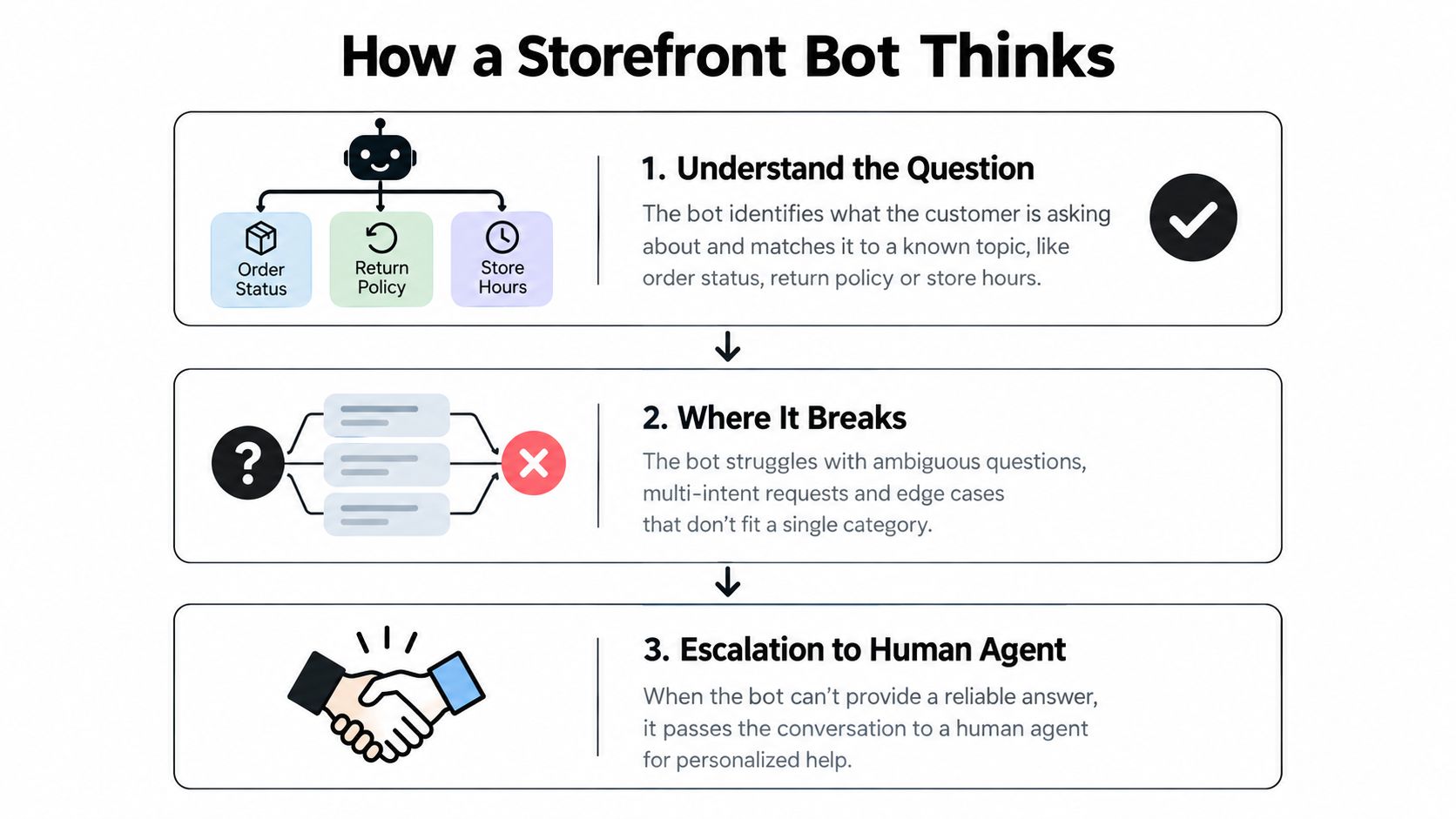
The simplest architecture is the rule-based bot. It follows decision trees, recognizes a narrow set of prompts, and answers the questions it was explicitly wired for. That's still useful for predictable requests, but it breaks down fast when a buyer asks two things at once, uses unusual wording, or needs a policy exception.
A more modern option is the retrieval-grounded bot. Instead of trying to “know” everything, it pulls from the retailer's own catalog, help center, shipping policy, and return rules. That is much closer to how a good floor associate works, because the bot is responding from the store's own facts instead of improvising from memory.
Then there's the agent-style flow, which can do more than answer. It can query inventory, draft a return label, or update an order, depending on how much system access the retailer gives it. That power is useful, but it also introduces more failure modes, especially when a bot is allowed to act before the data is checked.
How to tell what a vendor is selling
A vendor's pitch usually sounds similar, so the difference shows up in the control layer.
- Decision-tree bots are easiest to control, but narrow in scope.
- Retrieval bots are better for catalog accuracy and policy consistency.
- Agent frameworks promise more automation, but they need guardrails, logs, and approvals for anything high impact.
A retailer evaluating these tools should ask where the answer comes from, what happens when the bot is wrong, and whether the system keeps an audit trail. A polished demo can hide weak controls, but weak controls show up later as bad promises, bad refunds, and support escalations that have to be cleaned up by hand.
Three Job Flows Every Storefront Bot Must Handle
Pre-sales isn't a FAQ page with better wording
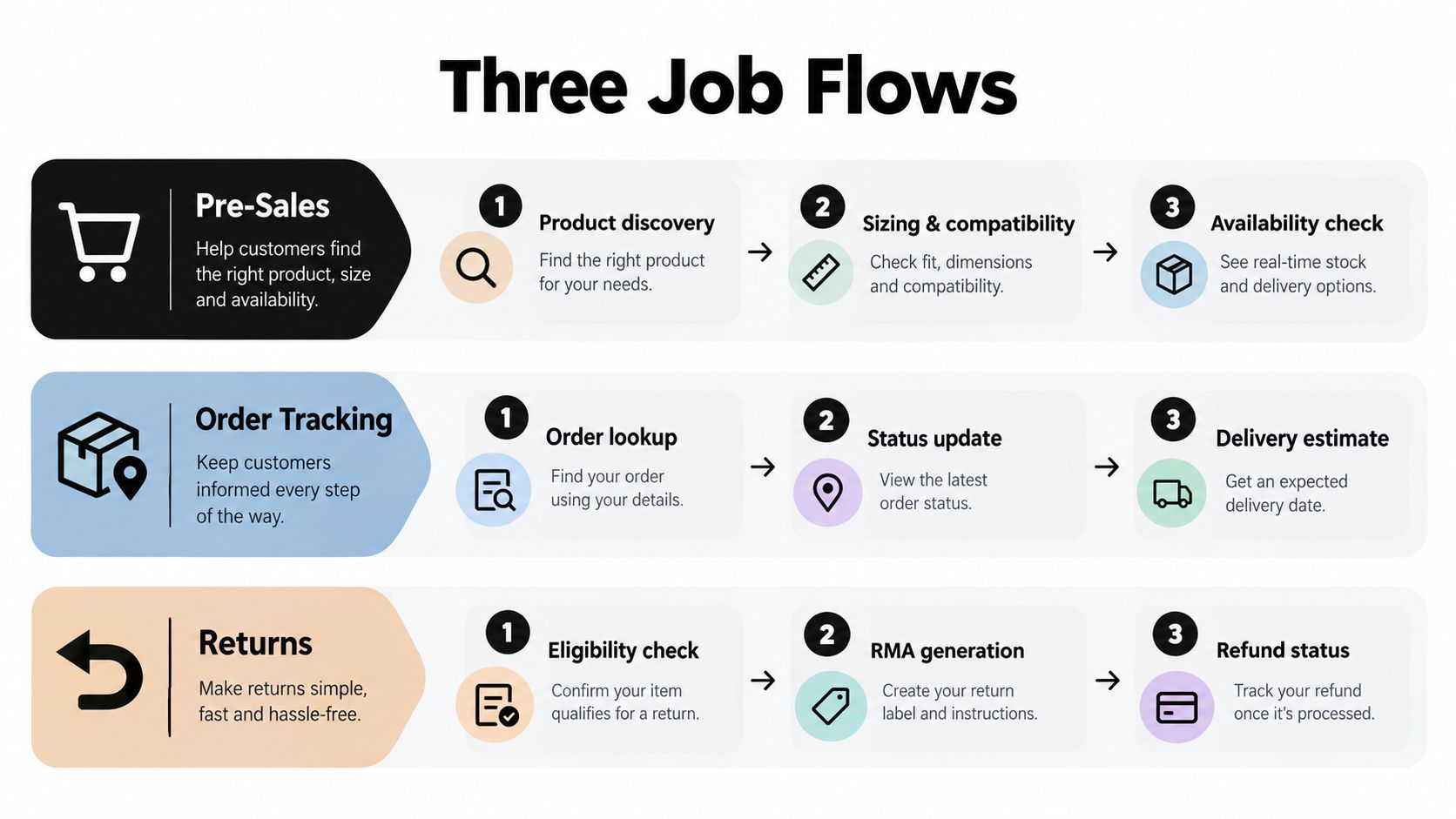
A shopper asks whether a trail shoe runs narrow, another wants a quick comparison between two models, and a third needs help choosing the right size for wide feet. Those are pre-sales jobs, and they are where a bot either reduces friction or creates it.
The bot should work from structured product data, not just marketing copy. Product discovery belongs here, too, because a conversational filter can narrow options by use case, fit, budget, or other constraints faster than a static page can. A running-shoe store, for example, needs the bot to understand width, terrain, and size availability, then hand off when the customer moves into a custom exchange or another exception the bot should not guess at.
Order tracking needs live state, not canned reassurance
Tracking only works when the bot can see the current order status, not just the help article that says shipping usually takes a few days. If the carrier has already marked a package delayed, the response needs to be specific and calm. A vague “your order is on the way” message after the parcel stalls causes more frustration than admitting the delay.
The bot should escalate when the status is unclear, the package has multiple exceptions, or the customer asks about compensation. A practical reference for broader support workflow design is the customer service in ecommerce guide, because tracking is only one part of the full support flow.
Returns are a process, not a sentence
Returns work best when the bot treats eligibility, label creation, and refund status as separate steps. A shopper asking whether an item can be returned may not need a human. A shopper asking for an exception after missing the window often does.
That separation is where automation pays off. The bot can collect the order number, check policy fit, and prepare the case, then a human can decide on exceptions. If the issue involves damaged goods, billing disputes, or an order override, the handoff should happen before the bot makes any promise it cannot keep.
Retrieval Bots, Intent Classifiers, and Agent Frameworks Compared
The market usually offers three broad architectures, and the wrong one can look fine in a demo while failing in production. A retailer with a stable catalog and a solid help center often does well with retrieval grounding. A store with a narrow set of repetitive questions may prefer intent classification. A team that wants deeper automation may look at agent frameworks, as long as it accepts more complexity and more review.
For a technical background on retrieval-driven systems, the retrieval augmented generation guide is useful because it explains why source grounding matters so much when a bot answers from company content.
| Architecture | Best fit for | Where it struggles | Maintenance burden |
|---|---|---|---|
| Retrieval-grounded bot | Stores with catalog depth and well-kept policy content | Missing source data, stale pages, conflicting policy text | Moderate |
| Intent-classifier bot | High-volume stores with a small set of repeat questions | Multi-step questions, edge cases, free-form phrasing | Lower at first, higher as intent count grows |
| Agent framework | Teams that want order actions, workflow automation, or deeper backend tasks | Refunds, exceptions, and any high-risk commitment | Highest |
The real trade-off is control
Retrieval systems are usually the safest fit for SMB retailers because the answer can be traced back to a product page, policy page, or help-center article. Intent classifiers are useful when the support load is dominated by repeat intents and the business doesn't need much flexibility. Agent frameworks can do more, but every additional action creates another place where the bot can be wrong.
The most important vendor questions are simple. Where did the answer come from, how fresh was the source, what happens when confidence is low, and can a human review the result before money moves? That's the difference between a bot that helps the store and a bot that creates rework.
For teams comparing support stacks, a guide to ChatGPT for customer support can also help separate conversational tools that draft answers from systems that resolve service work.
Measuring What Matters After Launch
The default dashboard in most platforms puts response time and deflection rate front and center. Those numbers help, but they can also hide a bot that answers quickly and still sends shoppers in the wrong direction. Fast is only useful if the answer is right.
Measure by intent, not by chat count
Break reporting into product questions, shipping estimates, returns, and complaints. A bot that handles product discovery well but falls apart on returns should not be flattened into one blended score. What matters is whether each intent is resolved cleanly, with the right next step for the shopper.
As noted earlier, shoppers often prefer bot-based help for simple questions and quick answers. That preference only lasts when the interaction is accurate, clear, and worth trusting. Once the bot starts guessing, speed stops mattering.
The metrics that catch bad handoffs
A weak escalation can do as much harm as a weak answer. If the human agent gets no context, the shopper repeats the issue, the queue slows down, and the handoff feels broken. Track post-handoff resolution time and post-chat satisfaction to see whether the transfer helped.
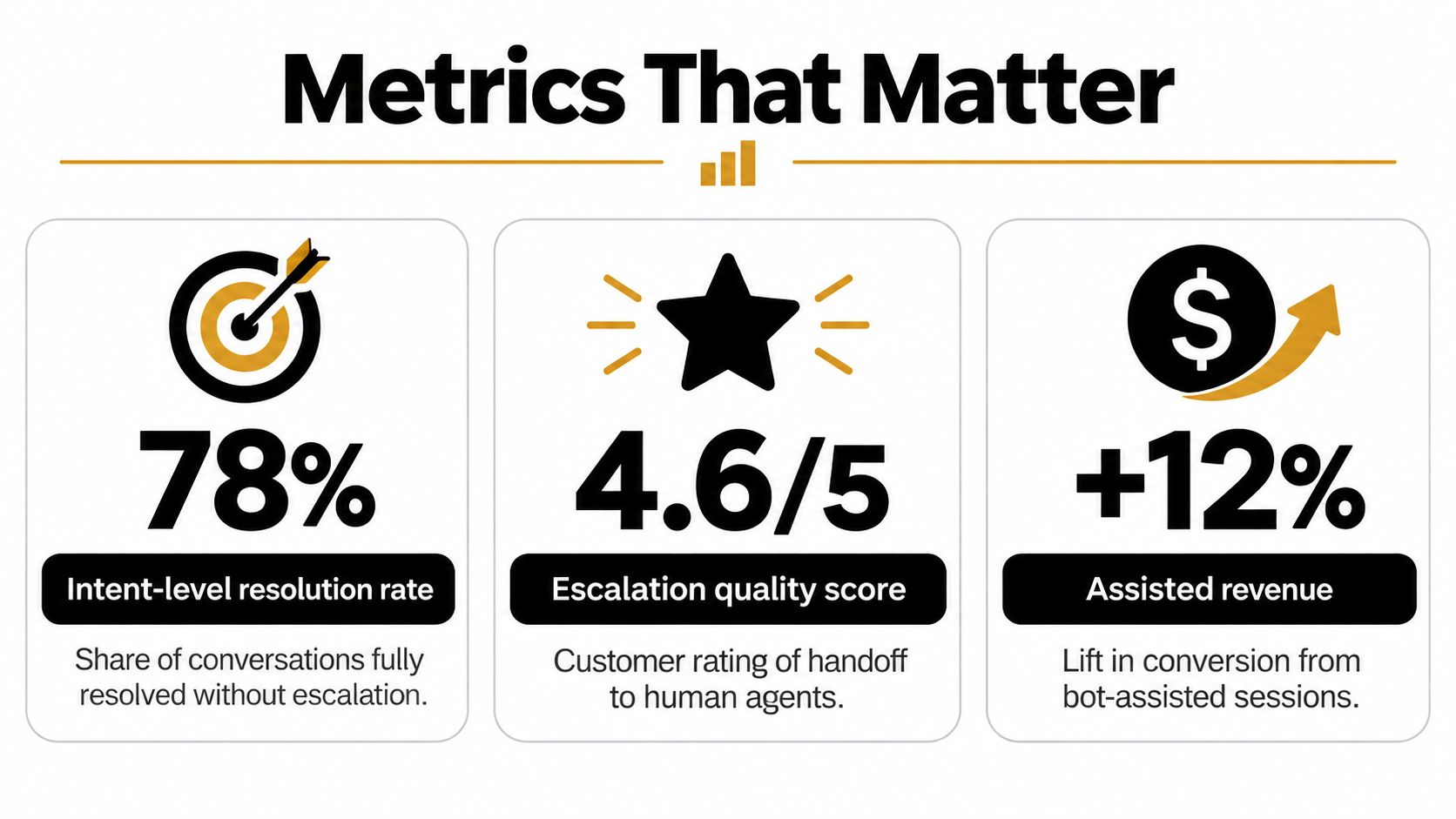
A compact view usually works best:
- Intent-level resolution, to show what the bot finishes on its own.
- Escalation quality, to check whether the agent receives useful context.
- Assisted revenue, to see whether bot-led sessions support conversion.
- Fallback rate, to spot where the bot is guessing instead of answering.
The goal is not a bigger chat count. It is a clearer read on which conversations the bot can close, which ones need a human sooner, and where the rescue path is still too slow.
Integrating the Bot With Your Storefront, Helpdesk, and Team Tools

Start with knowledge, then connect systems
The first integration job is usually the least glamorous: make sure the bot reads from the right source material. That means website pages, help-center articles, shipping rules, return policies, and product feeds need to be synchronized before the bot goes live. If the underlying content is stale, the bot will confidently repeat stale answers.
The second step is live data. Order status, inventory, and return eligibility should come from connected systems, not from scraped pages or old exports. That's where APIs or middleware matter, because the bot can't keep shoppers informed if it can't see the current state of the order.
Keep the human team in the same workflow
The third step is handoff. When a shopper needs a person, the case should land in the same workspace the team already uses, with the conversation history and order context preserved. A broken handoff is where a lot of chatbot projects fail, because the customer has to restate the problem and the agent starts from zero.
For teams that live in Zendesk, the help for Zendesk resource is useful for understanding how support systems can stay connected without turning routing into a mess. Similar thinking applies to internal chat tools, too. The support team should see exactly what the bot saw and what the shopper already tried.
A practical integration checklist looks like this:
- Source coverage, so the bot knows which pages and files it can trust.
- Sync frequency, so product and policy changes reach the bot quickly.
- Fallback handling, so uncertain answers route out instead of guessing.
- Notification behavior, so the right person gets the handoff at the right time.
For teams running support through collaboration tools, the Slack and Microsoft Teams live chat integration guide is a useful reference point for routing conversations without fragmenting ownership.
Where Chatbots Quietly Fail and How to Prevent It
A lot of ecommerce bot failures are not dramatic. They're small enough to miss in a weekly report, then expensive enough to matter when a customer complains publicly.
The stale return policy problem
A shopper asks about a return window, and the bot repeats yesterday's policy because the knowledge source hasn't been refreshed. The fix is simple in theory and essential in practice, source freshness checks plus visible citations inside the bot's response flow. If the answer is policy-driven, the system should know when that policy was last synced.
The translation drift problem
A policy answer gets translated into another language and changes meaning, usually around deadlines, exceptions, or refund language. Controlled translation with human review for high-impact commitments is the safer approach, especially when the bot is making promises about money or delivery.
The inventory mismatch problem
The overpowered refund problem
An agent layer with too much autonomy can issue a refund outside policy or approve an exception without review. Anything financial should be gated behind explicit human approval unless the business is fully comfortable with that risk. Automation is useful only when the approval path is as clear as the action path.
A bot should never be more confident than the data behind it.
The recoverability playbook
The fix for all of these is the same pattern: source freshness, language controls, inventory confidence checks, and approval gates for money movement. Retailers that treat the bot as a triage layer tend to recover faster because the system knows when to stop. Retailers that treat it like a salesperson usually learn about the failure only after trust is already gone.
Your Operating Principle for Choosing and Running an Ecommerce Bot
The best operating principle is simple. Deploy the bot as a triage and context-gathering layer, measure it by intent, and design handoff before designing autonomy. That keeps the system useful even when it isn't perfect, which is the only realistic standard for customer support automation.
Recoverability, first-party knowledge, and multilingual parity all belong in the same plan. A smaller bot with clear limits usually outperforms a larger one that improvises, because shoppers value accurate answers, clean escalation, and consistent policy language more than flashy automation.
The next three moves are straightforward. Write a one-page policy for what the bot will and won't do, choose the intent-level metrics that match the store's actual support load, and schedule a 30-day review focused on failure cases instead of wins.
SignalZen gives SMB retailers an AI support layer that answers from website content, files, and help-center material, with live chat and human handoff in Slack, Microsoft Teams, or Google Chat. If the goal is to run chatbots for ecommerce without losing control of support quality, visit SignalZen and see how it handles triage, escalation, and multilingual conversations in one workflow.


Better support without a bigger support team.
Start with AI. Add your team when the conversation needs a person.