

A customer finally gets a booking changed, but only after being transferred twice and repeating the same details three times. The support dashboard records a resolved case. The customer remembers an exhausting conversation.
That gap is where customer effort score becomes useful. For a support manager, it offers a way to investigate the work customers do between asking for help and getting a usable answer, including work that a resolution metric never captures.
Table of Contents
- What Customer Effort Score Measures
- How to Collect CES Right After Each Interaction
- Scoring Customer Effort Scores Correctly
- Reading CES Results Without Misleading Yourself
- Finding the Friction Behind a Low Score
- Low-Effort Journeys in Practice
- Start Your Next CES Test This Week
What Customer Effort Score Measures
Customer effort score (CES) measures how hard a customer had to work to accomplish a specific task. It usually comes from a single question asked after an interaction, rather than a broad assessment of the relationship.
In the booking scenario, nothing necessarily failed technically. Each agent may have been polite, and the final booking may be correct. The difficulty came from the process: finding the right person, explaining the request again, and checking whether the change had gone through.

Effort isn't the same as satisfaction
A customer can appreciate an agent and still find the experience difficult. Equally, a straightforward interaction can feel easy even when the company can't provide the outcome the customer wanted.
The main experience metrics separate those questions:
- CES asks about the work required to handle a particular issue.
- Customer satisfaction, or CSAT, asks how satisfied the customer felt.
- Net Promoter Score, or NPS, asks about willingness to recommend the company.
A commonly used CES agreement statement is “The company made it easy for me to handle my issue.” The response describes perceived ease, not the agent's friendliness or the customer's overall opinion of the business.
Why effort became a serious service metric
Matthew Dixon, Karen Freeman, and Nicholas Toman's 2010 Harvard Business Review study, described in this customer-experience overview, examined more than 75,000 business-to-consumer and business-to-business customers and found that reducing effort was more closely associated with loyalty behaviors than exceeding expectations.
The practical lesson isn't that thoughtful service has no value. It's that a pleasant conversation doesn't erase the burden of unnecessary steps. Support managers should investigate repeated explanations and difficult handoffs before adding gestures intended to impress customers.
Diagnostic principle: A resolved case shows that the task reached an endpoint. CES helps establish what reaching that endpoint cost the customer.
That makes CES most useful at the level of a specific journey. A company-wide score alone can't identify whether the booking form, routing rule, or agent handoff needs attention.
How to Collect CES Right After Each Interaction
A useful CES response needs a clear reference point. The customer should understand which conversation the question concerns, and the support team should be able to connect the answer to that conversation.
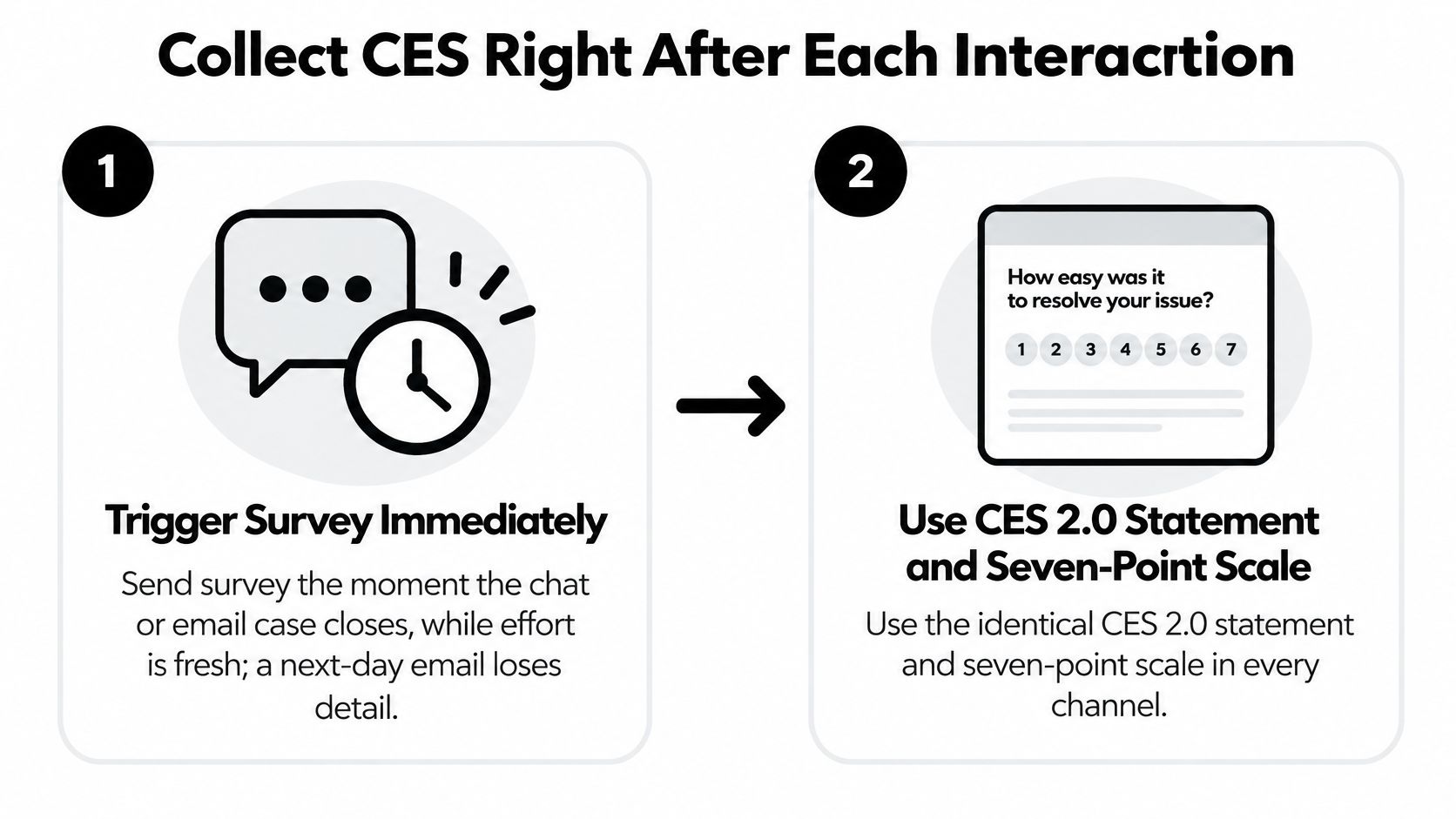
The SI-Labs customer effort score guide describes the commonly used CES 2.0 item as an agreement statement rated on a seven-point scale, and recommends connecting post-interaction feedback to workflow details rather than treating it as a standalone quality score.
Set up the collection path
- Trigger at case close. Send the prompt when the chat or email conversation closes, while the customer can still distinguish a difficult handoff from a difficult underlying problem. Closure should be recorded separately from confirmed resolution.
- Keep the measurement consistent. Use the same agreement statement and scale direction across channels. Translations should preserve meaning and agreement intensity, not mechanically copy English word order.
- Include an optional explanation. Ask the customer to describe what made the interaction easy or difficult. A rating identifies a case worth investigating; the explanation offers a starting point.
- Attach operational context. Store channel, language, issue type, automation or human involvement, transfer count, resolution status, and relevant timestamps with the response.
Survey timing also depends on the event being assessed. For retailers distinguishing purchase feedback from support feedback, Mayra's post purchase survey timing guide from Mayra - Order Edit & Cancel provides a useful companion resource. A purchase survey and a support survey shouldn't become interchangeable.
Check delivery, consent, and coverage
Before launch, the support manager should test both chat and email paths. Each test should confirm that the prompt displays properly, its labels remain readable on mobile, and the submitted answer attaches to the correct case.
Customers should receive a plain explanation of what information is collected and why, with participation optional. SignalZen asks for personal information only when needed to provide a service and collects it by fair and lawful means with the person's knowledge and consent. A feedback program should follow that same restrained approach rather than gathering unrelated personal details.
An early response audit should examine who isn't represented, not just what respondents say:
- Invitation coverage. Check whether all eligible case types receive the prompt.
- Response rate. Report completed responses relative to invitations delivered.
- Response imbalance. Compare respondents with the underlying case mix by channel, language, and issue type.
A survey that reaches only customers who remain in the chat window can miss those who left frustrated. No scoring formula repairs that collection problem.
Scoring Customer Effort Scores Correctly
How to report a CES result
| Scoring method | Response range | How to calculate | What it tells the team |
|---|---|---|---|
| CES 2.0 mean | 1, strongly disagree, to 7, strongly agree | Sum of all scores divided by number of responses | Average ease, useful for trend tracking |
| CES 2.0 top-3-box | Share choosing 5, 6, or 7 | Responses scoring 5 to 7 divided by all responses, multiplied by 100 | Share agreeing that the process was easy |
| High-effort share | Share choosing 1, 2, or 3 | Responses scoring 1 to 3 divided by all responses, multiplied by 100 | Share reporting difficulty that warrants journey review |
| Channel comparison | Same statement, split by channel | Compare top-3-box across chat and email, with AI-only journeys identified separately | Where reported friction sits, accounting for case volume |
The table operationalizes the agreement scale: higher means easier. The high-effort share is a defined review category, not a separate universal CES standard.
The survey statement remains “The company made it easy for me to handle my issue.” Keeping that wording attached to dashboard definitions prevents someone from interpreting a high score as high effort.
A worked calculation
Consider a hypothetical sample of 200 responses, with 140 selecting the top three agreement options. The calculation is 140 divided by 200, multiplied by 100, giving a 70% top-3-box result.
That result means the stated share of respondents agreed that the interaction was easy. It doesn't establish that the same share of all customers had an easy experience, because nonrespondents may differ.
The mean requires the actual rating values, not just the number of favorable answers. Two groups can have the same top-box share while differing in how strongly customers agree or how difficult the remaining customers found the interaction.
Choose a reporting view deliberately
The mean is convenient for tracking gradual movement on an operational dashboard. The top-3-box percentage is easier to explain in a management update because it expresses the proportion agreeing with the ease statement.
The high-effort share keeps difficult experiences visible. A stable average can hide movement at either end of the distribution, so the mean shouldn't be the only result shown.
A falling mean is a reason to inspect the underlying journeys, not a verdict on the support team.
Every report should name its method, period, response count, and included population. A mean and a favorable-response percentage aren't interchangeable, even when both appear under a dashboard label called CES.
Comparisons also require stable wording and collection conditions. Changing the survey statement during a workflow test makes it harder to tell whether customers experienced an improvement or answered a different question.
Reading CES Results Without Misleading Yourself
Low CES on a resolved case suggests that the customer reached an outcome through an unnecessarily difficult process. High CES with low satisfaction means something different: the interaction may have been easy, but the outcome or policy disappointed the customer.
Those interpretations follow the agreement scale. Confusing high ease with high effort can send a support manager toward the wrong fix.
How to read a CES pattern
| Pattern | What it signals | First step |
|---|---|---|
| Low CES on a resolved case | Process friction behind a resolved case | Trace handoffs and repeated questions |
| High CES with low satisfaction | Easy handling, but dissatisfaction with the outcome or another part of the experience | Inspect the outcome and comments before removing steps |
| High CES with high satisfaction | Easy handling and a positively rated experience, potentially including worthwhile work on a complex job | Preserve what works and verify that the journey was correctly classified |
Separate worthwhile work from avoidable friction
Effort isn't always wasted. A customer configuring a complex product may willingly spend time making decisions, while someone checking an order may reasonably expect a direct answer.
A study published in the International Journal of Market Research covering 314,194 interactions with 96 brands found that higher effort generally reduced satisfaction, but the relationship differed by industry, channel, and effort intensity. That finding doesn't support treating every demanding interaction as a service failure.
A hypothetical order-status conversation may feel easier than a successful technical setup session. Equal resolution rates wouldn't make those journeys equivalent, and their raw CES means wouldn't identify which team performed better.
Check whether the comparison deserves confidence
A meaningful review pairs CES with issue type, resolution status, transfers, and repeat contact. SignalZen's guide to customer service KPIs and metrics offers context for assessing an experience through more than an isolated survey result.
Reports should show sample sizes and confidence intervals. Small segments can fluctuate, and a narrow-looking dashboard line shouldn't imply certainty that the responses don't support.
Channel aggregation needs similar care. Weighting by case volume can address a mismatch in representation, but it doesn't automatically correct the tendency of certain customers to respond. The analyst should disclose that limitation.
Interpretation rule: Compare a journey with its own baseline and a deliberately chosen target, not an assumed universal benchmark.
CES can identify avoidable friction. It can't, on its own, prove retention, loyalty, or customer value.
Finding the Friction Behind a Low Score
Friction points behind low CES scores
| Friction point | Typical cause | First fix to test |
|---|---|---|
| Customer repeats the problem to an agent | Context lost at chat or email handoff | Pass the AI summary and relevant visitor details with the handoff |
| Customer answers the same questions twice | No shared case history across channels | Keep a connected conversation history across chat and email |
| Customer searches help content and gives up | Outdated or scattered articles | Consolidate articles and review unsuccessful searches |
| Customer waits for a reply out of hours | No useful initial response outside business hours | Automate common answers with clear escalation to a person |
| Customer is transferred between teams | Unclear routing rules | Define ownership by issue type and track transfers |
| Customer logs in again after a handoff | Verified session context isn't preserved | Retain verified identity where security policy permits |
| Customer's meaning is lost in another language | Inadequate translation or language coverage | Test two-way translation or language-matched routing |
A low score should lead to a case review, not an immediate automation project. The analyst should read the customer's explanation, reconstruct the event sequence, and identify where the customer had to supply work the company could reasonably have avoided.
The table offers testable explanations, not guaranteed diagnoses. Repeated authentication, for example, may reflect an intentional security control rather than an integration defect. The support manager should investigate the purpose before removing the step.
Prioritize a specific failure
A useful starting point is the most common avoidable problem within the selected journey. High volume matters, but severity also matters: an inaccessible recovery flow may deserve attention even if it affects fewer customers.
Each candidate fix needs an owner and a clear hypothesis. For example, preserving a handoff summary should reduce requests for customers to restate their issue. That hypothesis is more useful than a broad objective to improve the chatbot.
Fixes differ in scope:
- Content and routing changes. Updating an inaccurate article or assigning an issue category to the right team can be relatively contained.
- Context and identity changes. Preserving conversation history or verified session details may require engineering and security review.
- Language changes. Translation needs testing against actual customer terminology, especially product names and technical instructions.
Friction may also originate outside the support interface. A retailer investigating payment-related contacts might consult Sambapay's guide to choosing a contactless payment terminal when reviewing the purchasing workflow. Support wording won't repair an unsuitable checkout process.
Test the mechanism, not just the score
A controlled comparison is preferable when volume permits. Otherwise, the manager should hold the journey definition steady and record changes in staffing, demand, or issue complexity that could influence the result.
The test should change a clearly bounded part of the workflow. Updating documentation, routing, and handoff behavior simultaneously makes attribution difficult.
Evidence of improvement should agree across several observations: customers report greater ease, repeat contacts decrease, and comments stop describing the original obstacle. A shorter conversation isn't sufficient if the customer returns because the answer was incomplete.
SignalZen's guide to the customer feedback loop provides a useful framework for turning an identified problem into an owned change and checking the outcome. The essential discipline is closure: someone remains responsible until the team knows whether the intervention helped.
Low-Effort Journeys in Practice
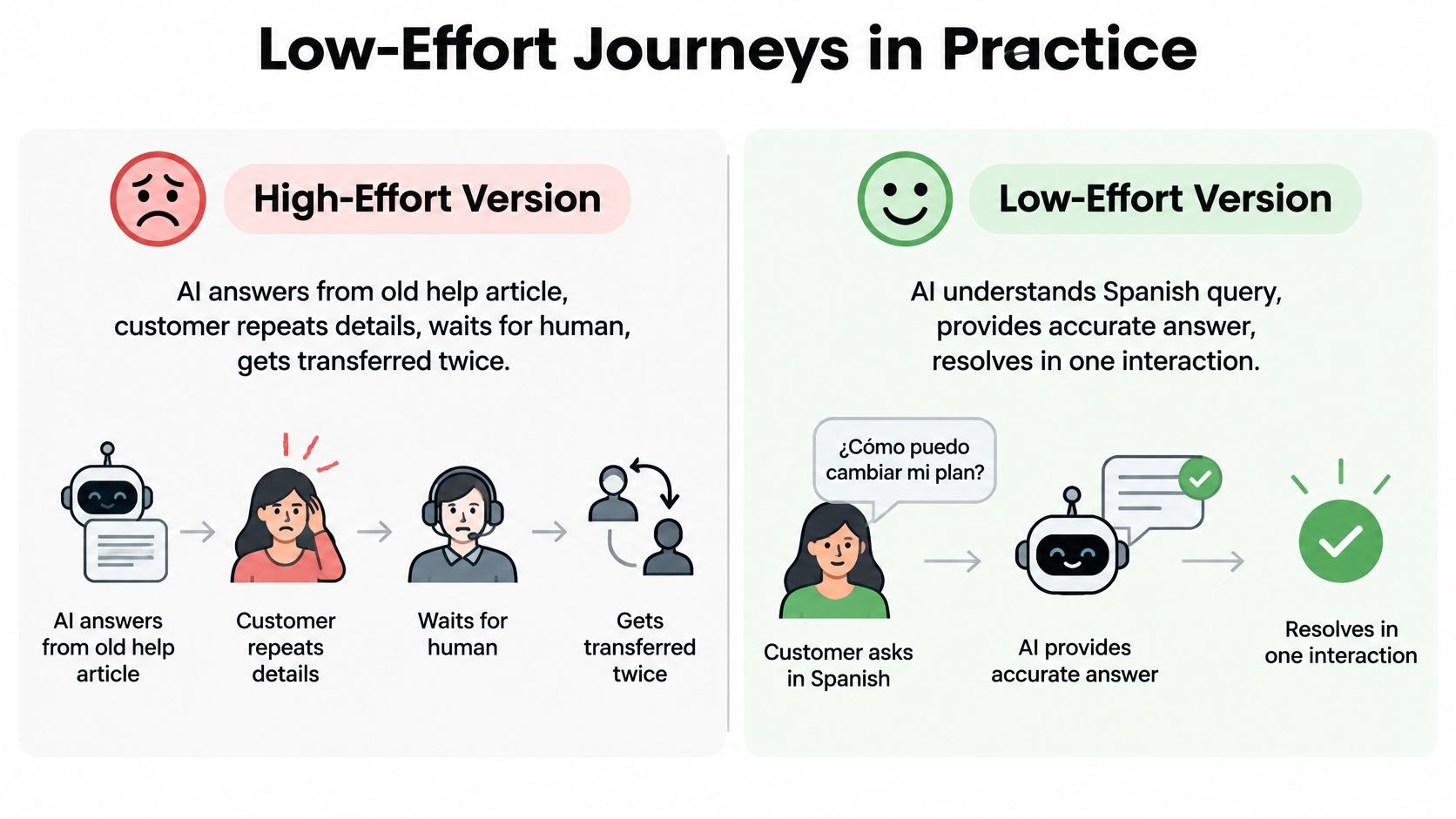
Consider a hypothetical Spanish-speaking customer who opens a website chat in the evening about a delayed order. The question is straightforward, but the customer can't tell whether the order is still moving or whether action is required.
In the high-effort version, the AI retrieves an outdated delivery article. When the customer asks for clarification, an agent takes over without a useful summary and asks for the order number again. An email follow-up then repeats the same article instead of addressing the delay.
The same request with preserved context
In the low-effort version, the AI uses the current delivery guidance and supplies the appropriate order-status link. When the situation needs a human decision, the handoff includes the order number already supplied, the customer's language, the explanation already given, and the unresolved question.
The agent can address the actual issue rather than restart discovery. When the conversation closes, the customer receives the same CES statement used for comparable order inquiries.
The difference isn't necessarily agent skill. An equally capable agent starts at a disadvantage when the system hides what the customer has already explained.
The event record should distinguish the mechanisms:
- Knowledge retrieval. Record which article version informed the answer.
- Handoff completeness. Record whether a summary and relevant details reached the agent.
- Repeated input. Identify requests for information already available.
- Follow-up outcome. Track whether the customer returned about the same unresolved delay.
When no human handoff is needed
A second hypothetical shopper asks whether a product fits a particular device. An accurate compatibility article supplies a direct answer, and the shopper can continue evaluating the purchase without waiting for an agent.
That journey needs a different review. The analyst should record the source used, whether the answer addressed the compatibility question, whether escalation was offered, and whether the customer needed further help. Absence of a human reply isn't itself evidence of success.
Both examples fit a broader approach to customer experience strategies: design around the customer's task rather than a preferred channel or automation target. The order inquiry depends on a complete handoff; the pre-sales inquiry depends on reliable knowledge.
A rating becomes actionable when those workflow differences remain visible in the case record.
Start Your Next CES Test This Week
A month-long pilot can establish a workable measurement routine without turning CES into a company-wide reporting project. The support manager should select a high-volume journey with a clear endpoint, such as order status or account changes.
A practical pilot sequence
- Opening week. Define the eligible journey, approve the survey wording, and check translated versions for equivalent meaning. Test delivery and case matching before collecting a baseline.
- Middle weeks. Gather responses without changing the workflow. Check that channel, language, resolution ownership, and transfers are recorded consistently.
- Final week. Introduce a bounded fix for a documented friction point. Continue collecting feedback under the same rules, extending the observation period if the sample remains too small.
The decision should use the favorable-response share and high-effort share, alongside repeat contacts and customer explanations. The manager should keep the change when those signals support an improvement, revert it if they indicate harm, and extend the test when the evidence is inconclusive.
SignalZen sends a service-rating request when a chat closes, and the business configures the rating screens itself. That close-of-conversation workflow offers a practical place to collect feedback tied to the interaction being assessed.
The pilot should end with an explicit decision and a named owner, not merely a dashboard update. Another friction point can follow once the team has established whether the first change helped.
SignalZen offers AI-powered support for small and medium businesses, with automated assistance, preserved context for human handoffs, and connected chat and email handling. Visit SignalZen to explore those workflows and plan a post-interaction rating setup around a specific customer journey.


Better support without a bigger support team.
Start with AI. Add your team when the conversation needs a person.