

A support inbox can look healthy while the same problem keeps returning. Scores are collected, chats are closed, and a dashboard moves up or down, yet nobody can point to who owned last month's top complaint, what changed because of it, or whether customers stopped coming back about it. That gap is where most feedback programs fail. A working customer feedback loop isn't more collection. It's an auditable chain from signal to owner to change to measured outcome, with deliberate effort to hear the silent middle of customers who never complain at all.
Table of Contents
- What a Customer Feedback Loop Is, With a Real Example
- Feedback Collection Methods Compared
- Hearing the Customers Who Never Complain
- Ranking Feedback So Teams Act on the Right Items
- Closing the Loop Fast Enough to Keep Customers
- Proving the Loop Changed Customer Outcomes
- Build Your First Loop This Quarter
What a Customer Feedback Loop Is, With a Real Example
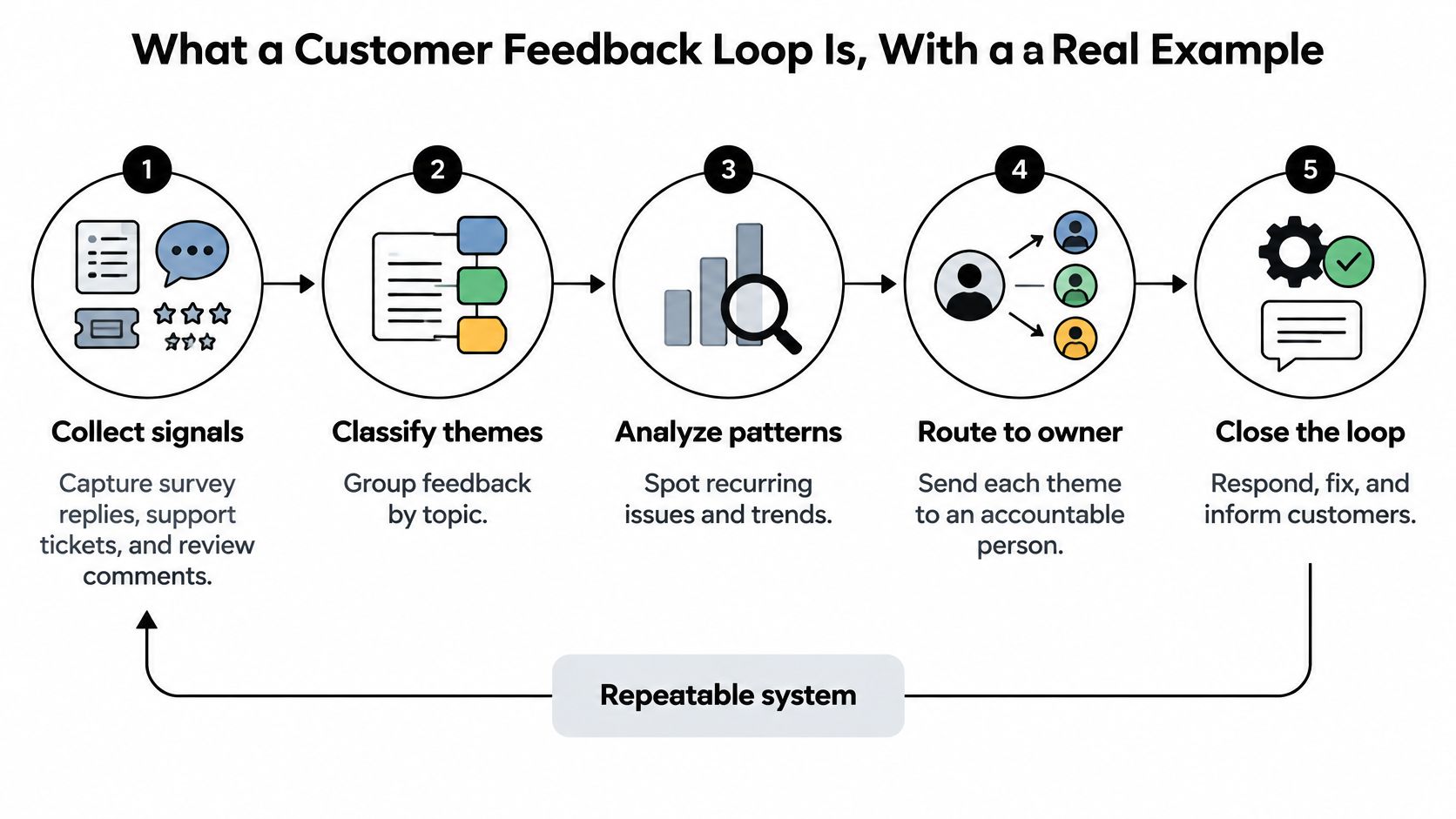
A customer feedback loop is a repeatable system that collects customer signals, classifies them, analyzes patterns, routes each theme to an accountable owner, implements a change, and tells the customer the result. Think of a thermostat. A sensor wired to nothing measures temperature without changing it, and feedback with no owner works the same way.
The Six Stages in Order
- Collect. Gather signals from surveys, chat and email transcripts, reviews, and usage data.
- Classify. Tag each item by issue, product area, segment, sentiment, and channel.
- Analyze. Find repeated patterns and compare them across the customer base.
- Assign an owner. Name one accountable person for each theme.
- Change something. Ship a fix, update knowledge-base content, or coach the agent.
- Tell the customer. Report the outcome to the people who raised the issue.
The same discipline applies outside support. Teams collecting client reviews for staging sites still need an owner who acts on each comment and confirms what changed, otherwise comments pile up as decoration.
What Toyota Changed When Rankings Slipped
Toyota built formal infrastructure rather than running isolated surveys. The Toyota history of its customer satisfaction improvement work reports that its U.S. Initial Quality Study ranking fell from first place in 1985 to fourth place in 1987. In response, Toyota established a company-wide Customer Satisfaction Improvement Committee in January 1989, with vehicle-quality and sales-and-service subcommittees in Japan and overseas linking customer-reported problems to design, production, sales, and service decisions.
That structure mattered more than the questionnaire itself. Structured data identified a gap, cross-functional owners took responsibility, corrective action followed, and customer outcomes were measured again.
Feedback creates value only when it's connected to accountable workflows and product or service changes, not when it's stored as conversation history.
Loops usually break in three places. Nobody owns the theme, the change never ships, or the customer never hears the outcome. Fix those three points before adding another survey tool.
Feedback Collection Methods Compared
No single method gives the full picture, so smart teams pair a structured score with an unstructured source that explains it.
| Method | Best For | Main Blind Spot | Typical Cadence |
|---|---|---|---|
| Post-interaction survey (CSAT) | Rating a single closed chat, call or ticket | Only reaches customers who finish and respond | Right after each closed conversation |
| Relationship survey (NPS) | Tracking loyalty trends over time | Gives a score without the reason behind it | Quarterly or twice a year |
| Support chat and email transcripts | Recurring issues in customers' own words | Reflects only customers who contacted you | Continuous, reviewed weekly |
| On-site or in-product prompt | Feedback at the moment of confusion | Interrupts users and gets low response from new visitors | Triggered by behavior, such as a stalled checkout |
| Reviews and social mentions | Public praise and complaints without prompting | Skews toward extremes and is hard to link to accounts | Weekly scan |
| Interviews and usage data | Explaining why a behavior happens | Small sample and high cost per insight | Monthly or after each launch |
Three Pairings That Work Together
A CSAT prompt after each closed chat works best with a weekly review of transcripts. The score flags which conversations went wrong, while the transcript shows the exact wording customers used. Choosing good questions matters here, and a focused guide to effective CSAT survey questions helps teams avoid vague prompts that produce unusable answers.
An NPS survey needs quarterly interviews beside it. NPS tracks movement, but interviews explain why the score moved. Broader UX research methods give teams options for that explanatory layer, from moderated sessions to diary studies, without treating every question as a survey problem.
An on-site prompt pairs well with usage data. The prompt captures frustration in the moment, and usage data shows where people stall, including the many who leave without writing anything.
Timing affects results as much as wording. A survey sent right after a closed conversation gets more answers than one sent days later, when memory has faded and motivation has dropped. Small samples need restraint too. A survey with 50 responses shows a direction, not a verdict, so small segments should be treated as directional until more evidence arrives.
Selection rule: Start where customers already complain, add one structured score, and add no further channels until the first one is reviewed every week.
Hearing the Customers Who Never Complain
Customers who write back tend to be the very satisfied or the very angry. The StartBrain guide to AI customer feedback analysis notes that participation is systematically non-random, with feedback more likely to come from highly satisfied or dissatisfied customers while the majority in the middle remains unseen. It also cites a 2025 study finding that only 13% of organizations collect and incorporate customer feedback about their AI interactions.
More volume doesn't fix that bias. If a collection method keeps overrepresenting extremes, decisions get louder, not better.

Three Checks for Missing Voices
1. Report the denominator beside every score. A CSAT figure built on 12 replies shouldn't be read as a company-wide verdict. Showing how many customers were asked, and how many answered, keeps leaders honest about confidence.
2. Sample customers who didn't complain. Pull a random set of closed conversations with neutral or positive outcomes and read them in full. Quiet customers often reveal workarounds, mild confusion, or steps they tolerated rather than reported.
3. Compare response rates by segment. Break feedback rates down by language, channel, customer value, tenure, and issue type. A segment that's absent from feedback isn't necessarily happy. It may face friction in the survey itself, or it may not trust that anyone will respond.
The Multilingual Classification Risk
Translation makes a message readable, but it doesn't prove cultural meaning survived. Idioms, slang, mixed-language messages, and polite complaint styles can be misclassified by AI systems, turning a serious complaint into neutral sentiment.
A practical audit helps. A native speaker checks a sample of translated or AI-tagged messages each month and flags mismatches by language and region. Each month, the team should also list segments with the lowest response rates and assign one outreach to each, so silence gets investigated rather than assumed away.
Ranking Feedback So Teams Act on the Right Items
Before scoring anything, normalize chat and email feedback into one event schema with customer segment, issue category, sentiment, product area, conversation outcome, and escalation status. Without that shared structure, the same theme gets counted differently across channels and never reaches critical mass.
| Criterion | What to Score | Scale | Example of a High Score |
|---|---|---|---|
| Frequency | Customers raising the theme in the last 30 days | 1-5 by count band | Billing confusion raised by many customers in one month |
| Customer value | Share of revenue or account tier affected | 1-5 | Issue hitting enterprise or multi-seat accounts |
| Severity | Whether the issue blocks a purchase, payment or core task | 1-5 | Failed checkout or locked account |
| Effort | Engineering or content work needed to fix it | 1-5, inverted so low effort scores high | Knowledge-base article update |
| Strategic fit | Alignment with current business goals | 1-5 | Onboarding friction during a product launch |
How the Five Criteria Pull Against Each Other
Frequency prevents one loud account from dominating the roadmap, but raw counts favor common, low-stakes annoyances. Customer value corrects that by weighting revenue or account tier, though teams shouldn't let it erase problems affecting many smaller customers.
Add the five scores for each theme. During a quarter when support volume runs high, move severity and frequency to double weight so blocking, recurring problems rise faster.
Name Themes Before Counting Them
The Springer chapter on integrating user feedback in software development recommends combining qualitative feedback early with quantitative observation later, based on research involving six global software-intensive companies. In practice, interviews, support transcripts, and open-ended complaints name the themes first. Usage behavior, satisfaction ratings, and repeated-issue frequency then measure how large each theme is.
Every Item Needs a Disposition
Scoring alone doesn't close anything. Every item must end in one of five states.
- Shipped. The fix or update is live.
- Declined with reason. The team decided against it and recorded why.
- Merged. The item duplicates an existing theme.
- Awaiting evidence. More signal is needed before a decision.
- Operationally resolved. Coaching, content, or process handled it without a product change.
The control metric is the percentage of items with an explicit disposition. A backlog with no state changes grows without producing learning. A monthly review of the top ten themes, each with a named owner, keeps the queue moving, and any item without an owner should be removed until someone claims it.
Closing the Loop Fast Enough to Keep Customers
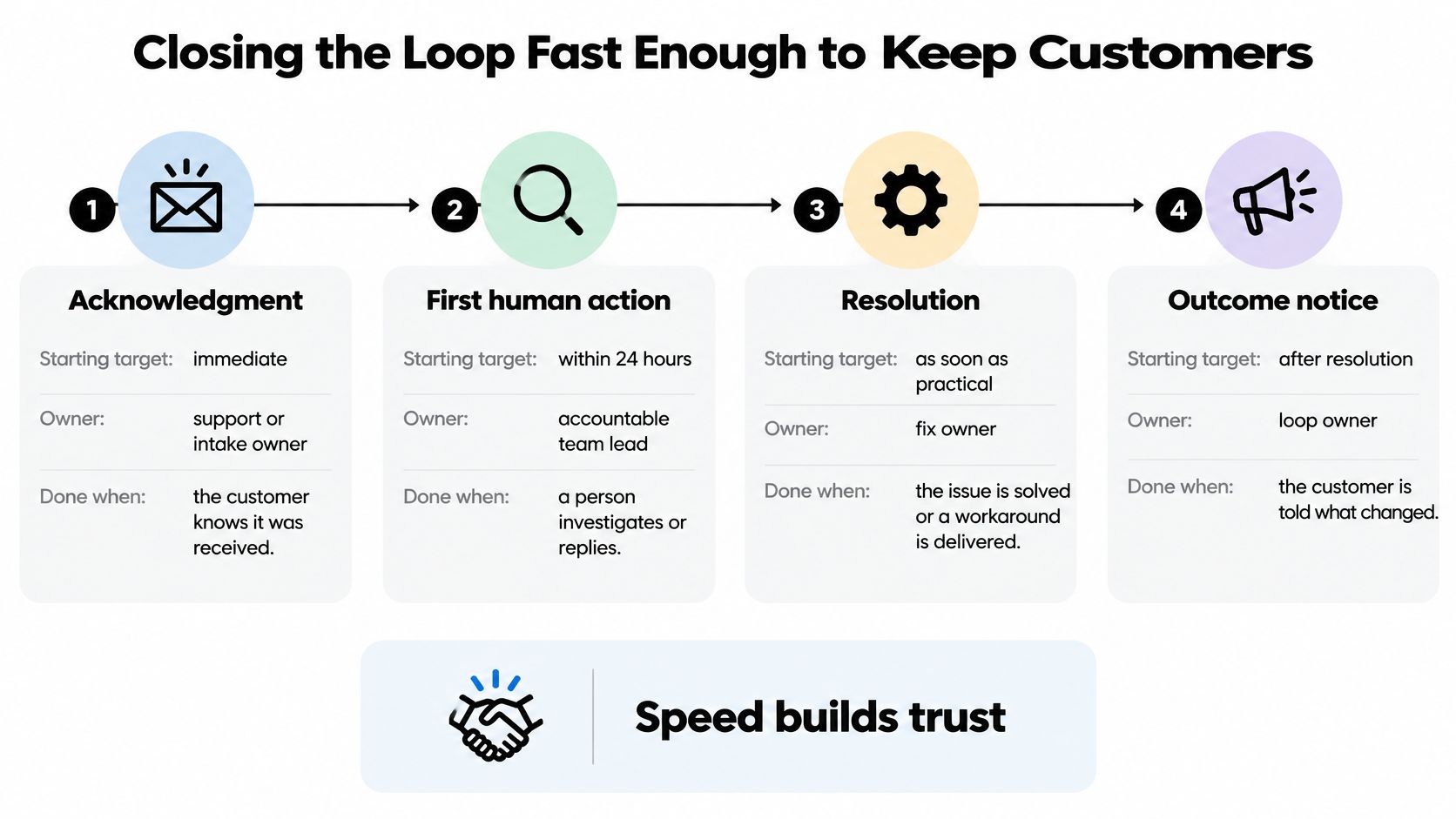
Acknowledgment and resolution run on separate clocks. A prompt reply confirms that the signal arrived; resolution decides whether the customer stays. For the silent middle that rarely asks twice, a missed milestone can become the last interaction before quiet churn.
| Stage | Suggested Target | Owner | Done When |
|---|---|---|---|
| Acknowledgment | Within 1 hour during staffed hours | Support lead | Customer receives a reply confirming receipt and the next step |
| First human action | Within 4 staffed hours for items needing judgment | Assigned agent | Owner is named and relevant evidence is attached |
| Resolution | Within 2 business days for common issues | Issue owner | Fix or workaround is delivered, or a dated milestone is sent |
| Outcome notice | Within 1 week of the fix | Support lead | Customer is told what changed or what happens next |
Why the Two Clocks Matter
The Feedlark summary of SaaS customer feedback benchmarks reports 71% retention for organizations responding within one hour versus 48% when response takes a full day. Those figures justify timers, although they do not prove that response time alone caused the difference. Fast organizations may also fix problems well, staff adequately, and communicate clearly.
Speed cannot rescue a weak fix. What speed buys is trust while the work happens. A retail example shows the narrower point: BonusQR points rewards for retailers uses points as a visible marker between larger milestones. Support needs a different marker: a dated progress update followed by real resolution.
Every stage should write to the same record: raw signal, named owner, due time, action taken, customer notice, and outcome. That auditable chain shows exactly where time was lost and whether the customer heard the result.
A Handoff Pattern That Preserves Context
An AI assistant can acknowledge a chat, extract intent and evidence, and open a human task when confidence is low. In SignalZen, AI Support answers from the business's website, uploaded files, help-center articles, and instructions, while the team can take over from Slack, Microsoft Teams, Google Chat, the Console, or the mobile apps. The assigned agent receives the transcript, customer context, and an AI handoff summary instead of asking the customer to repeat the story.
The handoff should carry the customer's wording, the attempted answer, the source used, and the required next action. Clear rules for when to escalate an issue to a human owner keep that decision consistent. Log whether the AI answer was accepted, corrected, escalated, or followed by another contact so routing and knowledge-base gaps stay visible.
The loop closes only when the customer hears the outcome or the next milestone. An internal status change doesn't count.
Segment Timing or Averages Will Hide Failures
Report typical and slow-tail elapsed time for each stage by channel, language, customer value, and issue severity. A healthy median can conceal a neglected segment waiting days while the rest of the queue looks responsive. When a cohort is small, inspect every conversation instead of trusting the average.
Review aging items with their owners, not as anonymous backlog rows. Any item without a named owner or customer-facing milestone has stopped moving, even if its internal status still says open.
Proving the Loop Changed Customer Outcomes
A closed loop isn't a polite reply. It leaves an auditable chain linking each complaint to an owner, a decision, an intervention, and a measured result. Guidance on how to measure customer satisfaction properly helps teams define those measures before they start reporting movement.
| Metric | How to Calculate | What It Reveals |
|---|---|---|
| Disposition rate | Items with a final status divided by total feedback items | Whether feedback reaches a decision or piles up |
| Median and 90th-percentile time to acknowledgment | Timestamp gap, split by channel | Speed for typical and slowest customers |
| Repeat-contact rate | Customers contacting again about the same issue divided by resolved customers | Whether the fix held |
| Reopen rate | Closed conversations reopened divided by closed conversations | Whether closures are premature |
| AI answer acceptance rate | Accepted AI answers divided by total AI answers | Where automation fails and needs knowledge-base work |
| Retention by feedback cohort | Retention of customers whose issues were closed compared with those whose issues were not | Whether the loop affects customers commercially |
Repeat Contact Is the Proof Point
Repeat-contact rate carries the most weight. If customers return about an issue marked fixed, the fix didn't hold, whatever the satisfaction score said at closure. Reopen rate plays a supporting role by exposing premature closures, where agents resolve tickets to hit targets while customers still have the problem.
Retention by feedback cohort connects the loop to commercial outcomes. Comparing customers whose issues were closed against those whose weren't won't prove causation on its own, but a persistent gap, tracked over several cohorts, tells leaders the loop is worth funding.
The Automation Trust Problem
Automation can make loops faster and less trustworthy at the same time. The 2025 systematic review in the Journal of Science and Technology Research identifies factual consistency, privacy, interpretability, computational cost, and training-data bias as continuing problems in automated feedback summarization. It also summarizes U.S. Federal Trade Commission evidence that AI-generated review summaries were systematically more positive than the underlying reviews, with an average sentiment gap of 0.23 points across 905 hotels and 96,630 reviews, strongest for lower-quality hotels and properties with fewer reviews.
The practical response is straightforward. Keep raw customer excerpts beside every summary, show a confidence indicator, apply access controls, and audit a random sample of summaries each month against the source text. Sentiment scores should be treated as leads for investigation, never as final truth.
Reporting rule: Publish any score change only with its sample size and the segment it came from.
Build Your First Loop This Quarter
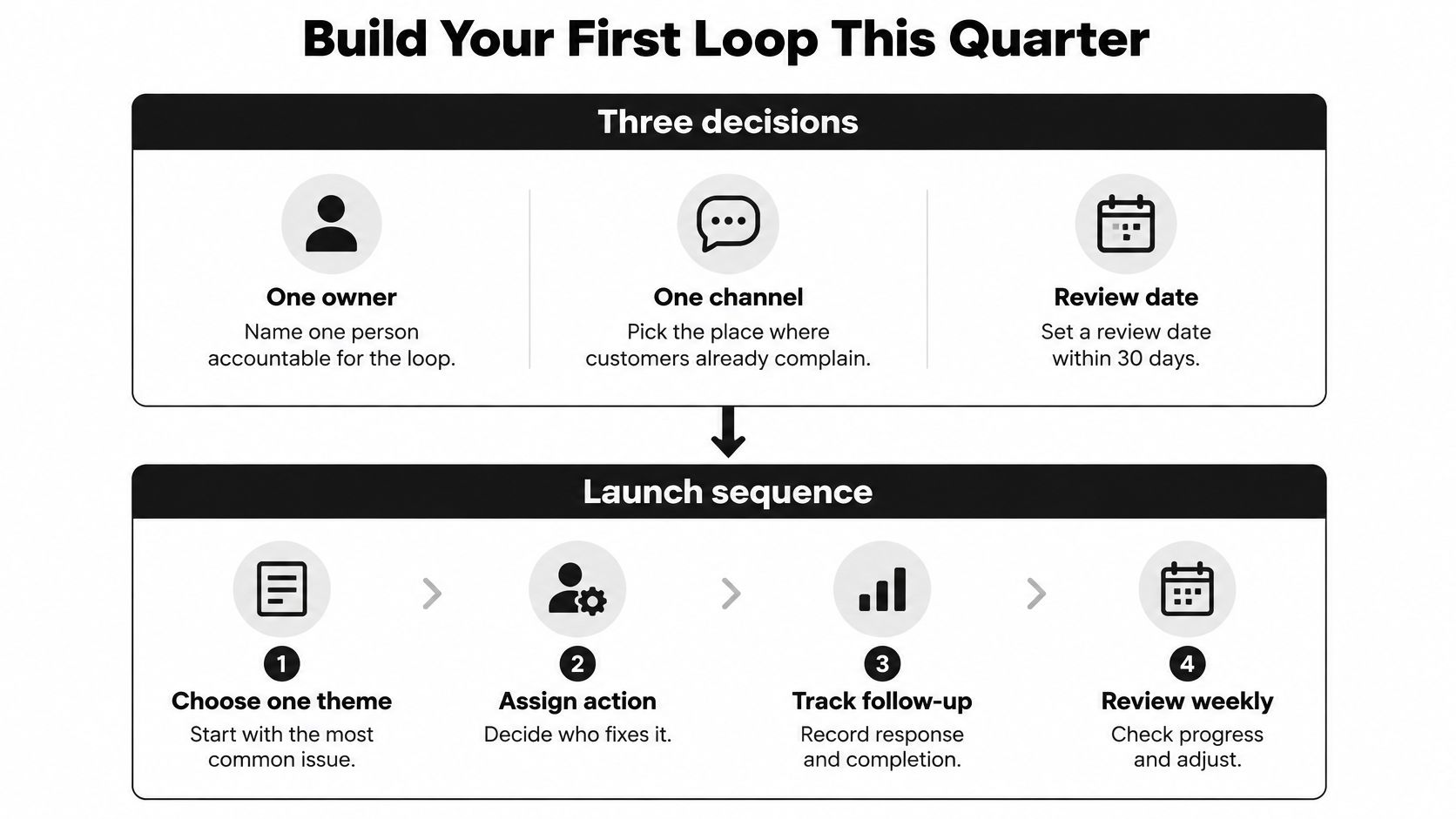
Three decisions come first. Name one owner for the loop, pick one channel where customers already complain, and set a review date within 30 days. Everything else follows from those commitments.
The Seven-Step Launch Sequence
- Choose one channel. Support chat or email transcripts usually hold the richest signal.
- Add one structured score. A CSAT prompt after each closed conversation is enough to start.
- Set the four timers. Acknowledgment, first human action, resolution, and outcome notice each get a target and an owner.
- Score the first batch. Rank themes on frequency, customer value, severity, effort, and strategic fit.
- Assign and record. Every item gets an owner and a disposition.
- Send outcome notices. Each customer whose issue was resolved hears what changed.
- Review at 30 days. Check disposition rate and repeat-contact rate before expanding scope.
The loop should live inside tools the team already uses, so owners can act without switching systems. With SignalZen, chat and email conversations land in the same place and are handled the same way, and when a chat is closed, the visitor or email sender receives a request to rate the service, with the business configuring the rating screens itself. Reminders about conversations that need attention appear in the Microsoft Teams channel, and closed conversations trigger reminders once visitors re-open them, which helps owners notice when a fix hasn't held.
One caution ends the build. Don't report a result until the sample size and the segment behind it are known.
SignalZen brings chat and email into one workspace inside Slack, Microsoft Teams, or Google Chat, with AI answers drawn from a business's own knowledge sources and human handoff that preserves full conversation history. That unified transcript, owner, and rating flow gives a customer feedback loop the evidence chain it needs to prove outcomes instead of collecting scores. Teams ready to build that loop on their existing support conversations can start at SignalZen.


Better support without a bigger support team.
Start with AI. Add your team when the conversation needs a person.