
Is there a support platform that fits a team's size, channels, and budget better than Gorgias, or would switching replace one set of compromises with another? The answer depends less on the longest feature list than on how agents handle an actual customer request, from finding an order to approving an exception.
Customer expectations make that distinction important. In Broadridge's 2023 Consumer Insights report, 92% of consumers said a simple way to interact with companies across all channels was important. A new inbox won't solve that requirement if customers still have to repeat their order details when a chatbot hands them to an agent.
The Gorgias alternatives below are judged against order context, AI grounding, channel coverage, integrations, and total cost. Ecommerce functionality matters, but so does the work required to connect a storefront, maintain approved answers, and preserve conversation history.
Per-seat subscriptions plus usage-based AI charges are the pricing pattern to watch. A plan that looks affordable before automation can become harder to forecast once AI outcomes, conversation allowances, channel charges, or add-ons enter the calculation.
Precise competitor prices aren't reproduced where the available sources don't establish them. Instead, each comparison identifies the billing structure and unresolved questions that matter before a team commits.
Table of Contents
- 1. SignalZen
- 2. Re:amaze
- 3. Richpanel
- 4. eDesk
- 5. Intercom
- 6. Zendesk
- 7. Freshdesk
- 8. Help Scout
- 9. Tidio
- 10. Zoho Desk
- Gorgias alternatives at a glance
- How to Choose and Trial Your Shortlist
1. SignalZen
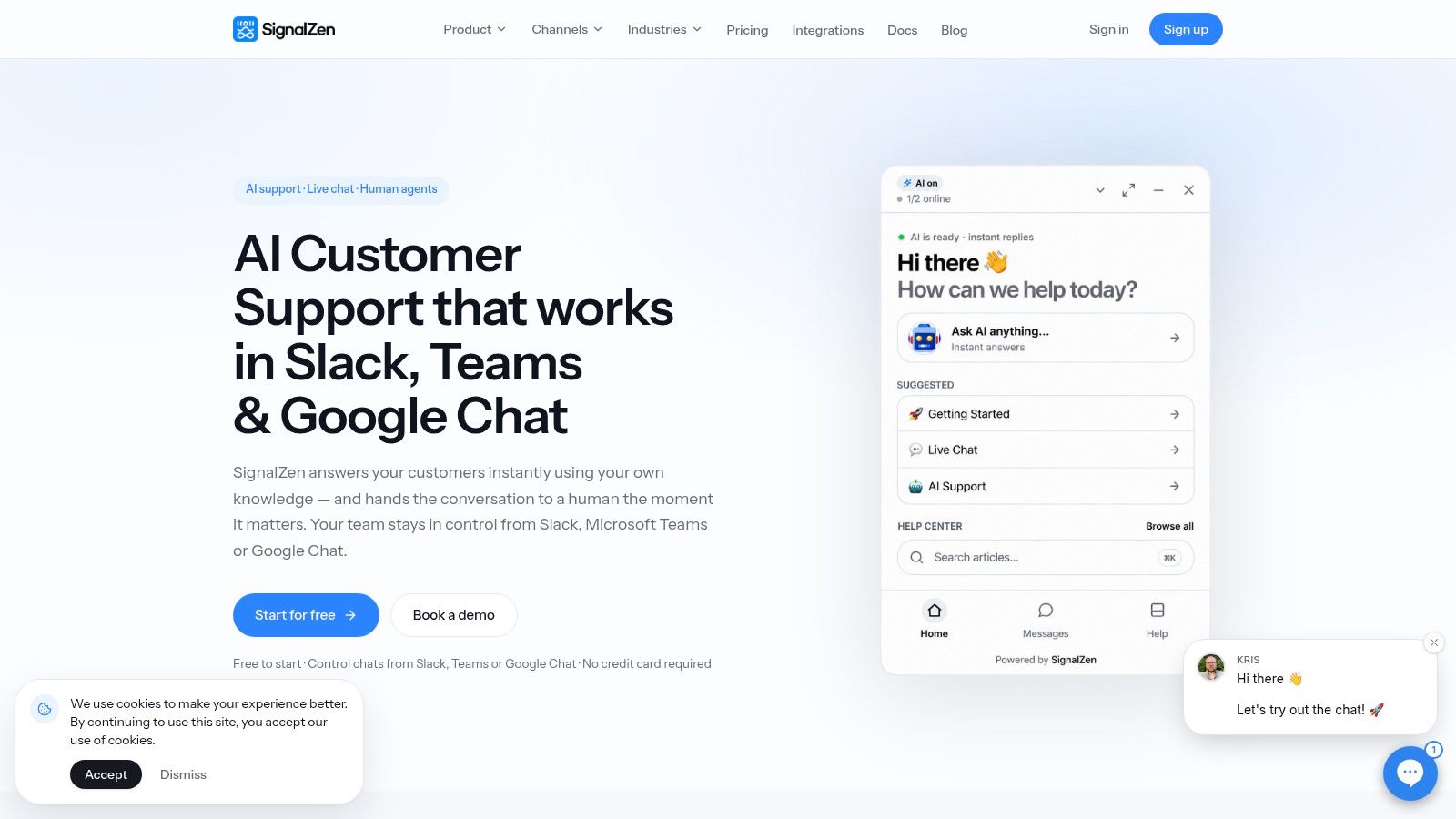
Best for small teams that want AI support without another separate inbox. SignalZen combines website chat and email with agent replies managed through Slack, Microsoft Teams, or Google Chat. That operating model suits businesses whose support, product, and operations staff already coordinate in those tools.
Its AI answers from website content, uploaded files, help-center articles, and specific instructions. When human help is needed, agents receive the conversation history and an AI summary explaining what happened and what remains open. Copilot can draft replies and adjust tone, while two-way translation supports conversations across languages.
Where the fit is strongest
The customizable widget includes suggested questions, file and screenshot sharing, and offline contact forms. A customer-facing knowledge base, mobile apps, and an in-app SDK extend support beyond a basic website chat window.
- Workflow advantage: Chat and email share a support workflow inside existing collaboration tools.
- AI advantage: Company-provided materials give the team direct control over the information used for answers.
- Ecommerce limitation: The described capabilities don't establish native order lookup, refunds, or cancellation actions. Retailers should test those requirements through their intended integrations.
The cost distinction is concrete: all plans include unlimited chats and bandwidth, with no per-conversation charge. Every plan starts with a 30-day free trial without a credit card or commitment, and monthly subscriptions can be cancelled at any time.
Paid subscription amounts and detailed plan limits aren't established in the available product information. Unlimited conversations also don't remove the operational work of maintaining accurate policies, reviewing AI answers, and assigning human ownership.
2. Re:amaze
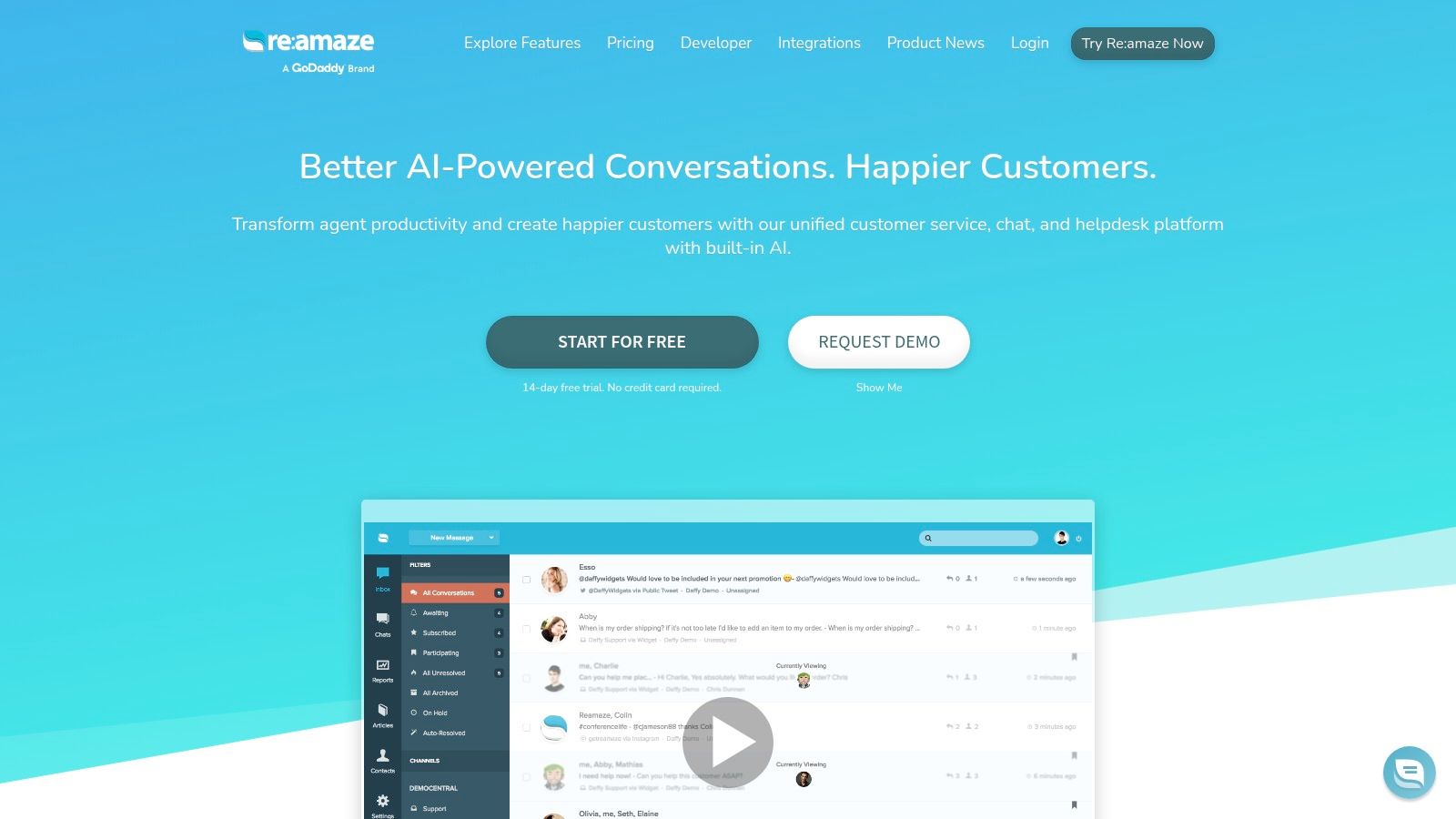
A retailer handling email, social messages, and storefront chat should consider Re:amaze before choosing a general-purpose ticketing suite. It combines a shared inbox with live chat, website FAQs, chatbots, and proactive visitor messages.
Its strongest fit is conversational ecommerce support. Agents can use macros and response templates for recurring questions, while website messaging can help customers before they submit a ticket. Multi-brand support and additional channels are available on higher plans.
The important distinction is between having an ecommerce integration and having the exact order workflow an agent needs. A retailer should test whether an agent can locate the correct purchase, understand fulfillment status, and perform permitted actions without opening several systems.
What deserves scrutiny
- Channel packaging: Multi-brand tools, SMS, voice, and advanced reporting depend on the selected plan.
- AI grounding: An included AI Agent isn't proof that answers reflect current return exceptions or shipping restrictions. Test approved sources and escalation behavior.
- Cost structure: Per-member billing can become significant when founders, warehouse staff, and part-time agents all need access.
Re:amaze offers a trial and month-to-month billing, making it possible to assess the workflow before a broader migration. The AI Agent's included usage, overage rules, and treatment of unresolved conversations still need to be established before comparing total cost.
Choose it for the combined inbox and storefront messaging, not merely because an AI feature appears in the plan description.
3. Richpanel
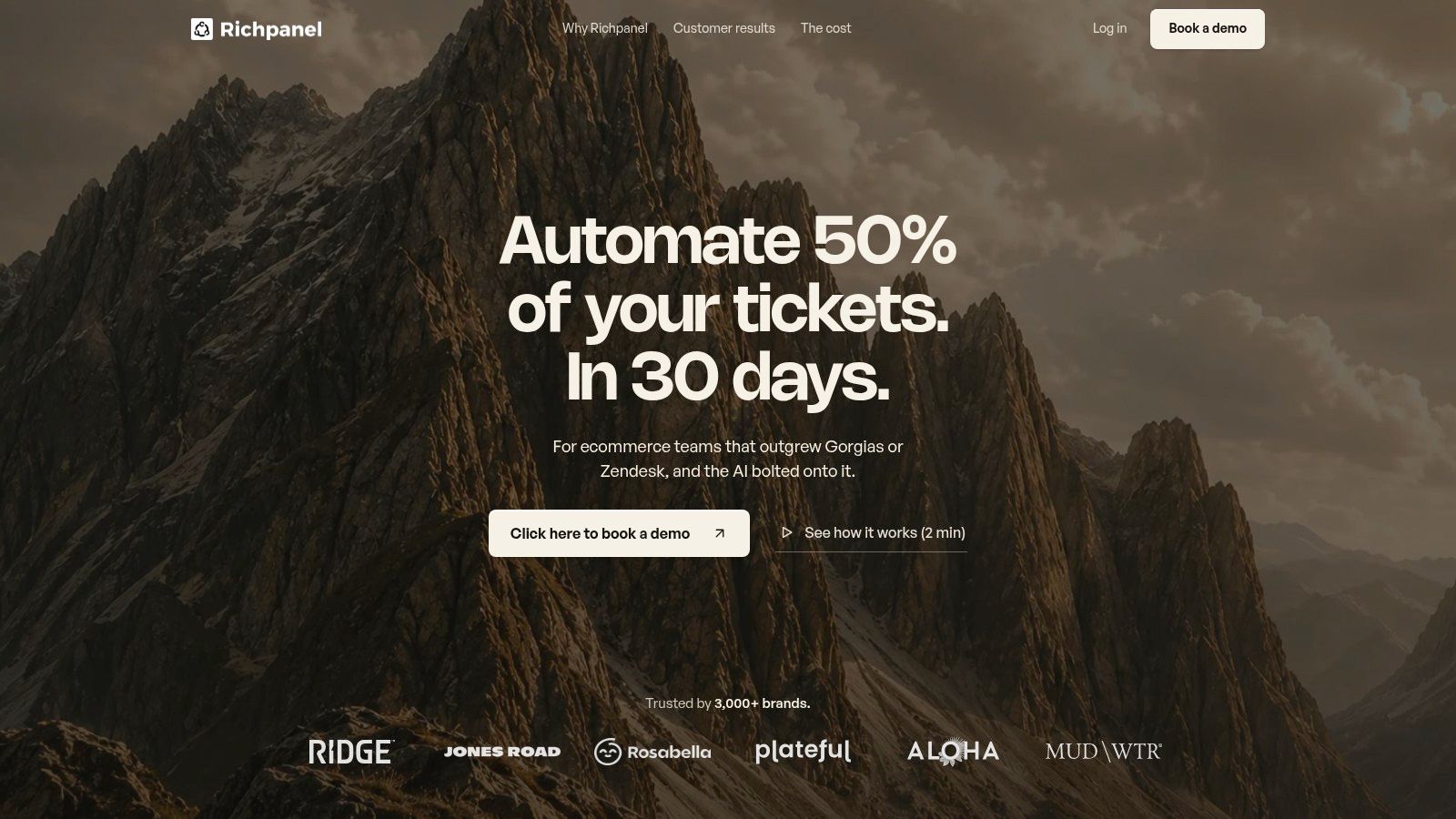
Order context is the main reason to shortlist Richpanel. Its help desk combines customer and order history with AI agents, a self-service portal, and returns-and-exchanges functionality. That makes it relevant when repetitive order questions dominate the queue.
For a retailer, effective customer service in ecommerce requires more than accurate policy answers. Agents need to distinguish an unfulfilled order from a shipped order, understand subscription status, and know which changes remain possible.
Richpanel's inbox covers email, chat, social, SMS, and WhatsApp. A multi-brand workspace and support reporting can help retailers coordinate related storefronts, while migration assistance is included in the described offering.
A chatbot that explains the cancellation policy isn't equivalent to an agent that checks eligibility and completes an authorized cancellation.
The bundled-AI trade-off
Richpanel combines seat-based help-desk pricing with usage-based AI and a minimum AI spend. The help desk isn't offered independently of the AI bundle in the described plan structure.
That arrangement may fit a lean team with substantial repetitive volume. It's less attractive when a business primarily needs an inexpensive shared inbox and expects little automation.
During a trial, test order changes, subscription updates, returns, and exceptions separately. Establish which actions require approval, how customer identity is verified, and whether failed automation creates a clean human handoff. The bundle only makes operational sense if the team can use the AI safely and consistently.
4. eDesk
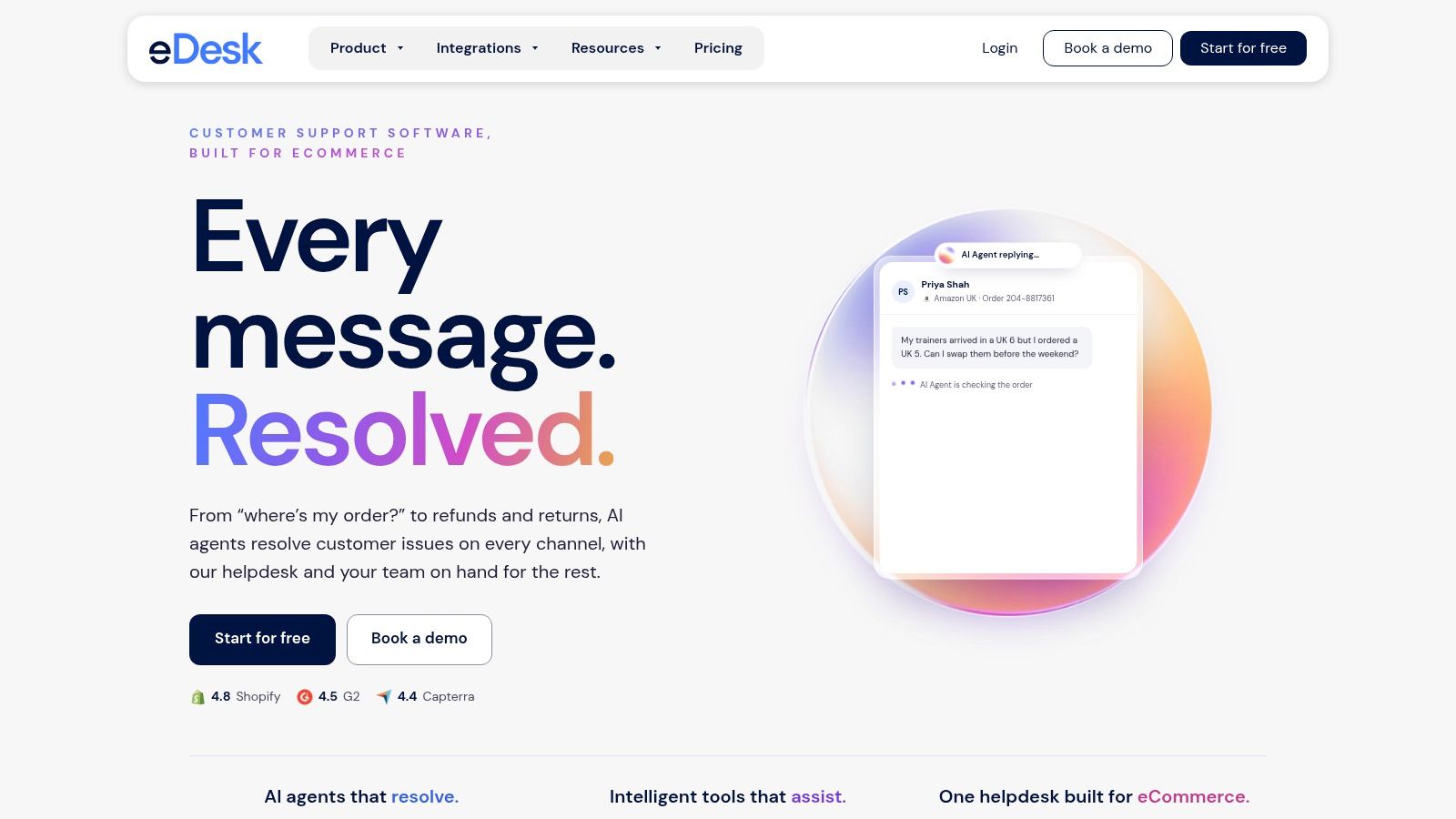
Selling through Amazon, eBay, Walmart, and a separate storefront creates a different support problem from running website chat alone. eDesk is designed around that multichannel seller workflow, consolidating connected messages and adding order information to tickets.
Its ecommerce integrations include Shopify and the major marketplaces named above. Email, live chat, social messaging, and sales-channel support can sit within the broader support operation, reducing the need for agents to search each seller account independently.
Test marketplace depth, not connector counts
A useful trial should include a marketplace delivery dispute, a storefront return, and a customer with purchases across channels. The agent should be able to identify the relevant order and apply the correct channel policy.
- Order context: Confirm which order fields appear automatically and how quickly updates arrive.
- AI behavior: Test whether the AI Agent can perform permitted actions and escalate exceptions with context.
- Plan boundaries: Reporting, CSAT surveys, and multi-store support depend on the selected tier.
Costs include per-user subscriptions and separately billed AI resolutions. That requires a forecast for both staffing and automated usage, rather than a comparison of seat prices alone.
eDesk offers a trial and states that the service can be cancelled at any time. Its marketplace specialization is a reason to consider it for online retail, but it may add little value for a SaaS company whose difficult tickets concern account configuration rather than orders.
5. Intercom
For a software business, the better Gorgias alternative may be a platform built around in-product support, not retail order management. Intercom combines an in-app messenger, shared inbox, ticketing, help center, and Fin AI Agent.
That combination supports customers who need help while using an application. Email and website chat remain relevant, but the key evaluation question becomes whether agents receive enough account and product context to troubleshoot without repeated questioning.
Teams comparing AI customer support software should separate autonomous answers from agent assistance. Fin handles customer-facing interactions, while optional Copilot capabilities support agents. Those functions solve different problems and shouldn't be treated as interchangeable.
Understand the billable outcome
Intercom combines seat subscriptions with usage-based AI and some channel charges. Fin is charged per outcome, so the commercial definition of an outcome matters as much as the rate.
- AI evaluation: Test missing documentation, conflicting instructions, and requests requiring human judgment.
- Integration evaluation: Confirm what customer information reaches the messenger and what actions connected systems permit.
- Packaging evaluation: Advanced workflows, assignment features, and multilingual help-center capabilities depend on the tier.
Fin can also work with certain existing help desks without requiring Intercom seats. That gives teams a potential AI-layer option rather than an immediate full migration.
For a simple email queue, however, Intercom may introduce more configuration and billing components than the team needs.
6. Zendesk
Complex routing is a stronger reason to choose Zendesk than a desire for a different-looking inbox. Its ticketing, automation, customer context, and analytics can support teams with specialized queues, escalation paths, and reporting requirements.
The distinction between Support and Suite plans matters. Email ticketing doesn't automatically mean the selected package includes messaging, live chat, telephony, and a knowledge base.
Zendesk is therefore a candidate for a growing operation that needs broader support infrastructure. It's not automatically a simpler replacement for an ecommerce-first help desk.
Operational caution: A configurable platform still needs someone to maintain routing rules, permissions, integrations, and reporting definitions.
Where implementation work appears
Retailers should demonstrate their order workflow before committing. Customer information inside a ticket is useful, but agents also need to know whether refunds, address changes, and subscription actions require additional apps or custom configuration.
AI agents appear in the described Support and Suite offerings, but inclusion doesn't establish every capability, allowance, or commercial condition. Grounding sources, escalation behavior, and the selected plan's AI terms need separate review.
Seat-based costs rise as agent access expands. Integration subscriptions and administrative effort can also affect the practical cost of ownership.
Zendesk makes sense when the business can name the operational complexity it needs to manage. A small team that only needs shared email and occasional chat should weigh that benefit against setup and ongoing administration.
7. Freshdesk
Freshdesk suits teams that prefer structured ticket handling over a chat-first support model. Its general-purpose approach can fit retailers, agencies, and service businesses that need assignment, automation, and reporting without centering every workflow on ecommerce.
The Freshworks ecosystem and app marketplace provide integration options. The practical question is whether the intended combination supplies the required channels and customer information within the chosen product and plan.
Start with the workflow specification
A retailer should define the required order fields and actions before evaluating connectors. A service business should instead test account ownership, priority routing, and escalation between departments.
- Ticket handling: Verify assignment rules, ownership changes, and visibility when several agents touch a request.
- Channel coverage: Establish which Freshdesk product includes the required email, chat, social, or messaging capabilities.
- AI costs: Separate agent-assistance subscriptions from automated customer interactions and any associated usage limits.
Freshdesk pricing and capabilities vary by product, tier, and billing arrangement. A familiar product name isn't enough to establish a comparable package.
Its broad design is useful when support extends beyond retail transactions. The trade-off is that marketplace order management and store-specific actions may require more deliberate integration work than an ecommerce-specialized platform.
A meaningful trial should therefore include an awkward cross-system case, not just an incoming email. That exposes whether the team is buying a complete workflow or only the ticketing component.
8. Help Scout
An email-heavy support team may not need an enterprise suite. Help Scout focuses on a shared inbox, help-center content, and supporting AI tools, making it relevant when clear ownership and readable conversations matter more than elaborate routing.
For a small retailer or agency, that can be a sensible operational choice. Agents need a dependable way to see previous replies, avoid duplicate responses, and maintain consistent answers.
The limitation is scope. Social support, marketplace messaging, detailed order operations, and product-led messaging shouldn't be assumed merely because the core inbox fits.
Keep the comparison email-centered
Teams evaluating Help Scout should test a long email thread with attachments, an internal handoff, and a customer who returns with a related issue. The purpose is to assess continuity, not just the appearance of a new ticket.
- Ecommerce context: Confirm which integrations expose orders and whether agents can act on them.
- AI grounding: Test approved help-center content, policy changes, and requests outside documented guidance.
- Commercial terms: Establish current plan limits and any separate AI usage charges.
Businesses considering Help Scout alternatives should preserve that same distinction between a straightforward inbox and a broader support platform.
Help Scout is most compelling when email is the operating center. If marketplace actions or in-app assistance dominate the workload, the team should compare those needs explicitly rather than stretching an email-first setup around them.
9. Tidio
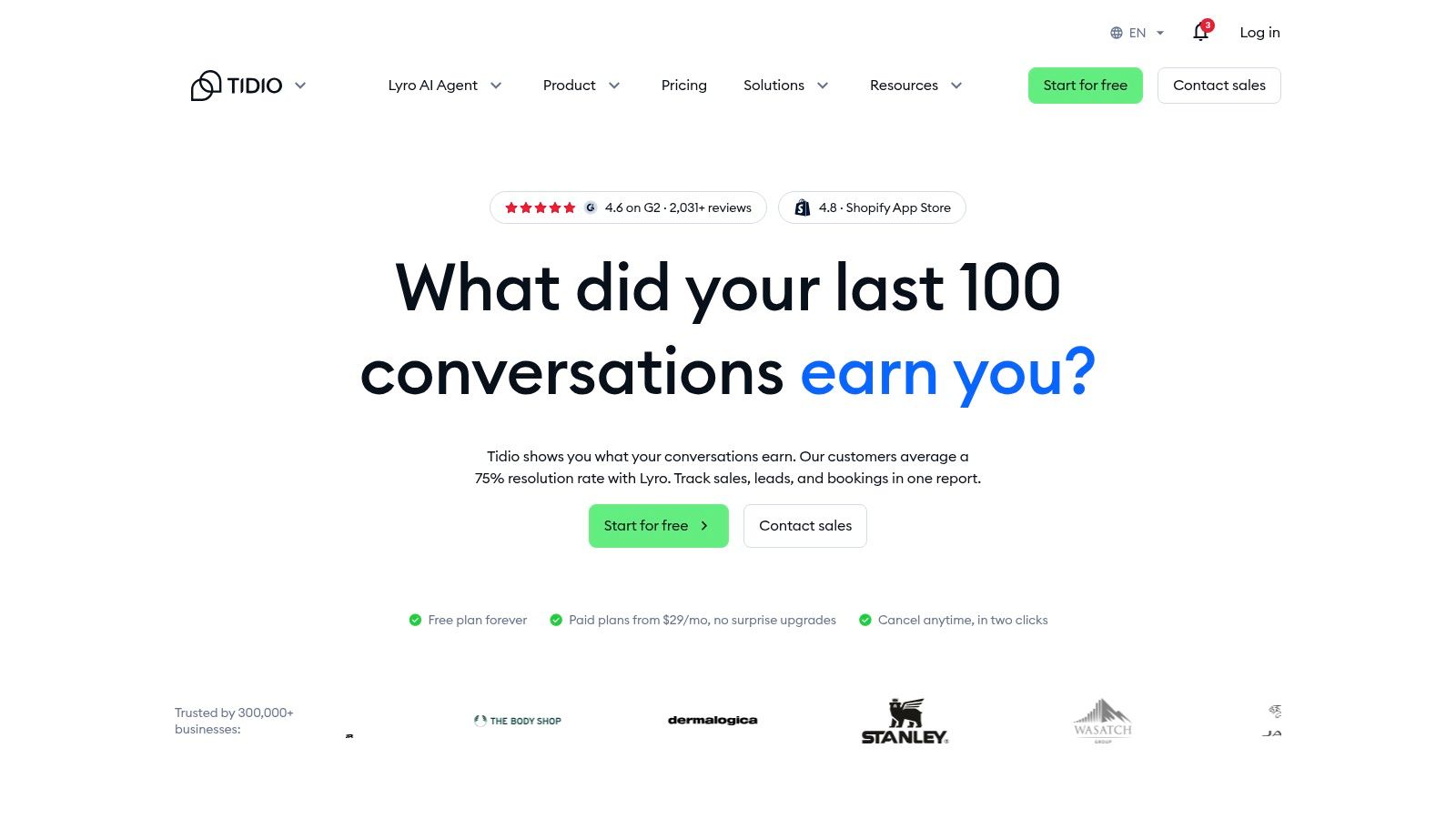
Tidio deserves consideration when website chat is the main support entry point. Tidio combines live chat, ticketing, social channels, structured Flows, and the Lyro AI Agent.
A storefront can use that combination for product questions, visitor routing, and recurring support requests. Lyro can answer questions and hand conversations to agents, while Flows provide a structured alternative for predictable paths.
Speed matters, but a prompt acknowledgment isn't a useful answer. In Verint's 2023 State of Digital Customer Experience Report, 65% of surveyed U.S. consumers ranked a quick company response as the most important or second-most important element of good customer experience.
Conversation allowances change the calculation
Tidio offers a free tier, and its plans depend partly on conversation volume. That can suit a small operation, but conversation quotas and separate feature allowances need to be modeled against actual demand.
- Order workflow: Test whether the intended integrations provide order-specific answers rather than generic policy guidance.
- Human handoff: Check whether agents receive the customer's question, relevant context, and unresolved issue.
- Peak usage: Establish what happens when conversation allowances are exhausted.
Higher-volume requirements and premium capabilities may require a sales discussion. Add-ons can also make the headline plan incomplete as a cost estimate.
Tidio fits chat-led support best when the team understands both its automation boundaries and its expected conversation volume.
10. Zoho Desk
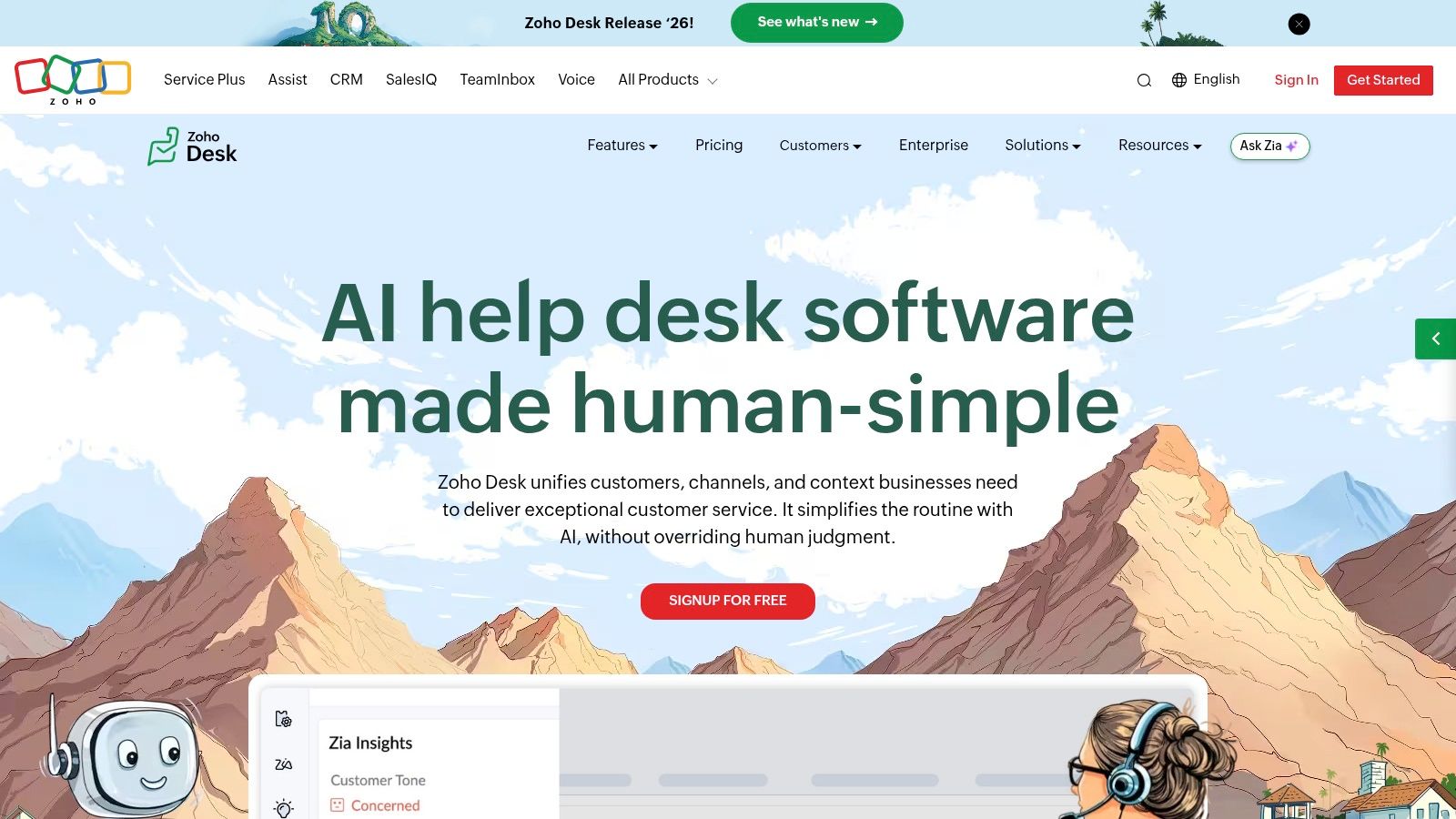
Existing Zoho users have a practical reason to evaluate Zoho Desk. Connections to the wider Zoho ecosystem may matter more than another isolated support feature, particularly when customer records and business processes already live there.
Zoho Desk combines email support, ticket assignment, workflow automation, and knowledge-base capabilities. Eligible plans add customer forums, an ASAP self-service widget, broader messaging, and more advanced automation.
The product offers a free edition and paid tiers, but the entry package shouldn't define the budget before requirements are mapped. Live chat, AI capabilities, and multilingual knowledge-base features vary by plan or connected product.
Evaluate the complete configuration
For ecommerce, the first test is order context. Agents should be able to identify the correct purchase and understand which actions are available through the selected integration.
AI requires the same discipline. The team needs to establish what sources the selected configuration uses, how changes become available, and when uncertain answers move to a human.
- Strong fit: Businesses already using Zoho that want connected customer-service workflows.
- Main trade-off: Significant differences between plan capabilities and potentially linked products.
- Hidden work: Configuring ecommerce integrations, permissions, and channel routing outside an existing Zoho setup.
Zoho Desk can be a rational cost-conscious choice, but subscription price and implementation effort belong in the same comparison. A lower entry tier isn't a saving if essential channels or order workflows require a substantially different configuration.
Gorgias alternatives at a glance
| Best for | AI capabilities | Channel coverage | Pricing model | Free option |
|---|---|---|---|---|
| SignalZen, SMBs wanting AI support in team collaboration tools | Answers from company content; drafts and translates replies; summarizes conversations | Live chat and email; replies via Slack, Microsoft Teams, or Google Chat; mobile support | Paid-plan pricing not provided; plans include unlimited chats and bandwidth | Free-to-start option; no credit card required |
| Re:amaze, Ecommerce teams managing customer conversations | AI Agent; chatbots; macros and response templates | Email, social messaging, live chat; SMS and voice on higher plans | From $29 per team member per month; month-to-month billing available | Trial available |
| Richpanel, Retailers automating order support and self-service | AI agents handle queries and order or subscription updates | Email, chat, social, SMS, and WhatsApp | $99 per seat per month billed annually, plus $200 monthly minimum AI spend | Free option not specified |
| eDesk, Online sellers supporting customers across marketplaces | AI Agent answers questions and takes actions, with human escalation | Email, live chat, social, and ecommerce channels including Shopify, Amazon, eBay, and Walmart | Per-user seats; AI resolutions billed separately; price not provided | 14-day trial |
| Intercom, SaaS teams embedding support in their product | Fin AI Agent charged per outcome; optional agent Copilot | In-app messaging, live chat, email, shared inbox, and ticketing | Seat subscriptions plus usage-based AI and some channel charges | 14-day free trial |
| Zendesk, Teams with complex support and routing needs | AI agents; AI support for over 80 languages; advanced AI features vary by plan | Email ticketing; Suite plans add messaging, live chat, telephony, and knowledge base | Seat-based, tiered plans; exact prices not provided | Free option not specified |
| Freshdesk, General-purpose customer support teams | AI availability and limits depend on product and plan | Ticketing and workflows; integrations via Freshworks and its app marketplace | Varies by product, plan, and billing arrangement | Free option not specified |
| Help Scout, Smaller teams focused on email support | AI tools alongside support workflows | Shared inbox, help center, and customer self-service; other channel coverage should be verified | Published plan pricing; current prices and AI charges should be checked | Free option not specified |
| Tidio, Businesses seeking website chat and AI automation | Lyro AI Agent answers questions and hands off to agents; chatbot flows | Website live chat, ticketing, and social channels | Partly conversation-volume based; add-ons and feature limits may affect cost | Free tier available |
| Zoho Desk, Cost-conscious teams, especially Zoho users | AI features vary by plan | Email, knowledge base, forums, self-service widget, and multichannel options; live chat varies by plan | Free edition; annual paid plans from $7 per user per month | Free edition for up to three users |
How to Choose and Trial Your Shortlist
The strongest shortlist starts with must-have workflows, not product rankings. An ecommerce retailer might require order lookup, authenticated cancellation requests, marketplace messaging, and an auditable handoff. A SaaS team may instead prioritize in-app context, technical escalation, and documentation-grounded answers.
Map those requirements to a small group of candidates, then trial each against a real week of tickets. Use historical cases for controlled testing and a limited live queue where appropriate. Protect customer data and keep payment, refund, and account-changing actions behind suitable permissions.
Test quality before automation volume
Include routine questions alongside missing orders, policy exceptions, conflicting documentation, and multilingual requests. Record whether the AI found the correct source, admitted uncertainty, and transferred unresolved work without making the customer start again.
A useful speed benchmark comes from Comm100's 2025 Live Chat Benchmark Report, which reports an average chat wait time of 23.6 seconds from its 2024 operational data. That's a comparison point, not a universal service target, and teams should distinguish an automated greeting from a useful response.
Trial rule: A correct escalation is a better result than a confident answer that creates another customer contact.
Calculate the complete operating cost
Estimate seats plus AI or conversation charges, then add required channels, integrations, onboarding, and ongoing administration. Model ordinary demand and a peak trading period separately.
- Billing definitions: Establish what counts as an outcome, resolution, session, or conversation, including reopened cases.
- Migration work: Test conversation imports, attachments, customer records, macros, knowledge articles, and ownership rules.
- Integration depth: Separate displaying information from performing authorized actions, then verify permissions and failure handling.
Businesses with booking-related support should apply the same scrutiny to PMS integrations and pricing tiers. A connection is only useful when it exposes the information and actions the support team needs.
SignalZen's 30-day free trial without a credit card provides a way to test the collaboration-tool model before committing. Starting with a limited queue keeps switching risk lower while the team evaluates answer quality, handoff, and ownership.
The final decision should favor the platform that handles difficult tickets reliably at a cost the business can explain. More automation isn't automatically better, and a successful demo isn't a substitute for a workable daily process.
SignalZen combines AI answers grounded in company materials with unified chat and email, plus human handoff managed through Slack, Microsoft Teams, or Google Chat. Teams comparing Gorgias alternatives can visit SignalZen to start a free trial and test their own questions, escalation paths, and collaboration workflow before committing.


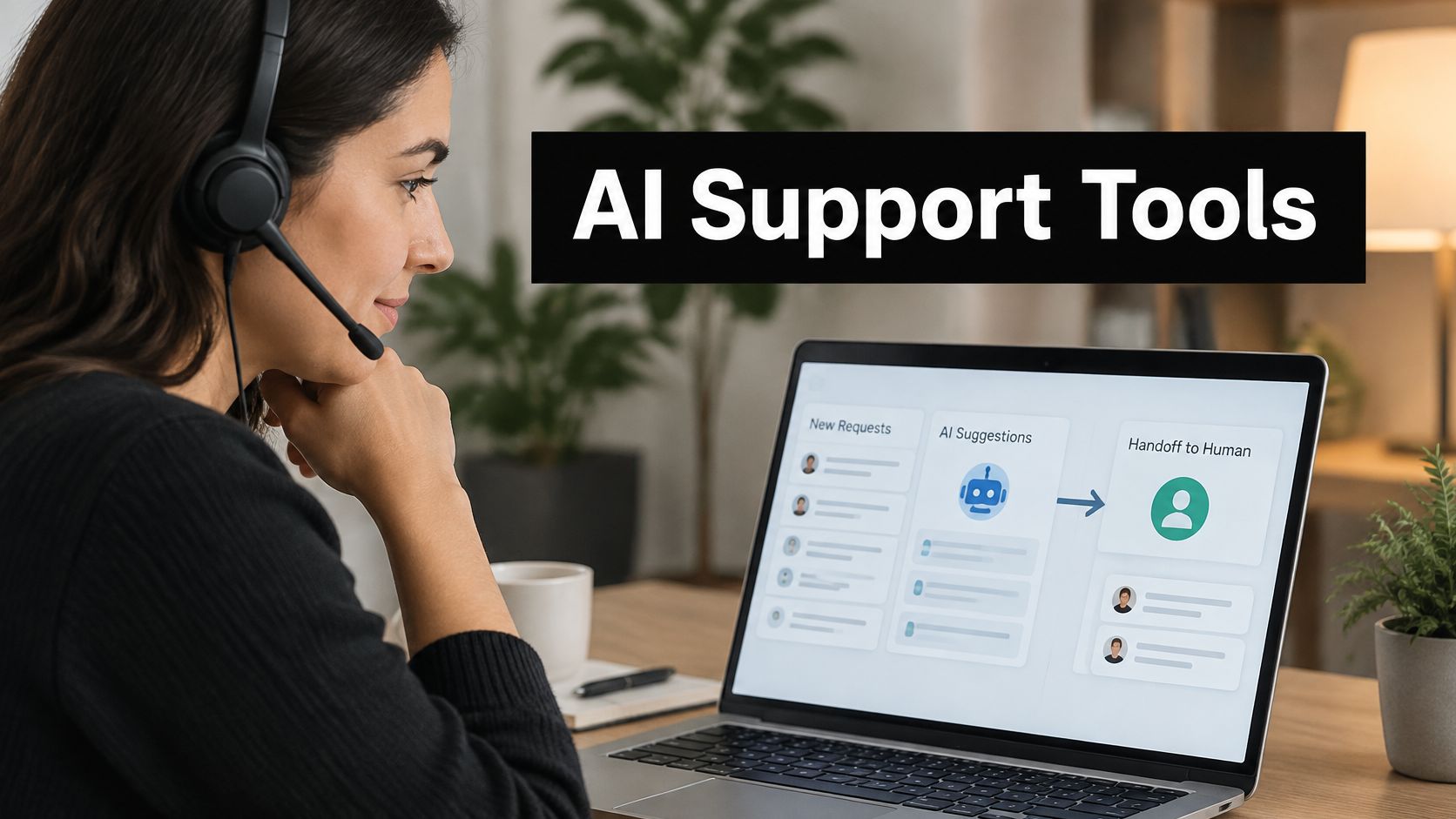
Better support without a bigger support team.
Start with AI. Add your team when the conversation needs a person.