

It's 4:45 p.m. on Friday. A support agent has several chats open, and a customer has already explained the same problem twice. The next reply could ask for the background again, offer a generic apology, or show that someone has finally understood what needs fixing.
A memorable service quote won't resolve that ticket. A clear principle can still change the agent's next move: read the history, acknowledge the inconvenience, and take ownership of the next step. That's where great guest service quotes become useful, not as wall decorations, but as instructions for handling a busy queue.
Hospitality teams face the same challenge before a guest even arrives. Practical resources such as welcome book advice from Global can help teams think about information guests need before they have to ask. Support teams can apply that approach to arrival instructions, order questions, account setup, and troubleshooting.
The sayings below connect familiar service principles with concrete desk habits. Some have clear organizational associations; others circulate with uncertain wording or attribution. None should replace judgment, accurate answers, or reasonable boundaries.
Table of Contents
- 1. "People will forget what you said, people will forget what you did, but people will never forget how you made them feel."
- 2. "There is only one boss. The customer. And he can fire everybody in the company from the chairman on down, simply by spending his money somewhere else."
- 3. "There is only one valid definition of business purpose. To create a customer."
- 4. "Selling focuses on the needs of the seller; marketing on the needs of the buyer."
- 5. "We are Ladies and Gentlemen serving Ladies and Gentlemen."
- 6. "Deliver WOW Through Service."
- 7. "Rule #1. The customer is always right. Rule #2. If the customer is ever wrong, re-read Rule #1."
- 8. "Customers will never love a company until the employees love it first."
- 9. "Leaders start with the customer and work backwards."
- 10. "The customer is not a moron; she is your wife."
- How the 10 Guest Service Quotes Compare by Origin, Focus, and Best Use
- From Quotable Principle to Daily Standard
1. "People will forget what you said, people will forget what you did, but people will never forget how you made them feel."
Widely attributed to Maya Angelou, this saying has an uncertain original source. Its practical value is clearer than its provenance: customers shouldn't have to fight to be understood.

Consider a guest whose arrival instructions never arrived. A warm greeting won't help much if the agent then asks for information already in the conversation. Recognition means using the available context, not merely adding the guest's name to a template.
In a global survey of consumers and business buyers, Salesforce found that 56% frequently have to repeat or re-explain information to different representatives. A useful desk rule is to read the history before requesting background.
Turn empathy into an opening sentence
The agent should acknowledge the specific inconvenience, confirm what's already known, and explain the next action. AI Copilot can help adjust tone, but the agent still needs to check that the acknowledgment matches the problem.
- Before replying: Check previous troubleshooting, promises, and unresolved questions.
- During handoff: Preserve the guest's goal and the action already attempted.
- During review: Ask whether the response demonstrated understanding or merely claimed it.
Guidance on communicating with customers can support that coaching. For hospitality teams, thoughtful hospitality at Irie Tulum Boutique Hotel offers another context for considering memorable treatment.
Warmth works best when the reply also reduces effort. A sympathetic paragraph followed by repeated questions still leaves the guest doing unnecessary work.
2. "There is only one boss. The customer. And he can fire everybody in the company from the chairman on down, simply by spending his money somewhere else."
Associated with Sam Walton and his autobiography, Made in America, this quote gives support leaders a commercial reason to examine frustrating conversations. Customers don't have to argue with an unhelpful process. They can leave.
Microsoft's historical benchmark makes the risk concrete: 62% of consumers surveyed said they had stopped doing business with a brand during the previous year because of a single poor customer-service experience, according to its 2016 Global Multichannel Customer Service Report coverage.
Review waiting by customer need
Say an online retailer receives a delivery-address correction after staff have signed off. An automated acknowledgment confirms receipt, but it doesn't tell the buyer whether the parcel can still be redirected. The useful response explains the available route and identifies anything requiring human approval.
Automation should answer what it can substantiate. It shouldn't promise an order change merely to sound responsive.
- Separate the measures: Review initial response time and actual resolution time.
- Inspect abandonment: Look for conversations where customers stopped replying before receiving a usable answer.
- Repair recurring gaps: Add missing delivery, cancellation, and weekend-support instructions to the knowledge base.
Operational priority: A fast acknowledgment isn't the same as a useful response.
The trade-off is coverage versus authority. Automated support can explain published policies outside business hours, while exceptions may need a person. Clear limits and an honest next step are better than an instant answer the business later has to withdraw.
3. "There is only one valid definition of business purpose. To create a customer."
Peter Drucker's The Practice of Management is the familiar source associated with this principle, often reproduced with slightly different punctuation. For a support team, its value lies in treating help as part of the customer relationship rather than an expense detached from it.
A buyer asking whether a product works with an existing setup isn't creating another ticket. The buyer is deciding whether the purchase is suitable. A precise answer may support a sale; an honest warning may prevent an unsuitable one.
Treat pre-sales questions as decision support
Consider a SaaS visitor asking whether a mobile app supports a required workflow. The agent should confirm the relevant capability, explain any limitation, and point to setup instructions. Pushing a trial without answering the compatibility question serves the seller's immediate goal, not the prospective customer's decision.
The desk behavior is to identify the decision behind the question. That might be whether to buy, renew, upgrade, cancel, or choose a different configuration.
- Record the obstacle: Tag missing compatibility details, unclear billing terms, and setup concerns.
- Share useful patterns: Send recurring questions to product and marketing owners.
- Check the outcome: Review whether customers received enough information to decide.
Support leaders should connect service reporting to retention and purchase outcomes where those records can be linked responsibly. They shouldn't claim that every assisted purchase happened because of chat.
The useful standard is simpler: the customer left better informed, without an unsupported promise or a disguised sales pitch. That applies equally to a hotel booking inquiry, an agency proposal, or a software renewal.
4. "Selling focuses on the needs of the seller; marketing on the needs of the buyer."
Theodore Levitt's Marketing Myopia is associated with this distinction. Applied to support, it challenges teams to organize help around customer tasks rather than internal departments or feature names.
A help article titled after an internal integration module may make sense to engineers. A customer trying to connect a phone needs a title describing that task. The same problem appears when agents send guests between reservations, billing, and property operations without maintaining ownership.
According to Microsoft's 2018 State of Global Customer Service report coverage, 59% of respondents had used multiple channels to obtain answers. Support teams should design for a continuing task, not assume that each channel begins a separate request.
Rewrite the route to the answer
Say a customer needs to connect a mobile app. The knowledge article should begin with prerequisites and the connection steps, not a description of the company's product architecture.
The agent should also check the customer's starting point. Instructions for an account administrator won't help someone who lacks permission to change settings.
- Use task-based titles: Describe what the customer needs to accomplish.
- State prerequisites early: Explain permissions, required access, and relevant limitations.
- Finish with verification: Show how the customer can confirm that the task worked.
Translation can improve access, but it can't rescue unclear instructions. Teams should simplify the original article before translating it or making it available to automated support.
The review question is direct: could a customer complete the task without knowing how the company is organized?
5. "We are Ladies and Gentlemen serving Ladies and Gentlemen."
The Ritz-Carlton's service motto frames hospitality as a relationship grounded in mutual dignity. That matters on difficult tickets, where customer care can otherwise become an instruction for employees to absorb unlimited hostility.
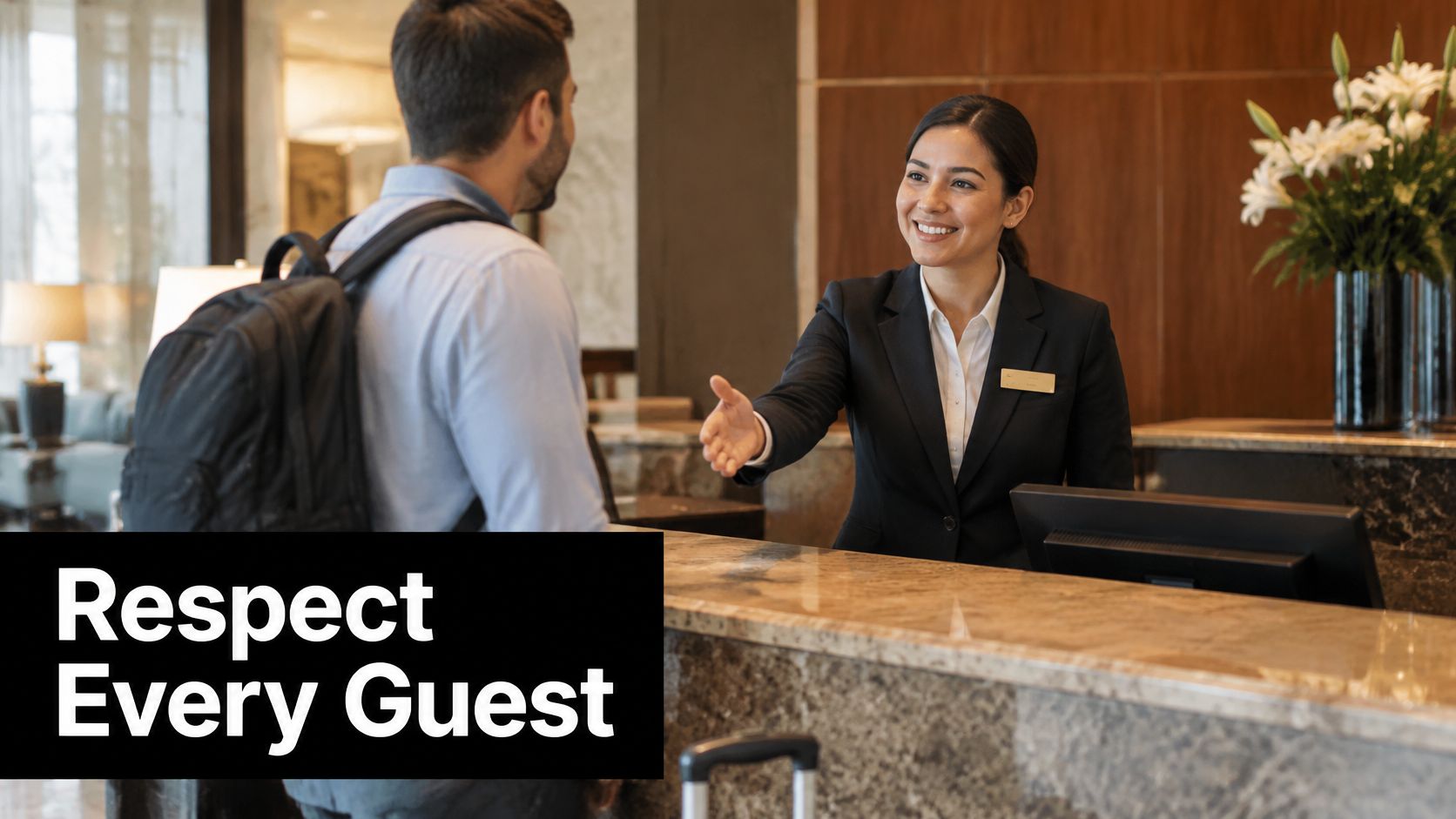
Respect has practical weight in hospitality. Hotel staff service achieved a satisfaction score of 701 on a 1,000-point scale, the highest among the guest-experience factors measured, according to J.D. Power's 2023 North America hotel guest satisfaction announcement.
Define dignity in observable terms
Consider a guest requesting an unavailable early check-in. A respectful agent explains the constraint, checks permitted alternatives, and avoids implying that the request was unreasonable. The agent doesn't invent availability or apologize repeatedly for a policy that cannot change.
A service credo should describe behavior, not demand a cheerful personality regardless of circumstances. Useful standards include explaining limitations without blame, avoiding sarcasm, and keeping sensitive details out of public replies.
Courtesy applies to guests and employees. A customer-first policy shouldn't require staff to accept harassment.
Managers need to define when an agent can offer flexibility and when a supervisor must approve an exception. They also need a clear route for threatening or abusive conversations.
Recognition should reinforce those standards. Praise the agent who delivered a difficult answer clearly and respectfully, not only the agent who gave something away. Otherwise, staff may learn that generosity counts while sound judgment goes unnoticed.
6. "Deliver WOW Through Service."
Zappos uses this phrase as a core value. For a busy support team, the useful interpretation isn't constant spectacle. It's thoughtful action that removes an avoidable burden.

A guest whose access problem has been fixed may appreciate a short follow-up confirming that the replacement instructions worked. An e-commerce customer may value a return label and clear packing instructions more than an enthusiastic paragraph.
Make exceptional service repeatable
The desk should define proactive actions agents can take without neglecting the waiting queue. These might include checking that a replacement arrived, sending the relevant setup article after a technical fix, or confirming that a billing correction is complete.
The trade-off is attention versus coverage. An elaborate gesture for one customer shouldn't leave other customers waiting for basic help.
- Choose a relevant action: Address the inconvenience that occurred.
- Preserve ownership: Assign the follow-up rather than assuming someone will remember.
- Close the underlying gap: Update instructions if the same confusion keeps returning.
Researching companies with excellent customer service can generate ideas, but copying a memorable gesture without its operating limits is risky. A small team needs actions it can deliver consistently.
Helpful personalization also needs restraint. PwC's 2025 Customer Experience Survey found that 93% of consumers say a brand will lose their trust if it mishandles their data, according to PwC.
Remembering an unresolved delivery issue can improve service. Mentioning unrelated personal information merely to demonstrate familiarity can make the same interaction uncomfortable.
7. "Rule #1. The customer is always right. Rule #2. If the customer is ever wrong, re-read Rule #1."
Associated with Stew Leonard's, these rules express a generous customer-first stance. They're dangerous when interpreted as a requirement to agree with every factual claim or grant every request.
A customer may misread a renewal date, misunderstand a return condition, or dispute a correct answer. The agent's job is to investigate without turning the conversation into a contest.
Separate acknowledgment from agreement
Say a buyer requests a refund outside the published policy. The agent should establish what happened, explain the applicable terms, and check whether an authorized exception fits. Repeating the policy in increasingly formal language rarely makes the decision clearer.
Acknowledge the inconvenience without endorsing an inaccurate claim. That leaves room for a fair review while protecting the business from inconsistent promises.
- Check the evidence: Review the order, relevant terms, and previous commitments.
- Explain available options: Identify what can change and what cannot.
- Escalate genuine disputes: Transfer the history and the exact decision needing review.
Guidance on dealing with angry customers should sit beside the policy, not replace it. Agents need both communication skills and decision boundaries.
The customer deserves a fair hearing. That doesn't make every requested outcome fair.
An AI answer shouldn't become an immovable barrier when the customer presents new information. Human review is appropriate when facts conflict, an exception requires authority, or the published guidance doesn't cover the situation.
The review standard is fairness and clarity, not whether the agent avoided saying no.
8. "Customers will never love a company until the employees love it first."
Widely credited to Richard Branson, this line connects employee support with customer treatment. It's best treated as a leadership principle, not a literal promise that satisfied employees automatically produce satisfied customers.

An agent handling repeated billing questions doesn't need another reminder to care. The agent may need an accurate billing article, permission to correct a routine error, and a clear escalation owner.
Remove a source of avoidable work
Consider an agency supporting several client websites. If agents must search scattered documents to determine which policy applies, a friendly tone guideline won't solve the delay. The practical response is to organize approved knowledge by client and make ownership explicit.
Employee support should change the work, not merely recognize the difficulty.
- Ask about friction: Identify missing permissions, contradictory guidance, and repetitive copying.
- Assign a repair owner: Give a named person responsibility for fixing each recurring obstacle.
- Review automation critically: Check whether drafts reduce work or create more editing.
SignalZen's AI Copilot drafts replies from conversation context and adjusts tone, while AI Summaries condense long threads into what happened and what remains open. Those tools can assist agents, but managers still need to maintain the source material and escalation process.
Automation also changes the mix of work. If routine questions are answered automatically, human agents may handle a greater concentration of difficult cases. Staffing and coaching should reflect that complexity rather than treating fewer assigned conversations as proof of an easier shift.
9. "Leaders start with the customer and work backwards."
Amazon's Customer Obsession leadership principle includes this statement. For support leads, working backwards means starting with the customer's intended outcome before choosing channels, templates, or automation.
A SaaS customer reporting a failed integration wants the connection restored. The customer probably doesn't care whether the request belongs to onboarding, technical support, or engineering.
Build the workflow around the outcome
Start with what successful resolution requires: the affected connection, the error, attempted troubleshooting, and a clear owner. Then decide which details the widget should collect and which situations need immediate human review.
A handoff summary should preserve the goal, established facts, attempted actions, and unresolved question. It shouldn't merely compress the conversation into a shorter transcript.
Speed matters, but the route must remain usable. In U.S. research, 56% of consumers considered receiving information quickly the most important aspect of good customer experience, compared with 15% who prioritized empathy, according to Verint's 2025 State of Customer Experience report.
- Inspect recurring requests: Identify where customers repeatedly get stuck.
- Fix the right layer: Choose a product correction, clearer article, better intake prompt, or escalation change.
- Test the result: Check whether customers can complete the task without another explanation.
Working backwards doesn't mean automating everything. A straightforward setup question may suit self-service. A disputed charge or conflicting account record may need a person.
The strongest workflow makes both routes clear and preserves context when the customer moves between them.
10. "The customer is not a moron; she is your wife."
Commonly associated with David Ogilvy, this line circulates in inconsistent versions. Its gendered wording is dated, and its exact wording shouldn't be treated as settled without checking the original text.
The useful principle is respect for customers' intelligence. Customers deserve evidence, direct instructions, and honest limitations, not condescension or sales language disguised as help.
Explain the action without judging the person
Consider a customer struggling with account access. An agent should identify the relevant account, explain the recovery route, and state what happens next. Words such as obviously and just can make a difficult task sound like a personal failure.
Plain language isn't baby talk. Technical detail belongs in the answer when it helps the customer make a decision or complete the task.
- Name the exact control: Use the label the customer can see on screen.
- Explain consequences: State whether an action changes access, removes information, or interrupts service.
- Give a recovery route: Explain what to do if the expected result doesn't appear.
Respectful support makes instructions easier to follow without making the customer feel smaller.
For AI-assisted replies, tone review should check more than friendliness. Agents should remove unsupported certainty, unnecessary praise, and simplified explanations that omit a material limitation.
A useful article also distinguishes prerequisites from optional advice. Customers shouldn't have to complete unrelated steps because a generic troubleshooting template includes them.
The final review question is whether a capable adult could understand the answer, verify important details, and act without guessing. That's a stronger standard than whether the reply sounds polished.
How the 10 Guest Service Quotes Compare by Origin, Focus, and Best Use
| Quote Source | Origin | Primary Focus | Best Used For | Main Caution |
|---|---|---|---|---|
| “People will forget what you said, people will forget what you did, but people will never forget how you made them feel.” | Widely attributed to Maya Angelou; exact source is difficult to confirm | Emotional impact of customer interactions | Coaching teams to make customers feel heard and respected | Feelings are hard to measure; empathy should not replace efficient resolution |
| “There is only one boss. The customer. And he can fire everybody in the company from the chairman on down, simply by spending his money somewhere else.” | Sam Walton, Made in America (1992) | Customer choice, revenue, and retention | Building urgency around response quality and customer retention | Can encourage over-accommodation without clear policies |
| “There is only one valid definition of business purpose: to create a customer.” | Peter Drucker, The Practice of Management (1954) | Creating and keeping customers | Connecting support quality to growth and business strategy | Abstract without practical service behaviors |
| “Selling focuses on the needs of the seller; marketing on the needs of the buyer.” | Theodore Levitt, “Marketing Myopia” (1960) | Designing service around customer needs | Improving help content, channels, and support processes | Requires customer research; needs may conflict or be unclear |
| “We are Ladies and Gentlemen serving Ladies and Gentlemen.” | The Ritz-Carlton Hotel Company; associated with Horst Schulze | Respectful, dignified service | Setting consistent standards for tone and conduct | Formal tone may not fit every brand |
| “Deliver WOW Through Service.” | Zappos core value; popularized by Zappos and Tony Hsieh | Exceeding expectations through personal service | Encouraging thoughtful, memorable customer interactions | Exceptional service can increase costs and be difficult to scale |
| “Rule #1: The customer is always right. Rule #2: If the customer is ever wrong, re-read Rule #1.” | Associated with Stew Leonard's; origin is disputed and sometimes attributed to Harry Gordon Selfridge | Customer-first service and accommodation | Encouraging agents to hear concerns and reduce conflict | Taken literally, it can enable unfair outcomes or policy abuse |
| “Customers will never love a company until the employees love it first.” | Widely credited to Richard Branson of Virgin Group | Employee engagement as a foundation for customer experience | Making the case for agent support, tools, and recognition | Does not prove causality or solve systemic problems by itself |
| “Leaders start with the customer and work backwards.” | Amazon Leadership Principle; associated with Jeff Bezos | Starting decisions with customer needs | Prioritizing support, product, and process improvements | Requires reliable customer data; short-term requests can dominate |
| “The customer is not a moron; she is your wife.” | Often associated with David Ogilvy; exact wording and source may vary | Respecting customer intelligence | Promoting clear, honest, non-condescending communication | Wording may feel dated or gendered; attribution should be verified |
From Quotable Principle to Daily Standard
A quote changes service only when someone can check whether the team followed it. The most useful starting point is a small set of behaviors: preserve context, explain the next step, and answer in plain language.
A support lead should choose a manageable group of principles for the coming month and turn each into an observable standard. Empathy could mean acknowledging the specific inconvenience before proposing a fix. Ownership could mean naming the person or team responsible for the next action.
Review the reply and the workflow
Conversation reviews should examine both agent decisions and the conditions behind them. If an agent repeatedly gives incomplete answers because the knowledge base lacks a policy, coaching alone won't repair the problem.
- Inspect the opening: Did the response recognize the actual request?
- Inspect the action: Did the customer receive an accurate answer or a clear next step?
- Inspect the handoff: Could the next agent continue without requesting established facts?
- Inspect the source: Was the relevant guidance current, complete, and easy to find?
The reviewer should record a specific repair rather than a broad instruction to improve service. That might mean revising a return article, changing an intake question, or clarifying who can approve an exception.
SignalZen teams can carry those standards into AI Support instructions and AI Copilot tone adjustments. Its knowledge base can support both customer-facing articles and automated answers, while human takeover preserves the conversation history and customer context.
Measure more than a pleasant tone
Service ratings can help identify conversations worth reviewing, but they shouldn't stand alone. SignalZen requests a service rating when a conversation closes, and businesses configure the rating screens themselves.
Managers should examine those ratings alongside unresolved requests, repeat contacts, and handoff quality. A courteous conversation can still leave the original problem untouched, while a respectful policy refusal may be the correct outcome.
Great guest service quotes are prompts for judgment, not substitutes for it. Their value comes from the practical decisions they improve: what an agent reads before replying, what the customer receives next, and what the team fixes afterward.
SignalZen combines AI answers from business knowledge, agent reply assistance, and human handoff with preserved conversation history. Visit SignalZen to explore how those tools can help a small support team apply clear tone rules, consistent answers, and better handoffs from its existing collaboration workspace.



Better support without a bigger support team.
Start with AI. Add your team when the conversation needs a person.