

Poor customer service is any interaction in which the customer pays in time, repetition or frustration and still doesn't get the outcome they came for. After two to five poor interactions, 53% of consumers would switch from a favorite brand.
That threshold matters because failure rarely looks dramatic from inside a support queue. A reply is late, a form requests the order number again, a promised update slips by a day. Each incident looks small to the team handling it. For the customer, the incidents add up to one clear message, which is that the business cannot keep track of its own conversation.
Speed helps, but speed alone doesn't fix that problem. A fast answer that ignores what the customer already explained still counts as poor service. The more useful question is whether the business preserves context, assigns a clear owner, and gives the customer a credible next step. Those are design choices, and they're fixable.
Table of Contents
- What Poor Customer Service Looks Like in Practice
- Why Service Breaks Down Even When Staff Try Hard
- What Poor Service Costs a Business in Lost Customers
- Metrics That Reveal Service Problems Early
- Ownership Rules and Policies That Stop Repeat Failures
- Serving Customers Who Cannot Easily Be Heard
- Start a One-Week Service Audit
What Poor Customer Service Looks Like in Practice
A buyer asks where her delayed parcel is. Chat sends her to the FAQ, which doesn't mention delays. She emails, gives her order number, and gets a reply from a second agent asking for the order number again. A callback is promised for Tuesday and never arrives. She leaves a one-star review and doesn't reorder.
Nothing in that sequence requires rudeness. Every step can be polite and still fail. The damage comes from repetition, waiting, and a missing next action, not from tone.
Seven Signs of Poor Customer Service and Their Underlying Failures
| Warning sign | What the customer experiences | Underlying failure |
|---|---|---|
| Repeated questions | Customer repeats the order number to three different agents | No shared case history |
| Slow silence | Email reply arrives four days after a same-day issue | No response standard or queue owner |
| Scripted non-answer | Told to check the FAQ, which says nothing about the issue | Gaps and outdated content in the knowledge base |
| Channel ping-pong | Chat sends the customer to email, and email sends them back to chat | No single owner for the case |
| Broken promise | We will call you Tuesday and no call arrives | No tracked next action |
| Language barrier | Customer writes in Portuguese and gets English-only replies or none | No multilingual coverage or routing |
| Dismissal | That is our policy with no alternative or exception offered | No escalation path for exceptions |
Most rows describe a process gap rather than a difficult employee. No shared history forces repeat questions. No queue owner creates silence. No tracked next action turns a sincere promise into a broken one.
The self-check is simple. If a team member can name a recent example of any row from the last month, the pattern isn't hypothetical. It's already in the inbox, and it's worth counting rather than debating.
A polite conversation can still be poor service if the customer has to start over twice.
That distinction changes where a business looks first. Training for tone won't repair a missing case record. A new script won't create an owner for an untracked promise.
Why Service Breaks Down Even When Staff Try Hard
A customer reports a billing error on chat, follows up by email two days later, and calls at the end of the week. Three different agents handle it. Each one is polite. The customer still explains the problem from zero on the third contact, because nobody could see what the others had said. Nobody was rude. The case still failed.
A leaky pipe explains failures like this better than a lazy agent does. Agents can mop faster, work longer, apologize more often. The floor stays wet until someone fixes the pipe. The constraint is the process.
Recovery work comes down to three operational decisions: who starts the recovery, how fast the response comes, and what remediation follows. Service recovery research on initiation, speed and remediation links longer recovery times to lower satisfaction and more negative word of mouth, and faster responses to better relationship outcomes.
Causes Worth Checking First
- No single owner: Each channel restarts the story, so the customer becomes the record keeper. Quick test: ask who owns a case that began on chat and continued by email.
- Fragmented tools: Separate inboxes for chat, email and social create separate, incomplete records. Quick test: find one customer's full history in under a minute.
- Outdated answers: The FAQ, help center and canned replies disagree with each other. Quick test: compare the top five answers across every channel.
- Coverage gaps: Evenings, weekends and contacts in unstaffed languages go unanswered. Quick test: review contacts that arrived outside staffed hours.
- Rigid policies: Agents have no exception path, so policy becomes the whole reply. Quick test: find the last approved exception and who approved it.
- Closing metrics: Targets reward closed tickets, so cases close before the problem does. Quick test: count reopened conversations this month.
- Invisible history: Agents can't see prior purchases, files or promises. Quick test: open a repeat contact and check what's visible.
Handoffs are where context dies. Every transfer drops the order number, the screenshots, the promise made yesterday. The customer pays for that drop by repeating themselves, and each repetition makes the next agent's job harder.
Compensation doesn't reliably rescue a weak process. Ask people who run escalations and a consistent observation comes back: a prompt apology tends to land better than a late refund, and money offered after a long silence reads as a substitute for attention. Treat that as a working rule from practice, not a measured effect.
Check ownership and shared history first. Those two failures generate repeat questions, channel ping-pong and broken promises at the same time, so repairing them removes several symptoms at once. Fixing the pipe beats mopping harder.
What Poor Service Costs a Business in Lost Customers
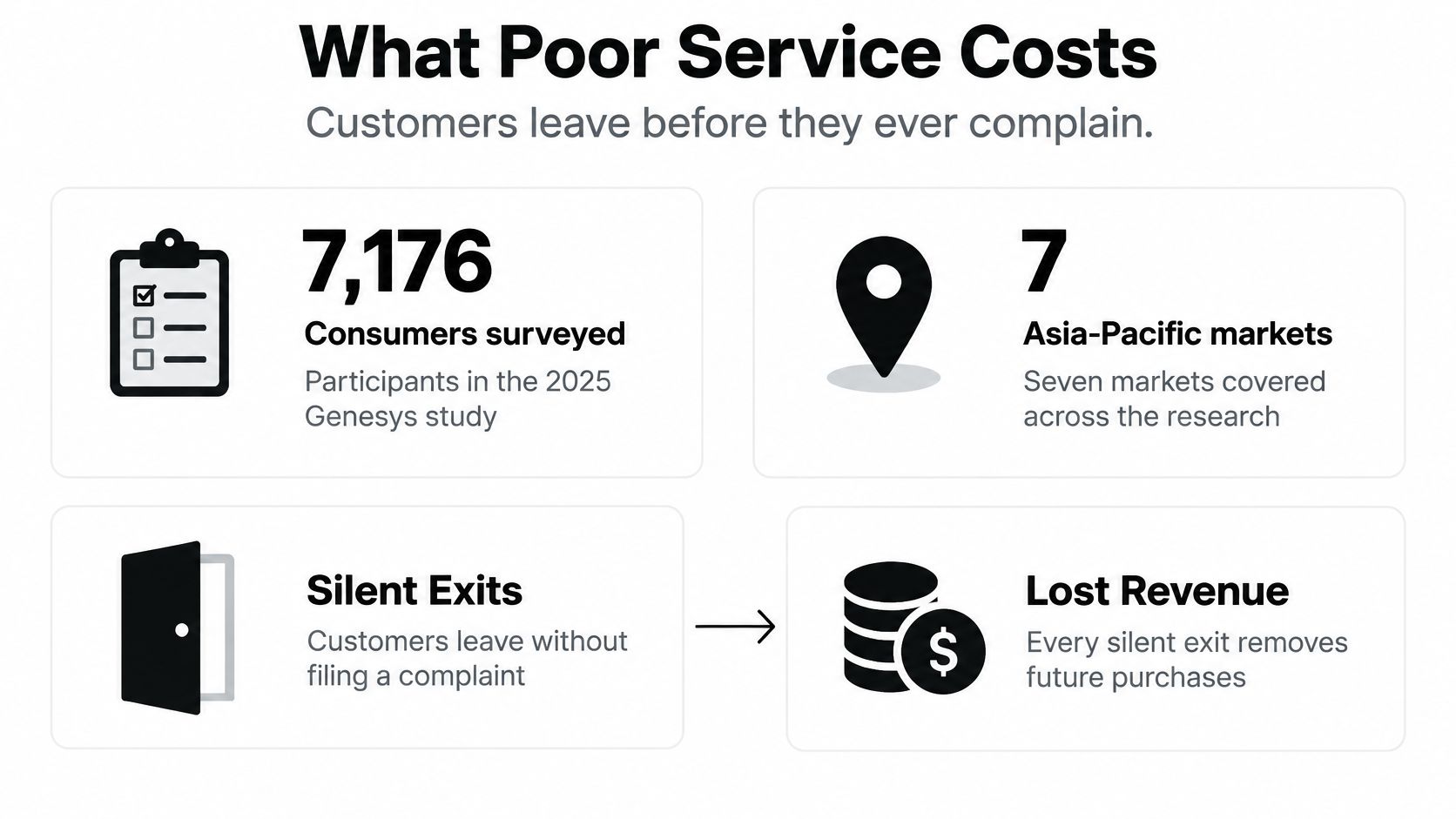
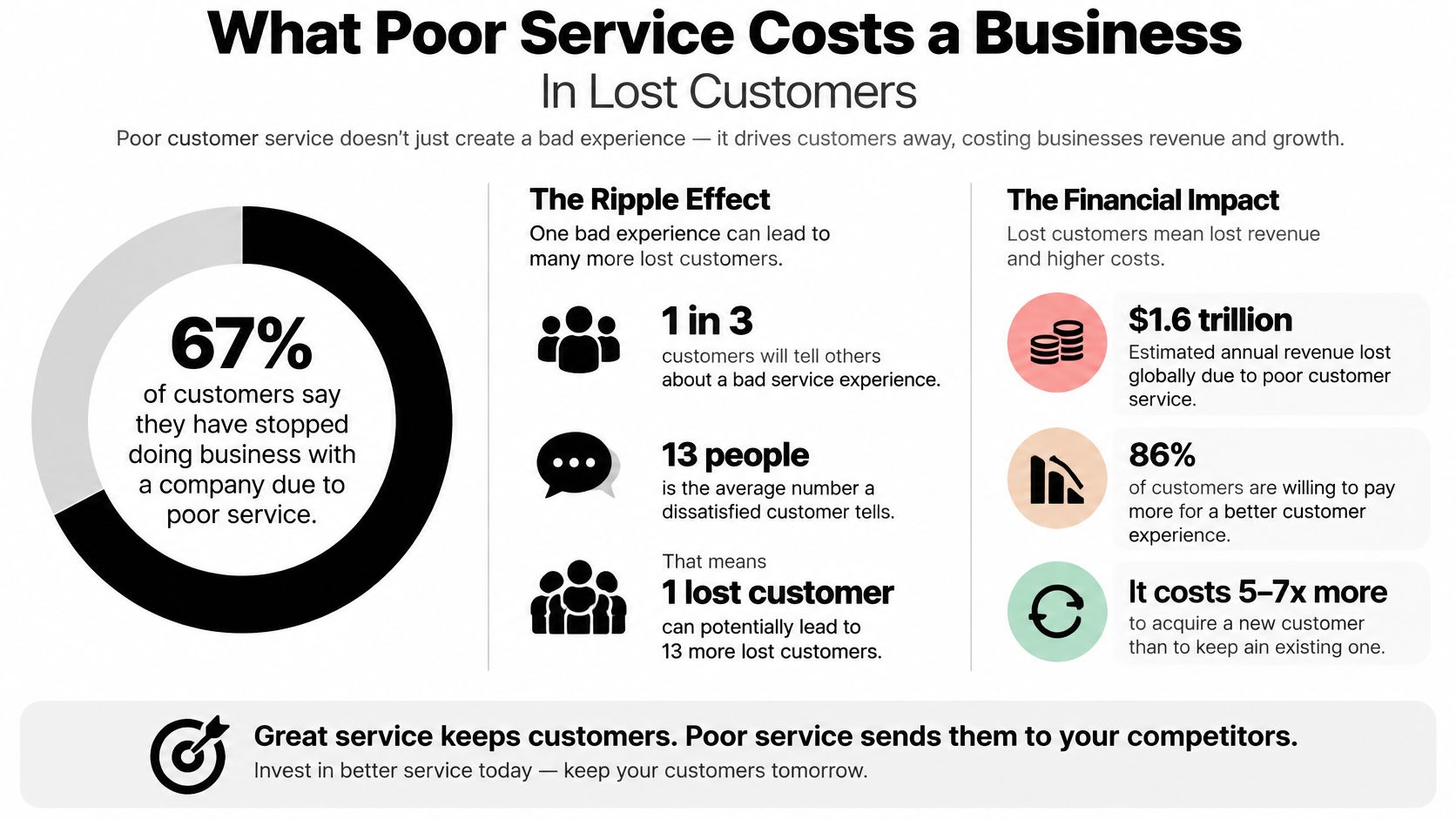
Poor customer service costs customers before it ever appears as a complaint. The 2025 Genesys study of 7,176 consumers across seven Asia-Pacific markets reported that 53% would switch from a favorite brand after two to five poor interactions. Loyalty doesn't buy unlimited patience. It buys a small number of chances.
What Poor Service Costs in Survey Figures on Switching and Churn
| Measure | Reported figure | What it means for a business |
|---|---|---|
| Would switch from a favorite brand after 2 to 5 poor interactions | 53% | A few bad contacts are enough to lose a loyal buyer |
| Occasional buyers who would leave after the same number | 47% | Infrequent customers are not safe from churn |
| Stopped doing business with a company in the previous year due to a bad experience | Nearly one-third | Churn happens quietly, without a formal complaint |
| Stopped buying from a company altogether | 30% | Direct, measurable revenue loss |
| Warned others against a company after a poor interaction | Nearly one-third | One bad experience can cost several future customers |
| Would post about a negative experience on social media | 10% | Most churn is invisible on public channels |
The bucket analogy fits here. Small holes drain a bucket slowly and invisibly, and the owner notices the level long after the water is gone. Only 10% of respondents would post publicly, so a quiet social feed proves nothing. Most loss never reaches a complaint dashboard.
Word of mouth widens the hole. Nearly one-third warned others after a poor interaction, which means one mishandled case can remove future buyers who never contacted support at all.
A rough exposure estimate needs only three numbers the business already has. Multiply customers lost per month by average annual value, then add the referrals those customers would plausibly have brought. The result is an estimate, not a forecast.
These are survey figures from specific markets, so they shouldn't be copied onto every business. The right test is local. Compare repeat purchase rates for customers who contacted support against customers who didn't, and the cost stops being abstract.
Metrics That Reveal Service Problems Early
A closed ticket is a misleading measure. It can mean a solved problem, an abandoned chat, or a customer who gave up and bought elsewhere. Teams that reward closures often get more closures and worse service at the same time.
Better measures separate the waits a customer actually feels. First response, handoff and resolution are different events, and each one can fail independently. Guidance on average handle time in a call center covers the related trap of rewarding short handling over real resolution.
Service Metrics, What They Reveal and How to Read Them
| Metric | What it reveals | How to read it |
|---|---|---|
| Time to first response | How long a customer waits before anyone acknowledges them | Track the median and the 90th percentile, not only the average |
| Time to human handoff | How long automation holds a customer before a person takes over | Set a maximum and review every case that exceeds it |
| Time to resolution | Total wait until the problem is actually fixed | Compare by issue type, not as one average |
| Repeat contact rate | Customers who return about the same issue | A rising rate means the first answer did not hold |
| Reopened conversations | Cases closed and then reopened | Signals premature closing and weak answers |
| Promised follow-ups kept on time | Whether promised callbacks or updates happened | Should approach full compliance; every miss needs an owner |
| Post-conversation rating | Customer rating after the chat or email closes | Read alongside repeat contacts, not on its own |
Ratings need a consistent trigger or they can't be compared. When a chat is closed, the visitor or email sender receives a request to rate the service, and the business configures the rating screens itself. When an email conversation is closed, the recipient receives a rating email where they can rate the customer support service.
A worked example shows why percentiles matter. A team reports a healthy average first response, yet its 90th percentile wait stretches to two days. Most customers are served quickly while a minority waits long enough to leave. The average hides exactly the customers at risk.
Reviewing these numbers weekly for three weeks sets a baseline before any policy changes. Without a baseline, every later improvement is a guess. Each metric also needs a named owner and a specific action when it moves the wrong way, or the dashboard becomes decoration.
Ownership Rules and Policies That Stop Repeat Failures
Customers judge more than the final outcome. A meta-analysis of complaint handling and perceived justice found that organizational responses shape distributive, procedural and interactional justice, and those perceptions drive post-complaint satisfaction, loyalty and positive word of mouth. For cumulative satisfaction, the construct tied most closely to loyalty, interactional justice can matter at least as much as compensation.
In plain terms, customers ask whether the company listened, communicated clearly, avoided repeat questioning and offered a credible path forward. A refund handled through three restarts can still fail that test. Active recovery also beats passive recovery, including after a second failure, so waiting for the customer to chase an update is a losing default.
Consider a damaged blender reported by chat on Monday. The customer uploads a photo and describes a cracked jug. On Wednesday, email asks for a description and a photo. On Friday, a phone agent asks what product is involved. Context drops at every handoff, and each agent looks uninformed through no personal fault.
The relay race analogy is exact. A dropped baton at each exchange costs more than one slow runner. Research coverage reporting that 72% of customers view explaining a problem to multiple people as poor service, while only 11% said all their inquiries were resolved and 13% said problems were rarely or never addressed effectively, is detailed in survey findings on repeat explanations and unresolved inquiries. Speed between handoffs doesn't compensate for losing the story.

An Operating Set That Prevents Restarts
- Classify every conversation. Record failure type, owner, promised next action and customer impact before anyone replies at length.
- Publish a response standard per channel. SignalZen's own team usually replies within one working day, which is the kind of concrete standard customers can hold a business to. Vague promises can't be tracked.
- Apologize immediately when failure is confirmed. Don't wait until the investigation ends. Early acknowledgement is cheap and late acknowledgement reads as reluctance.
- Update before the deadline. Send a specific update before any promised time, even when the answer isn't ready. Silence before a deadline is what customers remember.
- Set a human takeover trigger. Escalation should happen when automated confidence is low or the customer asks twice, and practical detail on how to escalate an issue helps teams define that trigger clearly. After escalation, send the customer a visible recap of what's known and what happens next.
- Keep one case record across email and chat. A human agent can take over any conversation with the full history and customer context, and AI Summaries condense long conversations into what happened and what is still open. The agent starts informed instead of curious.
- Ground automated answers in verified first-party material. Uncertain cases should escalate rather than produce confident, unsupported replies. A wrong answer delivered instantly creates a second failure.
- Review failure types weekly. Update the knowledge base for the top three recurring types, so the same gap stops generating new contacts.
Practical rule: the customer should never be the only record of what was promised.
Automation deserves a clear-eyed warning. Adding a bot to each channel can worsen service when every channel creates its own incomplete record. Automation earns its place only when it produces a reliable summary and escalates with context intact.
Every policy on this list needs a named owner. A rule owned by the whole team is owned by nobody, and unowned rules are the first thing dropped during a busy week. Ownership, not goodwill, is what stops the same failure from recurring next month.
Serving Customers Who Cannot Easily Be Heard
A customer who seems difficult is often a blocked customer. The barrier may be language, an inaccessible channel, missing documentation, or an inability to supply the exact detail a workflow demands. Treating that blockage as a bad attitude guarantees a bad outcome.
The inequality is measurable. The 2025 National Customer Rage Study findings on unanswered complaints reported that 43% of social media complaints received no corporate response, and upper class complainants were nearly twice as satisfied with outcomes as middle, working and lower class complainants. A separate 2025 survey in that coverage found 52% of consumers believed companies intentionally complicated support processes, and 10% had been told to Google it after seeking help.
Practical Options for Blocked Customers
- Two-way multilingual communication: Customers can ask questions on the business's website, in their own language, at any hour, instead of composing a complaint in a second language.
- Screenshot and file sharing: A photo of a damaged item or an error screen often says what a customer cannot describe in words.
- Offline contact forms: Forms that work outside staffed hours stop a closed widget from becoming a dead end.
- Plain-language status updates: Short updates with a named next step and a date beat long policy explanations.
- Alternative channels: When the preferred channel fails, another route should exist, and guidance on communicating with customers helps teams keep tone and content consistent across them.
- Human escalation on low confidence: Automated systems should hand over rather than guess when the request is unclear.
Adjacent fields face the same design problem. An AI receptionist for allied-health clinics illustrates how intake tools can capture a request in the caller's own words instead of forcing every caller through one rigid script. The principle transfers directly to support queues.
Edge cases expose weak design fastest. A customer using a screen reader needs forms and status pages that work without visual cues. A mobile user who cannot upload photos needs an email route for attachments. A complaint spanning several orders needs one record that links them, not three separate tickets.
Translation is a tool, not accountability. A fast translated answer that's wrong still fails the customer, and it fails them in polished language. Someone still has to own the outcome.
Start a One-Week Service Audit
An audit beats a reorganization as a first step. It shows which failure is actually costing customers, in the business's own conversations, within a week.
- Export the last 30 days of chat and email conversations into one place.
- Tag a sample of 50 conversations with a failure type from the seven warning signs listed earlier.
- Count repeat questions, channel switches and broken promises separately, because each points to a different fix.
- Compare first response and 90th percentile resolution times against the metrics table above.
- Pick the single most frequent failure type and fix its owner or its knowledge gap first.
- Re-measure after two weeks and check whether repeat contacts fell.
Results point to specific repairs. Repeat questions dominating the sample means the fix is handoff and shared history. Broken promises dominating means the fix is ownership and tracked next actions.
SignalZen offers a 30 day free trial with no commitments and no credit card required to begin. Plans are self-serve, and a customer can cancel or change plan whenever they like while keeping conversation history, so audit data isn't lost if plans change.
The decision is narrow on purpose. Start the audit this week, commit to one fix, and hold that fix for two weeks before judging it.
SignalZen unifies chat and email into one workflow with AI answers grounded in a business's own material, summaries that preserve context, and human takeover with full history, which directly addresses the restarts and broken promises behind poor customer service. Teams can run the one-week audit described above, fix the most frequent failure first, and measure whether repeat contacts fall. Visit SignalZen to start the trial and put one owner, one record and one tracked next action behind every conversation.



Better support without a bigger support team.
Start with AI. Add your team when the conversation needs a person.