

A knowledge base is an organized system for storing verified information so people and software can find and reuse the right answer quickly.
A customer asks when a refund will arrive. An employee searches an old email, another checks a shared document, and the business owner remembers that the policy changed recently. Everyone wants to help, but nobody knows which answer is current.
That's the problem a useful knowledge base solves. It gives the business a dependable place to publish answers, identify who maintains them, and control what customers, staff, and AI assistants are told.
Table of Contents
- What a Knowledge Base Is
- Public Help Centers Versus Internal Knowledge Bases
- How Customers and Support Teams Benefit
- How a Knowledge Base Feeds AI Answers
- Keeping Your Knowledge Base Accurate Over Time
- Measuring Whether Your Knowledge Base Works
- Start Your Knowledge Base This Week
What a Knowledge Base Is
A knowledge base combines information, organization, and responsibility. It doesn't merely hold documents. It helps a person find an answer, understand when it applies, and trust that someone has checked it.
A kitchen offers a useful analogy. A recipe box with labeled dividers, readable cards, and a named person responsible for updating ingredients works like a knowledge base. A shoebox of loose receipts and handwritten scraps is just a document pile.
The practical difference
A small business can assess its existing information with a few simple tests:
- Findability: Can a new employee locate the refund policy without asking a colleague?
- Ownership: Does each important answer have a named person responsible for its accuracy?
- Authority: Can an employee tell which version is approved and who's allowed to read it?

Say an online shop keeps delivery instructions in a shared folder. The folder becomes a useful knowledge base when the team organizes those instructions by customer question, removes conflicting versions, and assigns responsibility for updates.
The same distinction applies to FAQs. A short FAQ can belong to a knowledge base, but a long FAQ isn't automatically a governed system.
Practical rule: An answer isn't ready for reuse until someone can explain where it came from and who keeps it accurate.
For an owner asking “what is a knowledge base,” the starting material is usually close at hand: recurring questions about refund timing, plan prices, or password resets. Those questions reveal what needs documenting, while the intended reader determines where each answer belongs.
Public Help Centers Versus Internal Knowledge Bases
| Type | Main readers | Typical content | Primary goal |
|---|---|---|---|
| Public help center | Customers and prospects | Setup guides, pricing questions, troubleshooting, policies | Reduce repeat contact and let buyers self-serve |
| Internal knowledge base | Support agents, sales and staff | Procedures, escalation rules, product edge cases, scripts | Keep answers consistent across the team |
| Hybrid knowledge base | Both audiences | One source with public and restricted sections | Avoid maintaining two copies of the same answer |
Public answers and private procedures
A public help center serves people outside the business. Articles should use customer language, explain prerequisites, and describe an action the reader can complete. Suitable topics include setting up an account, understanding an invoice, and fixing a common error.
Public articles can also appear in search engines when the publishing system permits indexing. That makes the help center useful before someone opens a chat, rather than only after an agent sends a link.
According to Heretto's 2025 Self-Service & AI Report, 58% of surveyed organizations had implemented self-service solutions, while another 22% intended to implement them soon. That supports giving customers a direct route to routine answers, without assuming every customer wants to avoid human support.
An internal knowledge base supports work customers shouldn't need to see. A refund article might explain the customer's eligibility publicly, while a restricted procedure tells agents how to check the transaction, obtain approval, and record the decision.
Choosing the right arrangement
A hybrid knowledge base accommodates both audiences. Shared policy information should have a canonical home, with internal instructions connected to it rather than copied into competing documents. Restricted content still needs permission controls, not merely an unlisted address.
The help center feature guide offers a practical reference for organizing customer-facing documentation.
The decision starts with who asks the question. Customer questions belong publicly when the answers are safe to share. Staff-only decisions belong internally. When both groups need related information, a hybrid arrangement keeps the public explanation connected to the private workflow.
How Customers and Support Teams Benefit
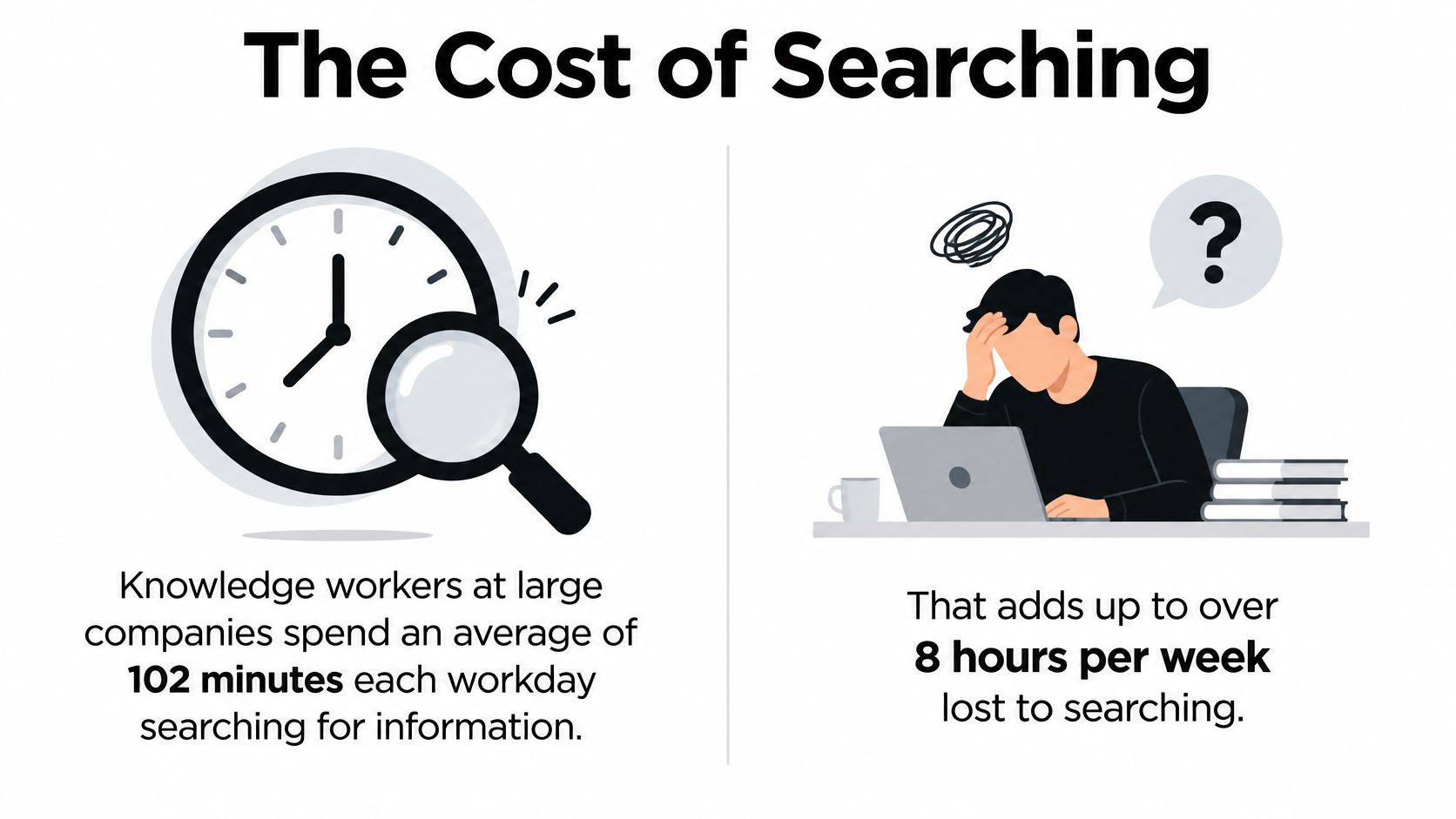
In a 2022 survey commissioned by Starmind and conducted by Sapio Research, respondents reported spending an average of 102 minutes each workday searching for information needed for their jobs; the survey covered 1,404 full-time knowledge workers at companies with more than 10,000 employees across the United States, United Kingdom, Germany, and Switzerland, according to the Starmind report.
That isn't a savings estimate for a small business. It illustrates the friction that appears when useful information is hard to retrieve.
For customers
A published answer remains available outside staffed support hours. Customers can follow instructions at their own pace, revisit a step, or share the article with a colleague without waiting in a queue.
Good articles also clarify when self-service won't solve the problem. A password-reset guide should explain what happens when the reset email never arrives and when an agent needs to investigate.
For support teams
Agents can reuse a verified explanation across chat and email instead of reconstructing it from memory. New employees gain a starting point for learning the product, while experienced staff spend less effort answering routine procedural questions.
Consider a shop receiving repeated shipping-policy inquiries. A well-written article can explain dispatch conditions, tracking updates, and delayed-delivery next steps. Agents can link to the relevant passage, then concentrate on the customer's specific order rather than retyping the general policy.
Documentation doesn't replace conversation context, though. A handoff still needs the customer's situation, completed troubleshooting, and unresolved issue.
The benefit isn't simply fewer conversations. It's less repeated explanation and more time spent resolving the questions that genuinely need a person.
Those gains depend on upkeep. An outdated article lets customers and agents repeat the same mistake with greater consistency.
How a Knowledge Base Feeds AI Answers
An AI assistant needs more than readable documents. It needs a controlled way to retrieve the passages that apply to a particular question.
A technical paper hosted on Zenodo describes this distinction through a governed retrieval layer: relevance matters, but so do ownership, publication status, timestamps, product versions, and permissions.
From source material to an answer
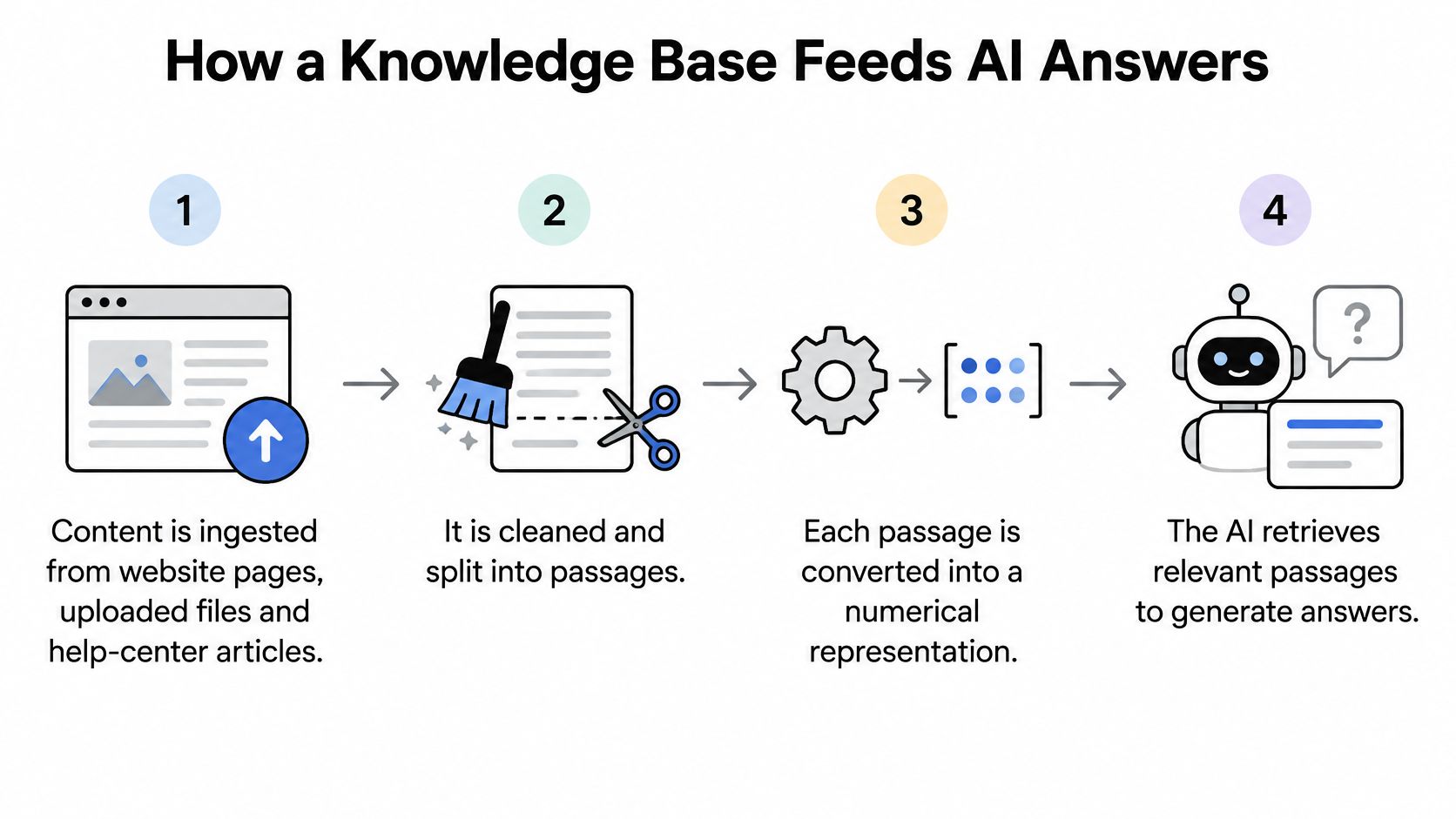
- Collect approved sources. Website pages, uploaded files, and help-center articles enter the retrieval system through an ingestion process.
- The system cleans the content and splits it into passages, retaining enough surrounding context to preserve conditions and exceptions.
- Index the passages with metadata. Each passage needs its source, owner, approval status, effective date, language, product version, and visibility rules.
- A customer's question retrieves relevant passages that the customer is permitted to access.
- Generate a grounded response. The assistant should write from the retrieved evidence rather than fill missing policy details with plausible guesses.
- When passages conflict or no suitable evidence exists, the assistant should decline to guess and hand the conversation to an agent with the question and available context.
Why matching words isn't enough
Say an old pricing page and a newly approved pricing article both describe the Pro plan. Both may closely match a question about its cost. Semantic similarity identifies related meaning, but doesn't establish which price is authoritative.
Metadata supplies that missing context. Approval status excludes drafts. Effective dates distinguish current terms from announced changes. Product-version labels prevent instructions for a retired interface from appearing in answers about its replacement.
Permissions are equally important. An internal exception allowing a manager to approve a refund mustn't become a public promise that every customer qualifies.
For teams preparing public documentation for AI tools, Agentable's llms.txt guidance for docs teams offers an additional documentation resource. It should complement clear source organization, not substitute for approval and access controls.
The knowledge base chatbot guide provides further context for connecting documentation to conversational support.
A useful acceptance test is straightforward: can a reviewer trace each AI answer to the approved passage that supports it? A fluent response without that evidence remains difficult to audit or correct.
Keeping Your Knowledge Base Accurate Over Time
Every article needs a named owner who answers for its accuracy. That person doesn't have to write every update, but must approve changes and resolve uncertainty about the underlying policy or procedure.
Work on quality assessment for evolving knowledge bases distinguishes correctness and completeness from other requirements, including suitability for a task, consistent representation, and reliable access. A document can therefore be factually correct yet still fail because the right reader can't retrieve or apply it.
Establish a publishing routine
Use explicit lifecycle states rather than leaving employees to infer readiness:
- Draft: Under preparation and excluded from customer answers.
- Approved: Checked and available to its intended audience.
- Deprecated: Superseded and excluded from current guidance.
- Archived: Retained for historical reference, not active answers.
Review dates should reflect risk. Pricing, eligibility, and policy content deserves more frequent attention than stable instructions, while a product or policy change should trigger review immediately.
An owner's queue should include overdue articles, broken links, duplicate explanations, failed imports, and customer questions that produced uncertain answers. The knowledge base article guide can help turn those corrections into clearer documentation.
Test the result, not just the upload
When a plan changes, the owner should retire the superseded pricing passage and approve its replacement. The team should then test real questions about billing, eligibility, and cancellation, checking whether search and AI retrieve the intended material.
Conflict rule: Prefer the approved, owned version that is effective for the customer's situation. Log the disagreement for review rather than assuming the most recently edited document is correct.
Successful indexing only confirms that the system accepted content. Maintenance is complete when customers and agents can retrieve and use the corrected answer.
Measuring Whether Your Knowledge Base Works
| Metric | What it tells the team | Healthy sign | Warning sign |
|---|---|---|---|
| Answer accuracy | Whether answers match approved sources | Spot checks find no conflicts | Answers cite outdated or unapproved material |
| Deflection without repeat contact | Questions resolved and not raised again | Customers don't return on the same topic | High self-service use followed by repeat tickets |
| Escalation rate | Share of conversations handed to a human | Falls as coverage grows | Rises after content changes |
| Unanswered-question clusters | Recurring questions with no article | Few clusters, closed quickly | The same unanswered question appears repeatedly |
| Time to resolution | Time from question to working answer | Shortens over time | Lengthens after handoffs |
| Correction time | Time from a policy change to updated content | Updates follow the change promptly | Stale answers remain available |
Resolution matters more than volume
Article counts and page views describe activity, not whether customers succeeded. A busy help center can still leave people confused, particularly when agents repeatedly repair the answers customers found there.
The 2025 World Quality Report announcement from Capgemini reported that 89% of organizations were piloting or deploying generative-AI-augmented workflows, but only 15% had reached enterprise-scale deployment. Adoption alone shouldn't be treated as evidence that a knowledge system works.
A wrong or stale citation belongs in the table's warning column. It's a knowledge-base failure requiring investigation, not automatically a problem that a different AI model will solve.
Keep the review manageable
A small team can begin with a compact dashboard:
- Accuracy: Spot-check answers against approved passages.
- Repeat contact: Check whether customers return about the same unresolved issue.
- Escalations: Separate appropriate handoffs from avoidable documentation gaps.
- Missing topics: Group unanswered questions by customer intent.
- Correction time: Track how long changed policies remain incorrectly represented.
Customer questions reveal missing explanations; escalations expose ambiguity; corrections improve the source material. A practical target is to assign and resolve every recurring unanswered topic during the review cycle, rather than publish articles merely to increase the total.
Start Your Knowledge Base This Week
A small business doesn't need an elaborate migration before publishing useful answers. A focused launch can begin with existing support conversations and a clear approval process.
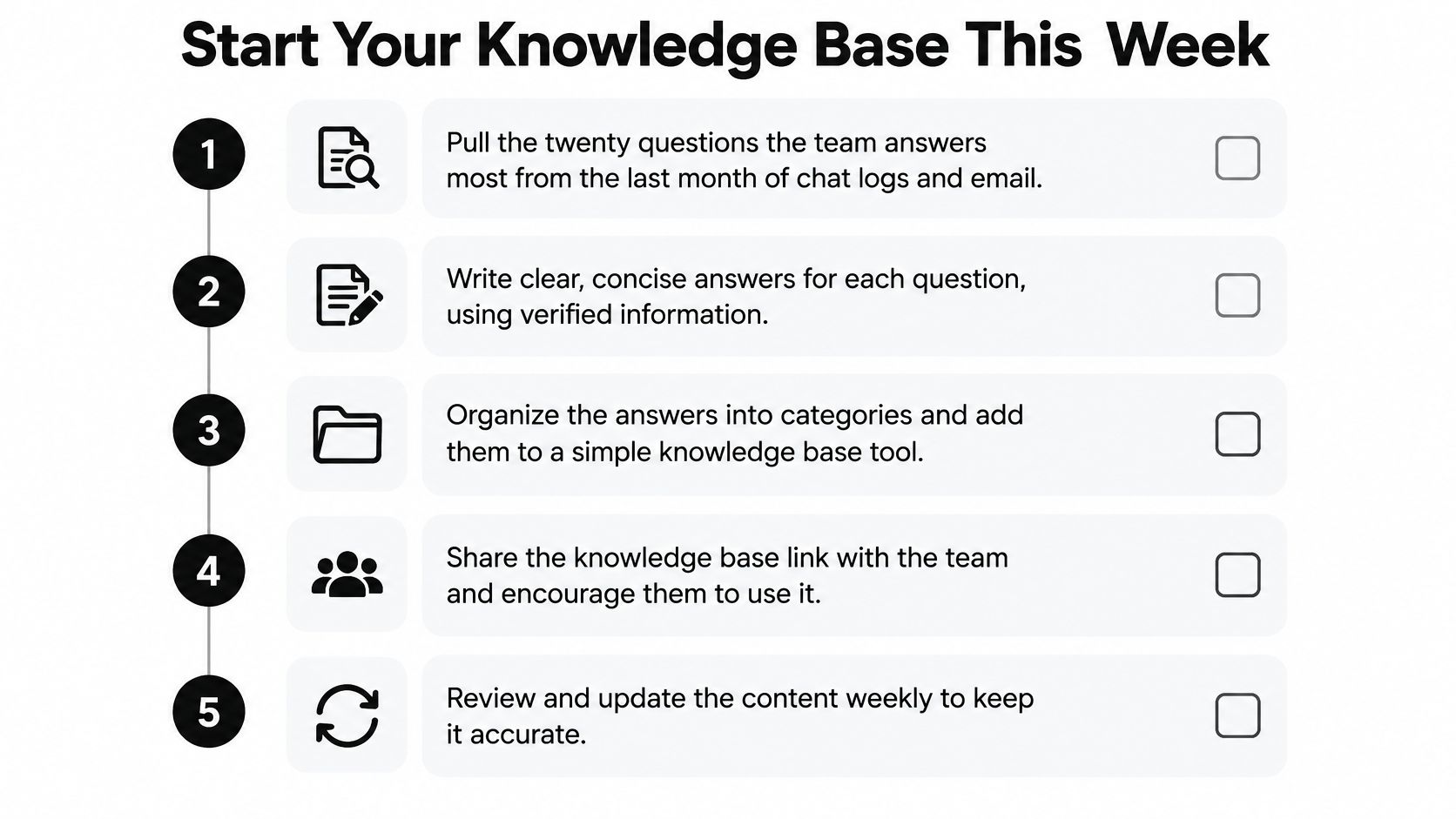
- Gather recurring questions. Review recent chat logs and email, group equivalent requests, and prioritize questions that interrupt the team most often.
- Assign a named owner and review trigger to each topic. High-risk policies should be checked whenever their underlying terms change.
- Write a direct answer first. Follow it with prerequisites, steps, exceptions, and the point at which a customer needs human help.
- Mark each article draft or approved, and remove superseded guidance from active search.
- Set the audience. Publish customer-safe explanations publicly and restrict operational procedures, escalation rules, and scripts.
- Connect the approved articles to the support widget. Test search suggestions using the language customers type, not only internal product terminology.
- Review outcomes regularly. Use failed searches, repeated contacts, and delayed corrections to decide which articles need attention next.
SignalZen publishes a help center that customers can read and its AI can answer from; its server-side-rendered articles can also be indexed and found through Google.
The most useful action today is to finish a small set of verified answers before opening another topic. A narrow collection with clear ownership is a stronger foundation than a large import nobody has checked.
SignalZen connects customer-facing knowledge with AI assistance and human support, helping a small business reuse approved guidance across conversations. Business owners ready to publish their answers can visit SignalZen to explore a help center that supports both customer reading and AI responses.



Better support without a bigger support team.
Start with AI. Add your team when the conversation needs a person.